
Stafford staff detail FTE shifts: ESOL reductions, special‑education and class‑size hires offset by grant moves
Get AI-powered insights, summaries, and transcripts
Subscribe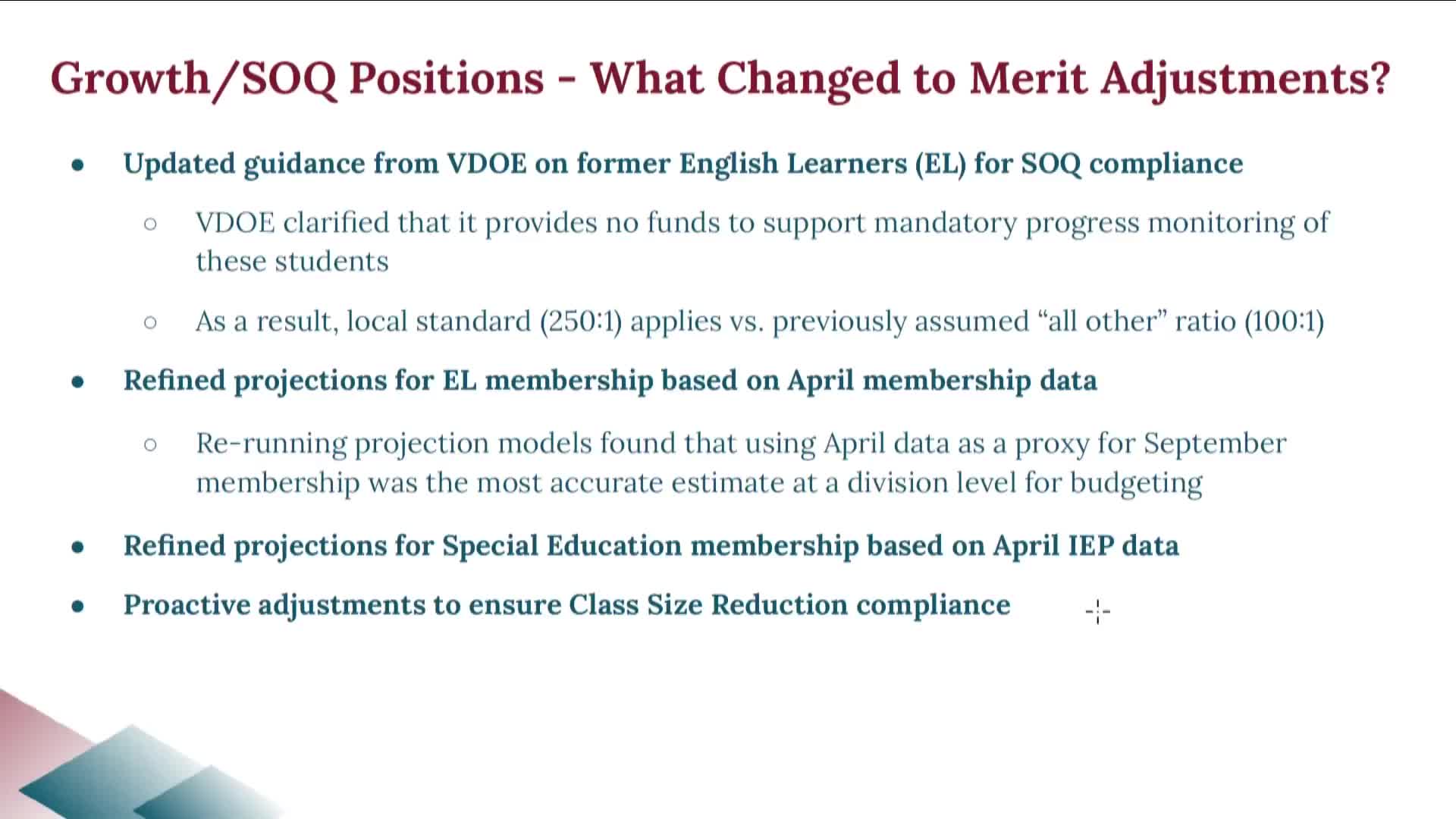
Summary
Staff told the board they used late‑April enrollment and new state guidance to reduce 8.5 proposed ESOL positions while adding targeted teachers for level‑2 special‑education and certain class‑size reduction grades; they said the net FTE total remains unchanged from the board‑approved budget.
Staff presented a staffing reallocation for FY26 that moves personnel within the board‑approved budget rather than increasing the total number of funded positions. Using late‑April enrollment and updated state guidance on English‑learner (EL) funding and monitoring rules, staff said they reduced the previously proposed 8.5 ESOL positions because many students reached “former EL” proficiency levels and because the state clarified how proficiency affects funding and staffing expectations.
At the same time, staff said they identified growth needs that require additions to remain compliant with class‑size reduction and special‑education staffing standards: they recommended adding teachers for level‑2 special‑education at several schools and for one grade in three schools participating in the K‑3 class‑size reduction program. Staff emphasized that these are targeted, site‑level changes to keep the division compliant and to hire proactively rather than adding classrooms in August.
Staff told the board the reallocation nets out to the same total FTEs approved in February; several positions previously budgeted from the operating fund will instead be covered by grant carryover (Claude Moore, Title funds) or reclassified to grant funds for another year. Staff said they could provide a one‑page breakout showing the site‑level distribution, the 111.4 school‑based FTEs for growth, and a separate list of the two support positions affected (one technology support position is reduced and an ESOL coordinator is kept). Board members asked for a clearer, updated attachment that reconciles the 111.4 total and lists which positions move between operating and grant funds.
Board members pressed staff on hiring status and fill rates for hard‑to‑fill positions; staff said many ESOL slots had been filled this year but acknowledged continued challenges recruiting for some roles. Staff offered to report back with current vacancy and fill‑rate details and to present staffing‑standards and hiring‑status data in a future work session.