
School board adopts elementary redistricting plan; proposal to allow fifth‑grade exemptions fails
Get AI-powered insights, summaries, and transcripts
Subscribe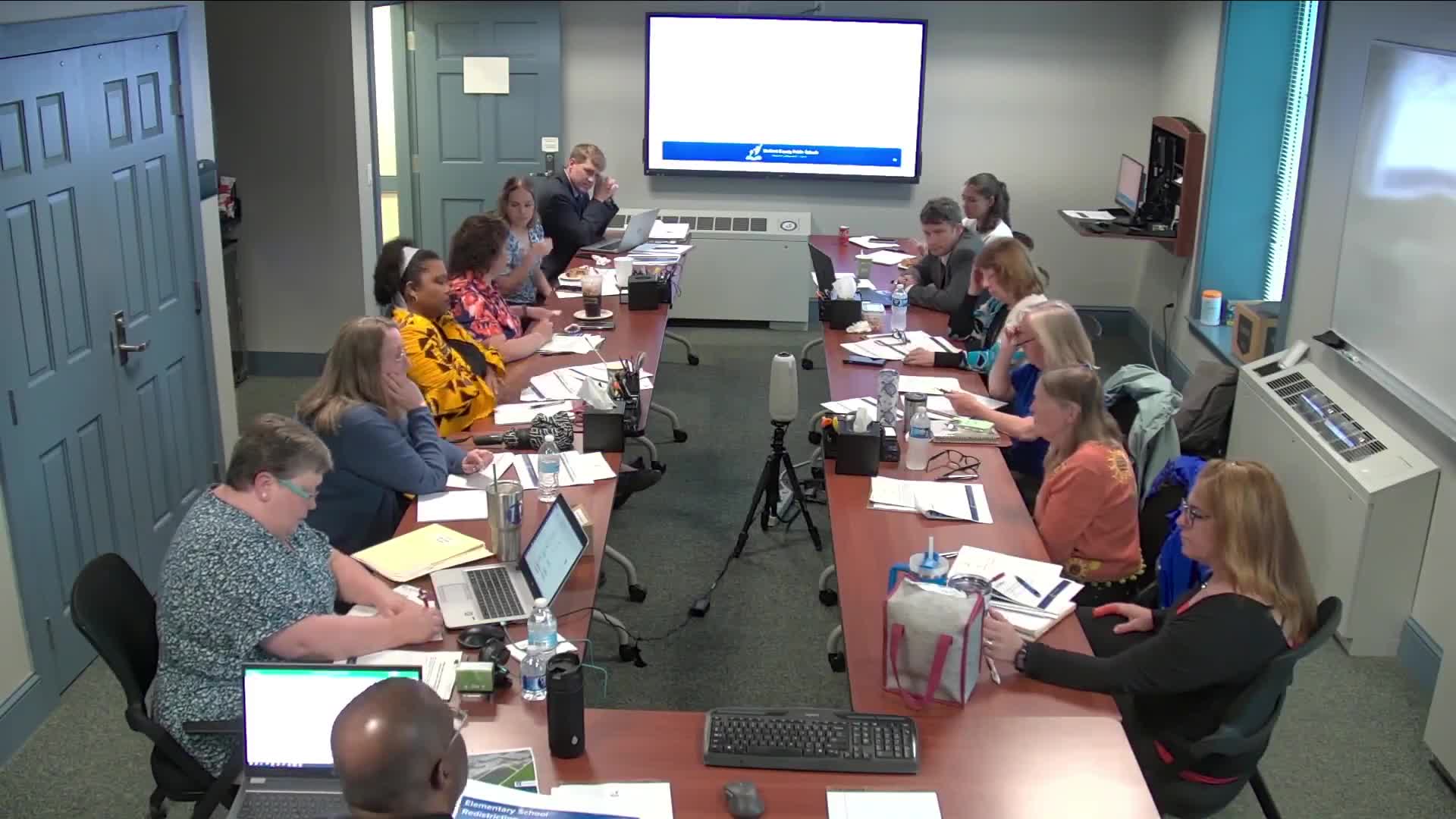
Summary
Stafford County School Board on May 20 approved the “lime” elementary redistricting map to open two new elementary schools and rebalance enrollment. A separate motion to allow fifth‑grade students to remain at their current schools with parent transportation failed 4–3.
Stafford County Public Schools on May 20 approved a redistricting plan called “lime” to reassign students as two new elementary schools come online and to reduce crowding at several existing schools. The board approved the map unanimously after a prolonged presentation of three options and public comment.
The decision formalizes a boundary plan staff and consultants said keeps most schools below 100% utilization when new buildings open, while targeting crowding relief in high‑growth areas. “This gives you an idea of how many students are being reassigned,” redistricting presenter Mister White said while walking the board through enrollment and reassignment charts.
Board members and staff emphasized the plan’s capacity projections and transportation review. Staff presented utilization projections for the new schools (ES 18 and ES 19) under each scenario; ES 18 was shown as opening at about 92% utilization in the green and lime plans and about 82% under the purple plan. The district also reported the lime plan would produce roughly the same number of schools above 100% by 2030 as the other scenarios but shifts where pressures occur. Transportation staff had reviewed all three scenarios and “met their approval,” according to the presentation.
Board members raised neighborhood and equity concerns during discussion. Some trustees appealed for minimizing travel times and preserving Title I relationships; others said consolidation of some attendance areas would be disruptive but unavoidable given county growth. Public commenters representing Conway and Rappahannock Landing urged the board to select the purple plan; trustees noted competing neighborhood requests made any choice painful. Ultimately the board voted down a substitute motion to approve the purple plan and then approved the lime scenario.
Separately, the board considered but rejected a proposal to permit fifth‑grade students to remain at their current schools if parents provide transportation. Staff recommended against a broad fifth‑grade exemption, citing countywide impacts on car‑rider traffic, staffing and the pending addition of two new schools. “I am recommending that we not provide fifth grade student exemptions around this,” a school staff presenter told the board during the work session. The board voted 4–3 against the motion to allow a systemwide fifth‑grade exemption (the motion failed with Warner, Sigman, Halstead and Randall voting no).
What happens next: staff will communicate finalized boundary assignments, implement required transfer and application windows under the district transfer policy, and proceed with transition planning for the two new schools, including transportation and staffing assignments. The board instructed staff to return final implementation details as part of the district’s transition timeline.
Board actions and votes - Motion: Approve “lime” elementary redistricting scenario. Outcome: approved (unanimous vote). - Motion: Allow fifth‑grade students to remain at current school with parent transportation (exemption to transfer policy). Outcome: failed, 3–4 (no: Warner, Sigman, Halstead, Randall).
Why it matters The redistricting implements the county’s plan for two new elementary schools and distributes tens of thousands of students across attendance areas; it affects school capacity, transportation planning and Title I program alignments. The board’s rejection of a general fifth‑grade exemption preserves the district transfer policy and leaves decisions on individual transfers to existing policy procedures and appeals.