Get Full Government Meeting Transcripts, Videos, & Alerts Forever!
Get email alerts on the School Budget topic
No spam. Unsubscribe anytime.
Albemarle school board approves FY26 funding request after rejecting removal of SRO cuts
Summary
On March 13, 2025 the Albemarle County School Board approved a modified FY2026 funding request that preserves mental-health staffing and school safety coaches after debate and a failed attempt to remove funding for additional school resource officers (SROs). The board left a roughly $747,000 gap to bring to the Board of Supervisors.
ALBEMARLE COUNTY, Va. — On March 13, 2025, the Albemarle County School Board approved a modified fiscal year 2026 funding request of $284,699,140 in operating funds and $28,439,082 in special revenue funds after rejecting a motion to remove planned school resource officer (SRO) positions from the request.
The board’s final vote approved the modified scenario that maintains the district’s mental-health staffing and student safety coach positions while carrying an unresolved funding gap of about $747,000 to present to the Board of Supervisors. The motion to remove SROs failed on a 3–4 roll call; the funding request later passed on a 5–2 vote.
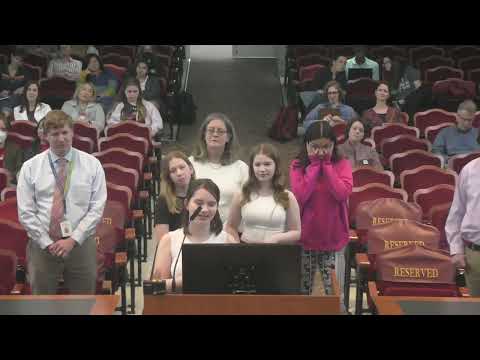
The vote followed more than an hour of public comment and board discussion about discipline, racial equity, mental-health supports and whether armed officers belong in school buildings. Numerous speakers urged the board not to expand the SRO program and to maintain or restore counseling and mental-health positions. Laura Harrison, speaking from the Rio magisterial district, told the board, "You have no data on the impact of the SRO program," and urged the board to keep student safety coaches instead. Michelle Benedict, a teacher and parent, described mental-health support specialists as "like the breaths we just took," saying reductions would harm students who rely on crisis and ongoing emotional support.
Maya Komazawa, the division’s director of budget and planning, presented the modified scenario the board debated. Komazawa said the modified scenario represented roughly $285 million in proposed expenditures, a 5.7 percent increase over FY25, and included $6.4 million in total reductions compared with the FY25 adopted budget. Key elements of the modified scenario retained in the approved request include 30 social-emotional/mental-health support specialist (MHSS) positions and eight secondary student safety coach FTE; proposed reductions in the draft that stayed in the modified scenario included eliminating the furniture replacement program and deferring certain classification and technology replacements. Komazawa noted the modified package still left a funding gap of approximately $747,000.
Board members debated several aspects of the package during the meeting, including an earlier proposal to cut 10 instructional coaches (roughly $1 million in savings). One board member proposed reducing only five instructional coaches after hearing from teachers about the workload around literacy and a planned elementary math curriculum; the final approved scenario left that and other items in the modified package as presented.
The SRO debate centered on competing testimony from community members and school leaders. Multiple parents, teachers and community organizers argued SROs contribute to the school-to-prison pipeline and disproportionately harm students of color and students with disabilities; speakers cited national studies and criticized a perceived lack of local data. Amanda Moxam, from the Briar (Bridal) district, said there is "0 data to prove" that SROs reduce threats to safety and called for investment in counselors and safety coaches instead. Other public commenters and board members expressed concern about the chilling effect of law-enforcement presence on immigrant families following state-level comments about immigration enforcement.
Representatives connected to law enforcement told the board how SROs are selected and trained. Officer Bradley (identified in the meeting as a police representative) described a selection process for SROs and required training through the Virginia Department of Criminal Justice Services (DCJS). Bradley said the SRO role is to address criminal and emergency matters, not routine student discipline, and said the Albemarle County Police Department has a standing policy not to participate in immigration enforcement absent a criminal warrant. "The SROs are not in the building to deal with daily discipline-related activities," Bradley said.
A motion by board member Allison Spillman to remove SROs from the FY26 request was seconded by Rebecca Berlin and lost on a roll call vote of 3 in favor, 4 opposed. Recorded votes on that amendment were: Rebecca Berlin (yes), Allison Spillman (yes), Margaret Lee (yes); Ellen Osborne (no), Graham Paige (no), Leslie Pryor (no), Kate Acuff (no). Later, the board voted 5–2 to approve the modified FY26 funding request. Recorded votes on the final motion were: Margaret Lee (yes), Ellen Osborne (yes), Graham Paige (yes), Leslie Pryor (yes), Kate Acuff (yes); Allison Spillman (no), Rebecca Berlin (no).
Board leadership said the approved funding request will be presented to the Albemarle County Board of Supervisors on March 17 for consideration of the locality’s contribution to the schools. Board members noted the process is not final; the supervisors will set a maximum tax rate for advertisement March 19 and the board will continue budget discussions in April and adopt a final balanced budget in May.
Board members and staff said they will continue to provide community updates on SRO activities and training if the positions are funded. Board members asked for periodic reports on SRO interactions and for clearer, more accessible reporting on SRO activities than the departmental materials currently provide.
The approved modified funding request keeps the division’s planned new investments in place while increasing reductions elsewhere; it preserves mental-health staff and safety coaches that speakers and board members had specifically asked the board to protect. The $747,000 gap will be part of the materials presented to the Board of Supervisors for the next step in the local budget process.