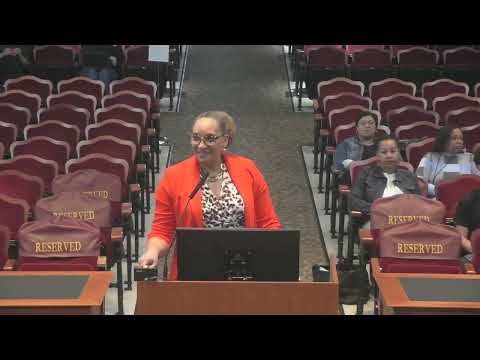
Albemarle County presenters outline expansion and data for culturally responsive educator program
Summary
Presenters for Albemarle County Public Schools described the division's culturally responsive educator (CRE) program, reported participation and credentialing numbers, and showed student work and division-level data the district says indicate improvements across demographic groups.
Presenters for Albemarle County Public Schools on Tuesday described the division's culturally responsive educator program and presented participation numbers, classroom examples and early outcome data.
The presentation, led in part by Ayanna Mitchell (staff member), focused on the district's effort "to end the predictive value of race, class, gender, and special capacities for our children's success," Mitchell said, summarizing the division's strategic aim.
Why it matters: The division framed the program as a systemwide strategy to reduce outcome gaps tied to students' backgrounds. Presenters said training and credentialing for teachers and other educators aim to change classroom practice, inform planning and improve student engagement and achievement across groups.
What presenters described
Dr. Melissa Hairston (staff member) and Steven Turner (staff member) explained the program structure, which they presented visually as a three-tier pyramid: a foundational book study (Zaretta Hammond's Culturally Responsive Teaching in the Brain), a micro-credentialing stage with evidence of classroom application, and a certification tier that requires tracking student data and demonstrating instructional changes.
Turner said the program is built on Hammond's framework and the division's work to move from surface-level acknowledgments (food, dress, music) to deeper cultural understanding that affects communication, expectations and classroom norms. "This roots us back into the reality that we all have a culture," Turner said. "Turns out, it's the way that every brain makes sense of the world." (quote attributed to Steven Turner)
Participation and credentialing numbers
Presenters gave specific participation figures: 1,318 employees have completed the book study from the program's start to the present; 60 additional employees are currently registered. The district reported it employs about 2,800 people; presenters said roughly 154 employees have not started the book study. Presenters also said 488 educators hold micro-credentials and 149 employees are certified through the program. Presenters described 637 educators as those required to complete the programming to meet division expectations (presenters noted this represents roughly 40% of the staff required to complete it).
Presenters and school staff repeatedly emphasized that the work is intended to be applied in classrooms and across operations, not limited to curriculum materials. Ayanna Mitchell described program levers that include building relationships, redesigning assessment and making curriculum inclusive and relevant for students.
Classroom and student examples
Panelists shared student work samples and gave accounts of classroom practice. Crystal Beasley (assistant principal, Henley Middle School), Amy Morris (principal, Roswell Elementary), Jen Graham (fifth-grade teacher, Wilson High School) and Erica Hernandez (English-language teacher, Lakeside Middle School) described concrete changes such as using home/community knowledge in lesson planning, conducting equity audits, and varying assessment types to let students display strengths beyond paper-and-pencil tests.
A student, Jack (eighth grader, Walton Middle School), said clubs and classroom activities made him feel seen and valued. Teachers and principals said those classroom signals can affect attendance and engagement: "All that work is getting kids in classrooms. I feel like I belong here," Mitchell said.
Legal and policy context
Presenters said state guidance and regulations prompted the division to formalize training. They referenced VDOE regulations on cultural competencies and identified a code cited in their presentation as "code 22.12980.7" as guiding the scope and frequency of training; they also said components are reflected in evaluation standards (presenters referenced "EPA and APA" as vehicle points for evaluation standard alignment) and an internal ABAR policy.
Discussion and next steps
Board members and panelists discussed expanding CRE beyond classroom teachers to other division staff (transportation, food services, operations, special education staff). Presenters said adaptations already are in progress for nonclassroom roles and that micro-credential cohorts and executive leadership sessions have been scheduled. Presenters described multiple delivery formats for the foundational book study (five one-hour to 75-minute sessions typically, with flexible pacing available).
No formal action was taken on the CRE presentation during the work session; presenters asked the board for continued support and outlined next steps in training and implementation.
Ending
Presenters closed with an appeal to view CRE as ongoing professional learning and a divisionwide practice rather than a single training event. "It's a constant evolution of the work, and we learn every day," a presenter said.
AI generated
The text on this page is AI generated. Summaries, highlights, analysis, and video transcripts are all produced from the original source material.
AI can make mistakes, so if you spot one, and we will fix it for everyone.
Note: the source content is unaltered by us. Any content source we link to, be it a video, an audio recording, or a document, is presented exactly as its publisher released it. That publisher is usually a government body, sometimes an individual official or another organisation.