Get email alerts on the Education Technology Ai topic
No spam. Unsubscribe anytime.
Montgomery County schools outline AI literacy plan, preview tech-use policy revisions
Summary
Administrators and teachers presented a draft generative AI literacy plan, demonstrations and a first reading of revisions to the division’s technology-use policy; students and teachers showcased classroom uses while board members pressed for academic-honesty and safety guidance.
Montgomery County Public Schools administrators presented a draft AI literacy plan and related revisions to the district technology-use policy, saying the work will pair classroom training with updated rules for staff and students.
The presentation, led by Assistant Superintendent for Curriculum and Instruction Barbara Wickham, described the literacy plan as an effort to help “users here in MCPS to be able to understand the fundamentals of artificial intelligence, recognize ethical concerns that surrounds it, understand practical applications, use it responsibly and ethically, explore the AI powered careers and innovations that are out there, and engage in hands on learning.”
Wickham said the district’s draft aligns with Commonwealth guidance and the division’s strategic plan, and she listed a timeline that begins with leader workshops this summer and classroom work the following school year. She said the instructional-technology team has been studying generative tools since summer 2023 and working with the region to prepare training modules for leaders, staff, students and families.
Teachers, a principal and students demonstrated classroom uses. Christiansburg Elementary Principal Morgan explained she used AI to summarize long conference notes and to generate images for teacher presentations; special-education teacher Josh Porter said, “This is my first year teaching. I'm also a career switcher. So AI has been a huge part of me learning everything. I use it like Google almost.” Students from Fallow Branch Elementary described class activities and projects, including machine-learning exercises and AI-generated images tied to student writing.
Board members pressed staff on safety and academic honesty. Board member Dr. Guidry said he sees AI as an “emergent crisis” for intellectual property and plagiarism and urged that the division’s policy explicitly address academic honesty. Wickham answered that literacy training and policy revision will include parameters for teachers and students, and that the division plans to give teachers clear guidance on when AI use is allowed and how to document it.
On specific tools, lead ITRT Julie Craft said the division has vetted student-facing platforms and negotiated data-sharing agreements; she said the district encourages tools that allow teacher-controlled parameters and that the division has identified platforms such as Adobe Express and a student-facing chatbot product for classroom use. Craft told the board the team had “a data sharing agreement with them” for platforms the district recommends.
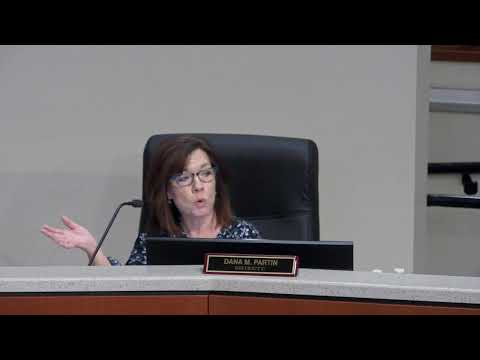
Board members repeatedly asked for stronger links between the revised technology-use policy and the student code of conduct. Dr. Guidry said the policy should be explicit about intellectual-property questions for both staff and students. Board member Ms. Purcell asked which AI tutors or chatbots the division allows; staff cited a vetted student-facing chatbot platform and established subscriptions such as Adobe Express for generative images.
Wickham and staff emphasized that training will highlight both how to prompt tools and how to evaluate outputs. “It's all about the human that's putting that information and those parameters in there and then the human reading that and deciding, is this good? Is this valid?” Wickham told the board.
The board received the policy revisions as a first reading and asked administration to bring a final version that more explicitly ties AI use to copyright, academic-honesty rules and the student code of conduct. No formal vote on the policy was taken at the meeting.
The administration said next steps will include expanded leader training this summer and classroom rollout with teacher and family supports in the following school year. Board members also asked for clearer links between the policy and disciplinary and academic procedures before the next reading.
AI generated
The text on this page is AI generated. Summaries, highlights, analysis, and video transcripts are all produced from the original source material.
AI can make mistakes, so if you spot one, and we will fix it for everyone.
Note: the source content is unaltered by us. Any content source we link to, be it a video, an audio recording, or a document, is presented exactly as its publisher released it. That publisher is usually a government body, sometimes an individual official or another organisation.