Get Full Government Meeting Transcripts, Videos, & Alerts Forever!
Get email alerts on the Collective Bargaining Fire Department topic
No spam. Unsubscribe anytime.
La Marque firefighters present multiyear pay and operations proposal, raise hazmat readiness concerns
Summary
La Marque and Local 3282 opened collective bargaining on April 22 in City Council Chambers, where the union presented a package seeking a 7% multiyear pay increase, higher certification and instructor incentives, a move to 48/96 shift scheduling and expanded training and equipment to address hazmat readiness.
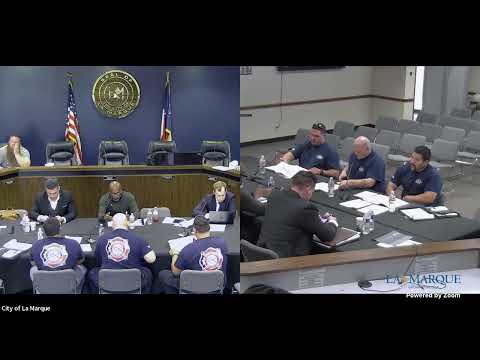
La Marque and representatives of Local 3282 of the International Association of Fire Fighters began collective bargaining April 22 in City Council Chambers, where the union presented a multi-part proposal that would raise pay and certification incentives, change shift schedules and push for expanded training and equipment to address hazardous-materials risks.
The proposal, presented by Cody Chandler, president of Local 3282, asked the city to adopt a 7% across-the-board pay increase phased over three years (2% in 2026, 2% in 2027 and 3% in 2028) and to raise or add a range of certification-pay incentives including paramedic pay, officer- and instructor-certification incentives and hazmat and arson investigator pay. "A lot of the ask that are in this packet, as far as the certification pays, the certification pays have not been adjusted since, I wanna say, 02/2012," Chandler said. He also proposed adding Juneteenth and Veterans Day to the department's holiday bank and increasing the boot reimbursement.
Why it matters: the package combines immediate compensation requests with steps the union says would improve departmental training and public safety. The union argued higher incentive pay would encourage paramedic certification and other qualifications that reduce overtime and sick-time usage and improve service quality. "This is just to stay current with the Cost of living," Chandler said of the multiyear pay request.
Key elements of the union's proposal discussed on the record included: - Compensation: a 7% total salary increase over three years (2%/2%/3%), and increased certification and officer/instructor incentive pay; paramedic certification pay originally introduced in February 2012 was cited as previously unchanged. - Shift schedule: a requested move from the department's existing nine-day rotation to a 48/96 schedule (often described as industry standard for many larger departments), which the union said reduces overtime and sick leave and helps recruit personnel who live outside the immediate area. - Holidays and leave: add Juneteenth and Veterans Day to the holiday bank (the department currently receives 132 holiday hours per year, equivalent to 11 holidays of 12 hours each) and clarify holiday usage rules for probationary employees. - Equipment and uniforms: raise the boot reimbursement from $125 to at least $200 and institute a timelimited boot-purchase program (union proposes a six-month timeframe after which unused funds could be reallocated to the department quartermaster for shared equipment such as raincoats and vests). - On-call/arson compensation: two hours of weekend pay for on-call arson/fire investigators was proposed. - Physical assessment funding: raise the department's PAT (physical ability/fitness) test funding from $250 per quarter to $2,000 per quarter to support regular fitness testing. - Training and certifications: expand in-house instructor and officer training (instructor 1–3 and officer 1–4 paths) to provide more in-house certification and reduce travel/per-diem costs for out-of-department training.
Operational readiness concerns also featured prominently. Union members and city staff discussed gaps in the department's hazardous-materials (hazmat) response capacity, with firefighters saying the department currently has four single-gas monitors and is acquiring a five-gas monitor to place at each side of the city. Union members described limits to offensive hazmat capability and reliance on mutual-aid hazmat teams. "Right now offensive posture. No," a city official summarized about the department's current hazmat posture; union speakers noted that responses now rely on mutual aid from neighboring agencies including League City and county or regional hazmat teams and that Texas City hazmat has been unavailable at times. Union members requested attention and resources to reduce reliance on distant mutual aid for incidents involving ammonia, chlorine or other hazardous cargo moving on nearby routes including IH-45 and local industrial facilities.
Staffing, minimums and scheduling details were discussed. Union representatives said the department operates two stations with a minimum staffing threshold of eight (five per station when fully staffed yields ten total on shift), that the department currently uses a Kelly day system tied to overtime and the Fair Labor Standards Act (FLSA), and that the 48/96 schedule would eliminate some Kelly-day overtime costs. JB Pritchett, interim city manager and the city's lead negotiator, described the session as the formal start of bargaining and emphasized the city's interest in an efficient process: "I think today, today's our formality day more than anything else," Pritchett said.
Ground rules and next steps: both sides agreed ground rules for bargaining that the teams recorded on the public record. Those rules include a prohibition on individual union members contacting city council members about bargaining issues during the negotiations without mutual consent of both negotiating teams, an agreement that negotiations will not be conducted through the media, and a limit that only three additional meetings after April 22 may be used to add new proposals; after that point neither side will add new proposals, the city said. Pritchett told the union that he will coordinate follow-up meeting dates with union president Chandler.
No formal votes or contract approvals occurred at the April 22 session; the meeting functioned as a bargaining kickoff and review of the union's written proposal. City officials and union representatives repeatedly emphasized the process orientation of the meeting and the need for subsequent bargaining sessions to work through details, cost estimates and implementation specifics.
Context and outstanding items: the union provided packet materials with comparative data from other departments (including Sugar Land and Galveston) and a tabbed breakdown of current versus requested certification pays, a feasibility summary of the shift rotation change, and a boots/uniform allowance spreadsheet. Several details — including exact fiscal impacts, whether certain increases would take immediate effect or be phased, and the total budgetary cost to the city — were not resolved on the record and were described as items city staff would "chew through" in subsequent sessions.
The meeting closed with both sides agreeing to continue bargaining and to circulate proposed dates for follow-up sessions. "I will either be in touch with you through my assistant, through HR," Pritchett said about scheduling the next meetings.