Get Full Government Meeting Transcripts, Videos, & Alerts Forever!
Get email alerts on the Collective Bargaining Fire Department topic
No spam. Unsubscribe anytime.
La Marque and IAFF Local 3282 open talks on pay, schedule, certifications and gear
Summary
City and union negotiators met April 22 to begin collective bargaining over a multi-year pay proposal, a move to a 48/96 shift, updated certification pay and equipment allowances; no formal agreements were adopted and the parties set ground rules and follow-up sessions.
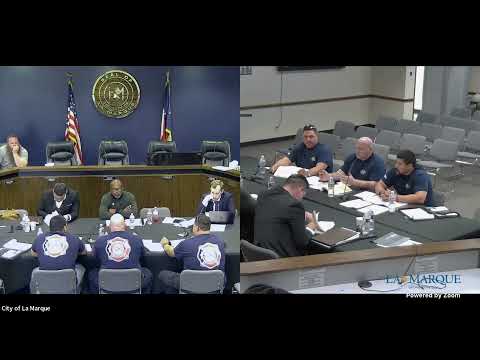
City of La Marque officials and representatives of IAFF Local 3282 met April 22 in the Council Chambers to open collective bargaining on a range of pay, scheduling, training and equipment issues.
The meeting — attended by Mayor Keith Bell; JB Pritchett, interim city manager and lead negotiator for the city; outside counsel Gus Knaebel; and union representatives Cody Chandler (president), Isaiah Reyes (vice president) and Jody Martinez — covered a 7% wage proposal spread over three years, a proposed shift change to a 48/96 rotation, requests to update long-unchanged certification pay, and increases to equipment and training allowances. No formal motions or votes were taken.
The negotiations matter to residents because they concern firefighter staffing, training and response capability. Union leaders argued the package would improve retention and on-the-job skills; city staff said they would review the union’s written proposal and schedule follow-up bargaining sessions.
Union president Cody Chandler summarized the union’s packet and identified several core requests: raising certification pay levels that have not been updated since February 2012 (the paramedic certification pay was cited at $500), adding new incentive pay for certifications such as hazardous materials technicians and officer certifications, and adding holidays recognized by the city (Chandler specifically mentioned Juneteenth and Veterans Day). Chandler also presented a pay proposal described on the record as a 7% increase over three years, allocated as 2% in 2026, 2% in 2027 and 3% in 2028.
City negotiator JB Pritchett said the session was largely procedural, praised the department’s service and confirmed the city would digest the written materials. Pritchett repeated that the city’s negotiating team would review the union’s submission and coordinate scheduling for additional bargaining sessions.
On scheduling, Local 3282 requested switching from the department’s current nine-day rotation to a 48/96 schedule (two 24-hour on-duty days followed by four off). Union speakers said the 48/96 schedule is increasingly used in larger departments (Galveston, Sugar Land and Pearland were cited) and argued it reduces overtime and sick leave while easing long commutes for some personnel who live outside Galveston County.
Staffing and minimums were discussed: the department operates two stations, with “fully staffed” described as 10 personnel total (five per station) and a stated minimum staffing level of eight. Under the current pattern, the department uses a “Kelly day” system; union members said the proposed schedule change would eliminate the need for Kelly days and reduce the city’s overtime costs tied to unused Kelly days.
On equipment and allowances, union members asked to raise the boot allowance from $125 to $200 and to set limits and timelines so unused uniform funds could be reallocated to a department quartermaster for necessary purchases (rain jackets, traffic vests, etc.). The union also proposed a larger quarterly PAT (physical ability/fitness) test stipend — the packet cited a current $250 per quarter amount and requested increasing it to $2,000 (as presented by union members).
Training and certification were a major focus. Union members described current in-house training led by captains and the chief, noted instructor- and officer-level certification pathways through the Texas Commission on Fire Protection (TCFP), and outlined benefits from raising instructor and officer certification levels (reduced travel and per diem costs, more in-house certification capacity). The union said some higher-level practical courses (for example, hazmat technician skills) require equipment the department lacks.
Hazardous-materials capability drew repeated concern. Union speakers said the department has only limited air-monitoring equipment (four-gas readers in current inventory and plans for a five-gas monitor donation) and lacks offensive hazmat response gear and some absorbents. They described reliance on mutual-aid hazmat teams (Fort Bend, Harris County, Texas City and others) and occasional mitigation measures such as using dirt or absorbents from public works. City leaders acknowledged these gaps and noted the need to address equipment and mutual-aid response planning.
Ground rules for negotiations were placed on the record: the parties agreed to a finite number of meetings to add new proposals (the mayor stated there would be three additional meetings during which new proposals could be added) and to restrictions on direct contact with city council members about bargaining issues without mutual consent of the negotiating teams. Both sides said they would keep negotiations at the bargaining table and avoid using the media to conduct negotiations.
Pritchett and Chandler agreed to coordinate future meeting dates; no tentative settlement dates or agreements were announced. The city and union left the meeting with their proposals on the table and a schedule of follow-up bargaining to be set by the city manager’s office.
The meeting produced discussion and clarifications but no formal votes or contract changes; the parties will reconvene for additional sessions before any final agreement.