Get Full Government Meeting Transcripts, Videos, & Alerts Forever!
Get email alerts on the Privacy Shielding Act topic
No spam. Unsubscribe anytime.
County staff briefed on new privacy-shielding law, software and workflow questions ahead of April 1 start
Summary
A vendor presentation outlined how Rusk County offices must implement a state privacy-shielding law that begins April 1, covering who qualifies, what records can be hidden, steps for handling requests and technical integrations with land-records systems.
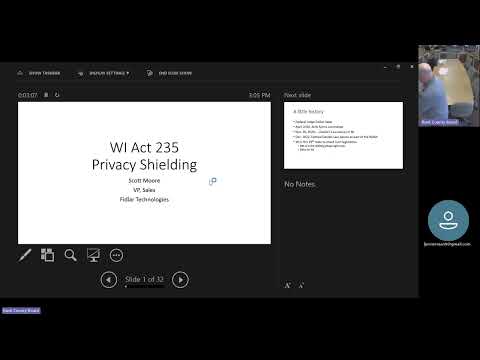
Scott Moore, a representative of Fiddler Technologies, told Rusk County staff and officials on March 26 that a new state privacy-shielding law — referred to in the presentation as Act 235 — requires local offices to accept requests to hide certain personal information starting April 1. The law initially targeted judges, but Moore said similar protections have expanded in other states and Wisconsin’s version carries a 10-year shielding period and criminal penalties for egregious disclosure.
The presentation explained who may qualify for shielding, what county offices must do when a request arrives, and software options to manage routing and redaction. Moore said the state has produced a standard application that officials must accept “as face value” and that county staff have 10 days from receipt to process an application routed to the county’s office of ultimate authority. “This passed, and it starts on Tuesday,” Moore said during his remarks, urging counties to prepare workflows and technical safeguards.
Why it matters: County clerks, register of deeds staff, treasurers and election administrators all maintain public-facing databases that could include home addresses, phone numbers and other details the law protects. Rusk County officials were advised to identify which office will act as the “office of ultimate authority,” to plan how to mark shielded records in land-records systems, and to decide whether to accept confidentiality agreements with outside searchers such as title companies.
Key provisions and local implications
- Who is protected: The presentation said judges and other covered judicial officers are explicitly included and noted that other states have expanded coverage to prosecutors, law enforcement and elected officials in later amendments. Moore said 28 states already had similar laws and Wisconsin would be the 29th when the act takes effect in the presenter’s timeline.
- What must be hidden: The county must not publicly display home addresses, phone numbers, email addresses and the identity of minor children for shielded participants. For register-of-deeds searches the law creates a carve-out: shielded persons must list specific document numbers to be blocked rather than a blanket name-based suppression.
- Document handling and timing: Moore described a 10-year default term for shielding and said the county has 10 days to act after receiving a properly completed application. If a participant later acquires new documents (for example, buys a new house), adding that document to the shielded set resets the 10-year clock.
- State forms and vetting: Moore emphasized the state has a prescribed form that will be created and posted by the director of state courts; the county may accept the information on that form without conducting independent vetting.
- Penalties and liability: Wisconsin’s law includes criminal penalties for improper disclosure; the presenter noted the statute carries class G felony exposure in extreme cases and cited fines and prison terms “not to exceed $25,000 or imprisonment not to exceed 10 years, or both.” He cautioned that even rare disclosures could invite litigation.
- Software and integration: The vendor showed a software workflow that scans an application into a central system, records the persons and document numbers, propagates notices to other county systems (for example, Laredo and Tapestry land-records platforms), and allows the county to grant timed access to individual searchers (for example, a title company for a specific closing). Moore said automated propagation should be verified by staff to avoid errors.
Questions and local concerns raised
County participants asked how to assign responsibility for incoming requests, whether to require confidentiality agreements with outside vendors, and how the shielded flag will appear in their existing search tools. Moore recommended counties decide whether to sign confidentiality agreements with title companies and other businesses that require regular access, and described three common access models: company-wide confidentiality agreements, timed access for specific searches, or per-instance requests backed by a notarized consent/affidavit.
Officials also discussed operational details such as whether townships and municipal offices are covered, how bulk data feeds to commercial vendors should be handled going forward, and how to handle cases in which a participant dies or moves out of the county. Moore said some counties plan to route difficult eligibility questions to counsel or the state rather than front-desk staff.
What did the county agree or decide? There was no board motion or formal vote recorded in the presentation. The meeting recorded discussion and questions but no formal county action; staff were advised to plan workflows, consider vendor agreements, and coordinate a broader briefing for township clerks and other municipal partners.
Ending
Moore urged Rusk County staff to prepare for the law’s effective date and to coordinate with vendors and neighboring jurisdictions. He offered follow-up briefings for combined clerk and treasurer groups and told the meeting he would return to present to towns and villages as counties organize implementation. “This is no longer theory,” he said near the close of his remarks, stressing the need for immediate operational planning.