Get Full Government Meeting Transcripts, Videos, & Alerts Forever!
Get email alerts on the Zoning Liquor Permits topic
No spam. Unsubscribe anytime.
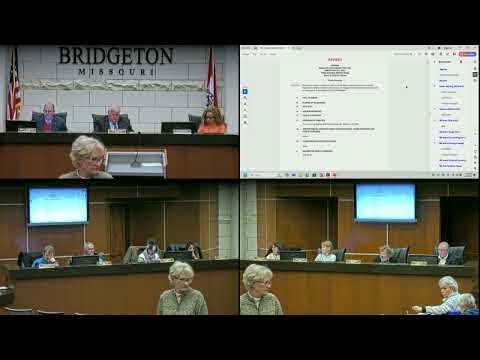
Bridgeton holds public hearing on zoning change to require special-use permits for taverns, tables ordinance
Summary
At a March 5 public hearing, city staff presented a proposed zoning text amendment to require special-use permits for taverns/saloons and liquor sales at restaurants in several commercial districts; the council tabled the ordinance (bill 64-85) for later consideration after a presentation and questions.
At a March 5 Bridgeton City Council meeting, staff presented a zoning text amendment (application 25-PZ-01) that would require special-use permits for taverns and saloons and for the sale of liquor at restaurants in multiple commercial zoning districts; the council held a public hearing and then voted to table the ordinance (bill 64-85) for future consideration.
Planning staff summarized the proposal and its scope, saying the amendment would remove tavern or saloon as a use permitted by right in the B-1 and B-2 districts (and applicable B-5 and M-3 planned districts) and instead allow those uses only by special-use permit. The change would also make the sale of liquor at restaurants a permitted-with-special-use-permit use in any district that allows restaurants. Staff noted the B-3 district already requires a special-use permit for taverns or saloons.
The proposal follows a six-month moratorium on new tavern or saloon liquor-license applications the council approved Dec. 4, 2024, and staff told the council the planning commission reviewed the amendment and recommended approval by an 8–0 vote. Staff also said the city was unusual among municipalities reviewed because taverns and saloons were currently permitted by right in several Bridgeton districts; the amendment would align Bridgeton with peer cities that require conditional or special permits.
Council members asked how the change would affect existing businesses and transfers of ownership. Planning staff said legally nonconforming establishments in operation would not be required to reapply; the ordinance as drafted would apply to new businesses. He explained that, under the city’s interpretation of existing nonconforming-use rules, a continuing operation after sale generally may continue without a special-use permit, but if a use is discontinued for the statutory time period it could lose that status and then would need to apply for a special-use permit.
Staff also said an existing restaurant that is not currently selling alcohol would need a special-use permit if it later sought to add liquor sales. Staff pointed to examples from other municipalities — specifically Ellisville — where restaurants may open before receiving a separate conditional-use approval to sell liquor and then add the liquor sale after the conditional approval is granted.
After the public hearing, which produced one speaker raising an unrelated signage/open-door concern, Council member Luther moved and Council member Luke seconded a motion to table bill 64-85. The motion to table passed without opposition.
Votes at a glance: bill 64-85 (zoning amendment, application 25-PZ-01) — motion to table made by Council member Luther, seconded by Council member Luke; outcome: tabled (unanimous). The council announced it will take final action on the proposed zoning amendment at a future meeting following this public hearing and additional review.