Get Full Government Meeting Transcripts, Videos, & Alerts Forever!
Get email alerts on the Housing Redevelopment topic
No spam. Unsubscribe anytime.
Pompton Lakes Council approves redevelopment amendment and 30-year pilot for 61 Q Avenue project
Summary
After a presentation from the borough's financial advisors and a public hearing, the Borough Council adopted a redevelopment-area amendment and a long-term tax exemption (pilot) financial agreement for a 23-unit residential project at 61 Q Avenue.
Pompton Lakes Borough Council voted to adopt changes to the Downtown Redevelopment Plan for Block 2400, Lot 1 and approved a 30-year Payment in Lieu of Taxes (PILOT) financial agreement for a proposed 23-unit residential project at 61 Q Avenue.
The council heard a detailed presentation from Brian Morris of Phoenix Advisors, the borough's financial consultant, and planning comments from Nick Dickerson of Colliers Engineering before opening the matter for public comment. Morris said the pilot payment structure the borough is considering would be staged over the term, beginning with a lower percentage of the project's gross revenue and escalating over time. "The pilot payments over that term are $2,750,000," Morris said, adding that the borough's net revenue after statutory and land‑tax adjustments was estimated at roughly $2.5 million over 30 years if the project meets stabilization assumptions.
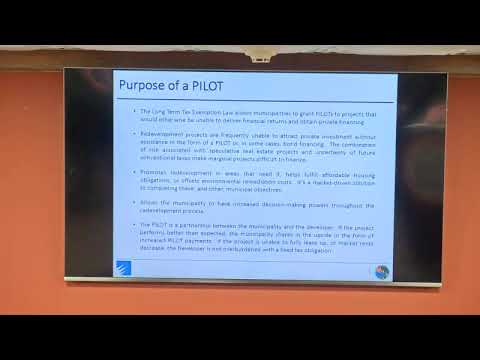
The presentation explained that under the long-term tax exemption law the land portion of the property remains subject to conventional property taxes while the improvement portion can be subject to an alternate payment; the municipality retains the majority of pilot revenues but must remit 5% of pilot collections to the county. Morris described how the recommended structure uses statutory 20/40/60/80 percent triggers and a 2% administrative fee; he also described why lenders often prefer the certainty of a PILOT on projects that have significant up-front fixed costs. "Because of economies of scale on this particular project," Morris said, "things like DEP permitting and wetlands mitigation ... can make a pretty big difference when your budget is $6,300,000." He added that Phoenix reviewed the developer's pro forma and comps and considered the assumptions reasonable.
Developer representatives and local residents spoke during the public comment period. Steve Malenick, representing 61 Q Avenue Urban Renewal LLC, urged the council to approve the ordinance and the pilot, saying the owner had negotiated the highest feasible PILOT percentages and that, without the PILOT, the project was unlikely to be financed. "This is the absolute most that we can do and can still believe that it will ever be financed," Malenick said. Several residents, including a longtime volunteer fire chief and nearby business owners, voiced support for redevelopment, saying the site is an eyesore and the project would bring modern housing and new tax revenue.
Council members discussed prior presentations on PILOTs, concerns about unit sizes (planning‑board members had recommended the council consider larger studio sizes), and potential school district impacts. Morris and Phoenix staff said their demographic multiplier analysis projected approximately four school‑age children from the 23 units; he noted those multipliers are from Rutgers and have not been updated since the pandemic but are commonly used in local fiscal impact reviews. Morris also emphasized the council should view the decision as "project versus no project," not pilot versus conventional taxes, because the site currently produces very low annual taxes.
The council conducted public hearings and recorded final votes. The governing body adopted Ordinance 25-11, the site‑specific amendment to the downtown redevelopment standards for Block 2400, Lot 1, and Ordinance 25-12, the authorizing ordinance for the tax exemption and financial agreement with 61 Q Avenue Urban Renewal LLC. Both measures were approved on final reading by roll call vote.
The ordinances do not themselves approve construction permits. If the council's adopted redevelopment text and PILOT ordinance remain in force, the developer still must submit a site plan application to the Planning Board; that site plan will be reviewed by police, fire, DPW and other technical staff for code and safety compliance and to resolve outstanding issues such as off‑site parking agreements and stormwater permits. Council discussion and public comments repeatedly noted that the redevelopment amendment and pilot are one step in a multi-stage process that includes Planning Board site plan review and any required agency permits.
Votes at a glance: Ordinance 25-11 (redevelopment amendment) — final adoption approved by roll call; mover: Councilman Vennon; second: Councilman Cruz; outcome: approved. Ordinance 25-12 (authorizing tax exemption/PILOT for 61 Q Avenue) — final adoption approved by roll call; mover: Councilman Vennon; second: Councilwoman Kent; outcome: approved.
The project proponents said they have communicated with the county about potential off‑site parking and reported the county indicated willingness to provide those spaces, subject to a formal agreement. Developer and consultant representatives emphasized the next steps are Planning Board site plan filings, DEP/stormwater work and finalizing any off‑site parking arrangement before building permits can be issued.