
Reinvestment Zone board ratifies finance plan, authorizes work on university-donation financing
Get AI-powered insights, summaries, and transcripts
Sign Up Free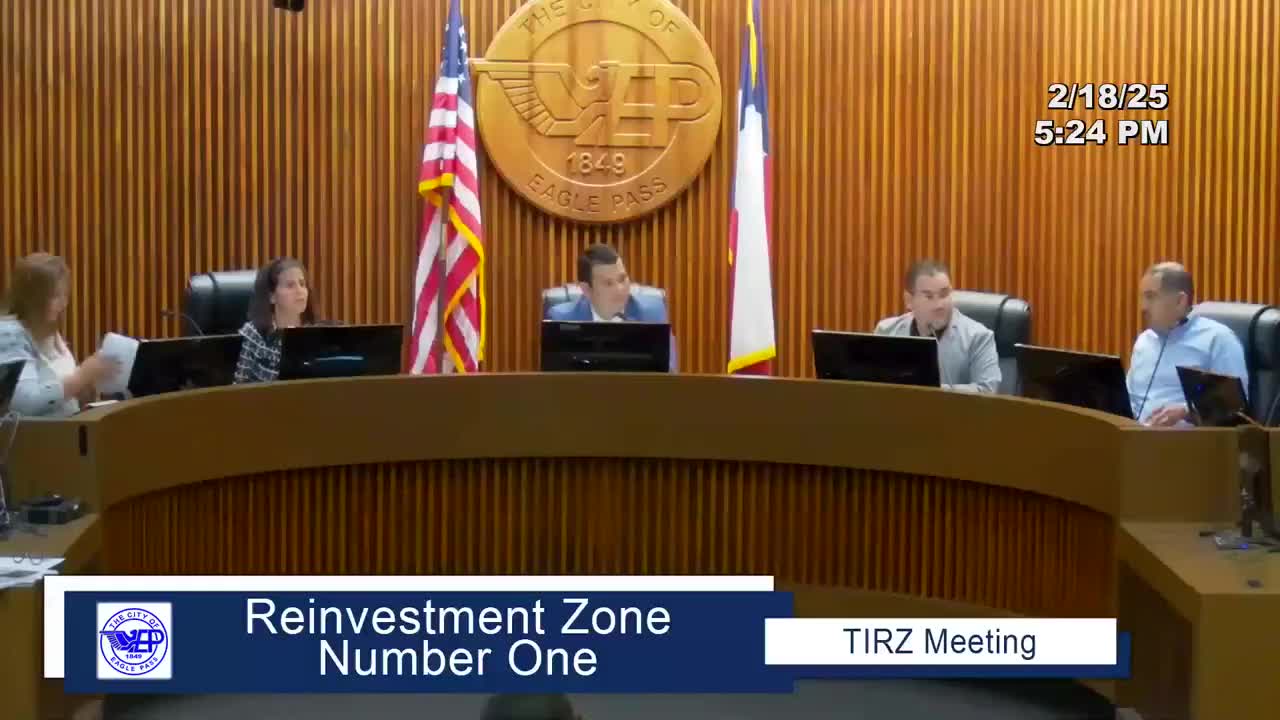
Summary
The board ratified the preliminary finance plan adopted by City Council, voted to allow developers to prepare cost estimates for a proposed 100-acre donation to a four-year university, and approved moving forward with project financing work.
The Reinvestment Zone Number 1 board on Tuesday ratified the project finance plan that the Eagle Pass City Council previously approved and authorized the developer’s team to begin preparing detailed cost estimates and financing documents tied to a proposed university land donation.
The board voted 4–0 with Sonia Jumpin abstaining to ratify the preliminary finance plan included in the ordinance establishing the tax increment reinvestment zone (TIRZ) and the public improvement district (PID). Later in the meeting the board voted to allow the developer to start engineering and cost work for a plan that would donate roughly 100 acres for a four-year university; that motion also passed with one abstention.
Juan Aguilera, the city’s bond attorney, summarized the legal framework: the TIRZ and PID were created under the Texas Tax Code §311 process, and bonds issued to reimburse development costs must be issued by the city. Aguilera said the board’s role includes ratifying a preliminary financial plan and reviewing future plan changes before they go to council for final approval.
Sonia Jumpin described project progress and the development map. She said the overall annexation covered about 2,276 acres and pointed to several parcels already in development: a 188-acre Empire Industrial Park (17 industrial lots, seven under contract), a Pilot subdivision with a 10-acre Pilot Travel Center site, and an 80-acre parcel sold to Team Housing Solutions. Jumpin said the developer committed to develop at least 10% of the land every five years; by May 2029 the plan calls for 228 acres to be developed.
On funding and assessments, Aguilera and other board members clarified that infrastructure and financing costs would be paid by assessments and bonds tied to properties inside the TIRZ/PID, not by the city’s general-tax base. Aguilera said the city and county will each receive 25% of the captured tax increment from the zone as development proceeds. He described the financing structure as a typical “reimbursement bond” model in which the developer’s eligible expenses are reimbursed from future assessments and tax increments.
Board members also discussed a proposed donation of roughly 100 acres to a four-year university; the developer said the plan is to construct the infrastructure and utilities so the university can “tap in” without using university funds for site construction. Jumpin told the board engineers and consultants will prepare a cost breakdown and appraisal; she estimated that a complete project-cost presentation could be available in one to two months.
Judge Cantu said the university donation and coordinated private-public development “is going to be a catalyst” for the south side of the community and moved that the board proceed with the finance-plan work; Councilman Garcia seconded. The motion to proceed passed with one abstention.
Next steps: the developer will proceed with engineering and cost estimates to produce a detailed project finance plan for the board’s review; any material changes to the plan will require board review and final city council approval before bonds or assessments are issued.