Get Full Government Meeting Transcripts, Videos, & Alerts Forever!
Get email alerts on the Parkland Dedication topic
No spam. Unsubscribe anytime.
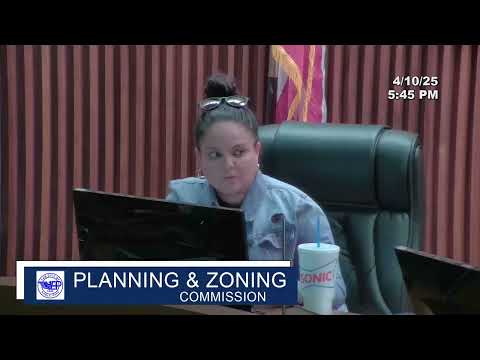
Planning commission backs reduced parkland requirement, asks council to consider 'Plan B' and workshop
Summary
The commission recommended the City Council amend parkland-dedication requirements, endorsing a lower land requirement (Plan B), asking staff to split land versus improvement fees, and requesting a public workshop with developers and stakeholders.
The Eagle Pass Planning & Zoning Commission voted unanimously to recommend that City Council amend Chapter 23 (Subdivision, Article V — Parkland Dedication) to reduce the amount of land required from new developments and to pursue a phased approach (referred to in staff materials as “Plan B”). The commission asked staff to return with a draft ordinance for council consideration and recommended holding a public workshop to gather developer and community input.
Staff briefed commissioners on comparative examples from other Texas cities: Seguin’s ordinance (1 acre per 75 units, plus an improvement fee), Del Rio’s (1 acre per 120 units equivalent), and Laredo’s density-based approach (about 1 acre per 256 units with a separate per-unit improvement fee). Staff noted Eagle Pass’s current ordinance equates to 8 acres per 1,000 residents (roughly 1 acre per 35 units) and a fee-in-lieu set at $1,150 per unit for single-family development, a rate staff said is higher in land requirement than many peer cities.
Commissioners and outside participants suggested several changes: reduce the land acreage requirement (several commissioners proposed moving toward 1 acre per 75–100 units or using Plan B as a new target), split the fee into separate land and improvement components, allow developers to build required improvements directly as an option (developer-built parks to be turned over to the city), and require that fees be tracked and spent on proximate park needs (for example directing fees toward the nearest park or into a capital improvements program with a set time to spend funds).
An engineering consultant in the audience described successful approaches in Laredo, including use of floodplain and regional parks to reduce maintenance burdens and developer-built park improvements where developers deliver finished amenities to the city rather than paying unrestricted cash-in-lieu. Commissioners asked staff to prepare an ordinance revision based on Plan B, to consider a phased schedule for changes, and to schedule a workshop inviting developers and parks stakeholders. The commission voted to recommend the ordinance change and to request a workshop for broader input.