Get Full Government Meeting Transcripts, Videos, & Alerts Forever!
Get email alerts on the Utilities Financing topic
No spam. Unsubscribe anytime.
Smithville officials outline $70 million water and sewer upgrade plan, endorse near-term COPs
Summary
City staff described an 8–10 year, roughly $70 million water and wastewater investment plan and asked the Board of Aldermen for general direction to issue short-term certificates of participation and pursue later revenue bond financing and state revolving funds.
Smithville city staff presented an 8–10 year plan that would invest about $70 million in the combined water and wastewater systems and asked the Board of Aldermen for general direction to proceed with a mix of short-term debt and future voter‑approved revenue bonds.
City staff emphasized that the projects are driven by aging infrastructure, ongoing growth and cash‑flow constraints. Chuck (city staff member, utilities/project lead) described the projects and estimated costs, and Rick (city finance staff) walked through projected cash flows. Financial adviser Todd Goffy of Piper Jaffray explained financing options and Megan Miller (bond counsel) joined to answer legal and timing questions. Alderman Russell and other board members asked questions about project scope, regulations and rate impacts.
The plan presented includes a mix of immediate rehabilitation and longer‑term expansions. Staff said the projects in the water and wastewater master plans include: replacement and capacity upgrades for multiple lift stations (including a 140 Fourth Street lift station bid at $3,400,000), decommissioning several functionally obsolete pump stations, a new 12‑inch river crossing water main, multi‑phase Owens Branch gravity sewer improvements to allow additional residential capacity, water plant rehabilitation (including carbon feeders, filter media and piping gallery work) and planning for future water plant expansion. Chuck said the work will reduce the number of small, costly pump stations and improve system reliability; he noted the 140 Fourth Street project will allow decommissioning of the Hills of Shannon pump station. He said, referring to recent bids, “they came in very good.”
Staff singled out several near‑term items: the 140 Fourth Street lift station (recently bid, with an upcoming award resolution anticipated in March), replacement of a cast‑iron main on Church and Mill streets to avoid redoing streetscape work later, and site‑specific repairs at the water treatment plant. The city also plans additional testing for lake taste and odor with consultant HDR before recommending any intermediate or plant‑level treatment changes.
On operations issues, staff reported the bar screen at the treatment plant is performing well and described continued problems with disposable “flushable” wipes; staff said they will seek to purchase WetWell Wizard degreasers at roughly $6,000 per lift station to reduce grease and wipe buildup.
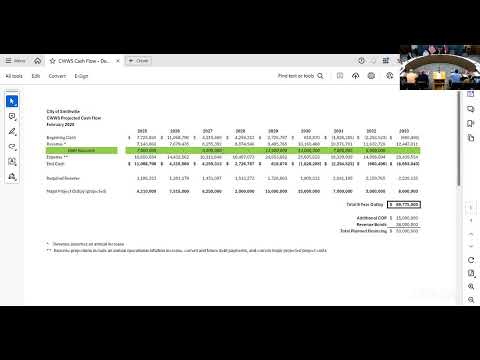
On financing, Rick and Todd outlined a staged approach the city’s advisers recommend: use certificates of participation (COPs) in the near term for projects that need funding without voter approval, pursue an application to the Missouri State Revolving Fund (SRF) for low‑interest loans where appropriate, and plan for revenue bond issuance that would require voter approval later in the decade. Todd noted that “the key point behind the COP is that it does not require voter approval.” Rick’s cash flow timeline presented at the meeting projected issuing $7,000,000 in COPs in 2025, an additional $8,000,000 in COPs in 2027 (total COPs of about $15,000,000), and revenue bonds beginning in 2029 totaling about $38,000,000 under current estimates. Staff noted those numbers are “today’s numbers” and will change as bids, grant awards and growth patterns evolve.
Advisers described SRF as a low‑cost lending program administered by the Missouri Department of Natural Resources; staff said SRF loans can offer long amortizations and quoted a representative 20‑year SRF rate at about 1.8% in current market conditions. Todd and Megan explained differences among general obligation bonds (which require a vote and count against constitutional debt limits), COPs (annual appropriation debt that avoids voter approval), and revenue bonds (typically used for utilities and requiring a simple majority vote). Todd also noted the city’s prior GO bond rating from Standard & Poor’s at AA‑ for general obligation debt.
Staff asked the board for general direction to proceed with the financing timeline and tools presented. Cynthia (city staff member) asked for a nod from the board; meeting minutes show, and the transcript records, nodding of heads in the room indicating concurrence. Rick said the city will bring a reimbursement resolution and other administrative steps forward in upcoming meetings if the board confirms direction. Staff emphasized that voter approval would be required for the larger revenue bond components in later years and that rate changes, impact fees from development and grant awards will affect the mix and timing of issuances.
The work session closed with staff confirming a continuing schedule of detailed briefings: a utility rate study, historical expenditure review, and further CIP prioritization to support debt decisions and any future ballot measures. A routine motion to adjourn the work session was made and approved.
Ending: The board’s general concurrence lets staff proceed with planning for near‑term COP issuance, SRF applications where appropriate and development of possible revenue bond questions for future voter consideration. Staff said it will return with reimbursement and issuance documents and with rates and expenditure history to inform final financing choices.