Get Full Government Meeting Transcripts, Videos, & Alerts Forever!
Get email alerts on the Municipal Utility District Creation topic
No spam. Unsubscribe anytime.
Planning commission recommends city consent to creation of Ironwood MUD after hours of public concern over traffic, drainage and water
Summary
The Bastrop Planning and Zoning Commission voted May 1 to recommend City Council consent to creation of Bastrop County Municipal Utility District No. 5, the financing district proposed for the 289‑acre Ironwood development near State Highway 304, after lengthy public comment about drainage, wells and traffic.
The Bastrop Planning and Zoning Commission voted May 1 to recommend City Council consent to the creation of Bastrop County Municipal Utility District No. 5, a financing district proposed for the 289-acre Ironwood development west of State Highway 304 and north of Lower Red Rock Road.
The recommendation, approved by a majority vote with one no, included an amendment asking staff and the applicant to verify the district’s meets-and-bounds before the matter goes to council. The commission’s action sends the MUD consent to City Council, which is scheduled to consider the request at upcoming meetings in May.
The municipal utility district (MUD) petition would let the developer finance streets, water, wastewater, drainage and related infrastructure through bonds repaid from property taxes within the district. Ryan Harper, an attorney with Allen Boone Robinson who represents the MUD petitioners, told commissioners “the purpose of the district is to construct and finance the water, sewer, drainage, and road facilities, which those facilities will be conveyed to the city.” He said water service would be provided by AquaWater (within AquaWater’s CCN) and wastewater would tie into the City of Bastrop wastewater plant; detention facilities would remain owned and maintained by the district.
Why it matters: neighbors said the proposal could increase flooding, harm private wells and overload Highway 304 — concerns that would fall on city and state agencies as subdivision engineering, traffic studies and drainage plans come forward. Several residents said notice of the proposal had been limited and asked for continued outreach and for city staff to share title/ownership documentation when boundary questions arise.
What commissioners and staff said: Andres (city staff) explained that a development agreement has already been negotiated and approved by council and that the MUD petition is an early, separate funding step. He described the city’s preference that the property be annexed into Bastrop so the city can apply its development standards and receive property tax revenue from day one. ‘‘If the city does not consent,’’ he told the room, ‘‘the developer could terminate the development agreement and pursue development outside the city in the county, which would be subject to different, often less-stringent rules.’’ He also noted a state process exists by which a developer could seek legislative approval over local denial.
Developer plans and clarifications: At one point in the meeting the applicant and city staff gave differing interim figures that participants sought to reconcile. Ryan Harper later clarified a concept-level count in the development agreement: “there’s 1,256 lots, which include up to 550 townhomes. There’s no apartments currently planned for the project, at all.” He also said the development agreement includes a requirement that impervious cover across the entire project not exceed 50 percent.
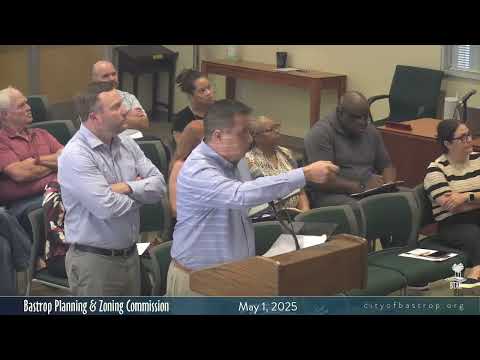
Public comments and concerns: More than a dozen residents spoke during the public hearing. Bella Smith of Casino Ranch said, “When 304 was redone, my backyard turns into a pool every time it rains,” and asked how stormwater from the new development will be handled. Karen Kathy (Hall Cat Estate Irrevocable Trust) and others claimed the proposed MUD boundary overlapped private drive entrances and asked for clarification; Garland Stillwell, administrative assistant for that trust, said his clients considered the delineation an encroachment pending survey confirmation. Several speakers said they rely on private wells and worried water-table impacts. Joe Emmert, who owns land contiguous to the project, said past construction nearby increased erosion and washed out outlets; he asked how runoff would be managed without damaging downstream channels such as Clear Spring Creek.
Notices and process: City staff explained the city mailed notices to 500 feet (the city used the Elgin Courier to satisfy state newspaper-notice requirements after the local paper closed) and encouraged residents to attend future P&Z and council meetings. Residents asked staff to provide a point of contact for neighborhood outreach and to share the ownership certificate and survey used to prepare the MUD petition; Ryan Harper said the petition includes a meets-and-bounds description and that the appraisal district has issued an ownership certificate for the property identified in the petition.
Other commitments: City staff and the applicant said the development agreement calls for at least 50 acres of public parkland open to everyone; a private recreation center for residents is also planned. The applicant said water infrastructure will be conveyed to AquaWater and wastewater facilities conveyed to the city. The developer committed to a final asphalt overlay after heavy construction is complete.
Formal action: The commission moved to recommend council consent to creation of Bastrop County Municipal Utility District No. 5, with the amendment that the district’s meets-and-bounds be verified prior to council action. Vote record captured at the meeting: Christopher Toth — yes; Jimmy Crouch — yes; Keith Alborn — yes; Gary Moss — yes; Jeffrey Estes — no; Patrice Parsons — yes; David Barrow — yes. Outcome: approved. Note: the commission’s recommendation is advisory; the city council will make the final local decision and the state can still act independently under Texas law in some circumstances.
Next steps: The item was scheduled to go to City Council for consideration later in May. Commissioners and staff encouraged neighbors to remain engaged at upcoming planning and council hearings and offered to provide a staff point of contact and to share the ownership/survey documents used in the petition.
Community input will be revisited in later technical phases — engineering plans, traffic and drainage studies, site plans and plats — where the commission and council will review project-level mitigation measures before any construction permits are issued.