Get Full Government Meeting Transcripts, Videos, & Alerts Forever!
Get email alerts on the Economic Development Tools topic
No spam. Unsubscribe anytime.
Bastrop council and EDC direct staff to pursue grants, study TIF/TIRS and foreign‑trade options for industrial park
Summary
At a joint Bastrop City Council and Bastrop Economic Development Corporation meeting on April 21, 2025, council members and the EDC board directed staff to pursue federal Economic Development Administration (EDA) grants, investigate tax‑increment financing (TIF) and tax‑increment reinvestment zone (TIRS) scenarios for the city’s industrial park and the Highway 71 corridor, and explore foreign‑trade‑zone and EB‑5 regional‑center options to attract investment.
At a joint Bastrop City Council and Bastrop Economic Development Corporation meeting on April 21, 2025, council members and the EDC board directed staff to pursue federal Economic Development Administration (EDA) grants, investigate tax‑increment financing (TIF) and tax‑increment reinvestment zone (TIRS) scenarios for the city’s industrial park and the Highway 71 corridor, and explore foreign‑trade‑zone and EB‑5 regional‑center options to attract investment.
The move aims to create funding streams for infrastructure improvements in the city industrial park, which officials said is not yet “shovel ready.” Sylvia (Bastrop Economic Development Corporation staff) told the board the EDC is funded by a one‑eighth cent sales tax that yields about $1,100,000 a year and said any TIRS would “freeze collections” at current levels for a set term so that incremental property‑tax growth above that baseline could be reinvested in the zone.
Why it matters: City and EDC leaders said infrastructure — roads, utilities and site preparation — is the primary barrier to recruiting more employers to Bastrop’s industrial park. Staff and board members described TIF/TIRS as tools to borrow against future incremental tax revenues to pay bond debt for that infrastructure rather than depleting current reserves.
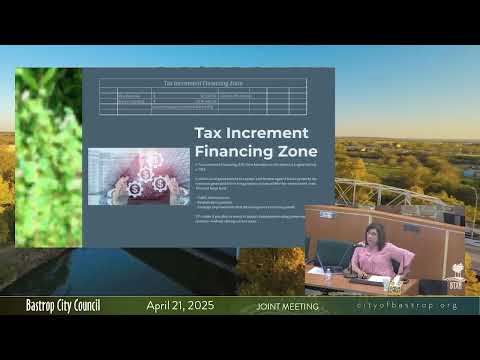
What the council and board heard - TIF/TIRS mechanics and example figures: Presenters explained a typical approach in which the city “freezes” the current property‑tax base for the zone and directs new property‑tax revenue above that base into a dedicated fund for the zone. Using a hypothetical example presented at the meeting, a base land value of $12 million with current annual property‑tax collections of roughly $59,000 could, after property‑value growth, generate an increment (the example showed about $93,500) that could underwrite bond borrowing. The presentation gave an illustrative conversion in which an annual increment of about $93,000 could support roughly $1.8 million in bond debt under the example’s assumptions. - Revenues and terms: Presenters used a 20‑year term as a common example for TIF/TIRS but noted borrowing terms can be shorter or longer depending on the project and the debt the city chooses to issue. - Scope and boundaries: Staff and many council members favored analyzing options that extend the TIRS boundary beyond the industrial park up Highway 71 to support both industrial and limited commercial development. Officials noted state or local rules limit residential uses within a TIRS to 35% of the zone if residential is included. - Grant programs and capacity: Staff said the EDC has not aggressively pursued EDA grants in recent years and that the organization relies on external grant writers. The meeting referenced one turnkey provider, GrantWorks, and the costs discussed included an approximate application fee of $7,000 per grant and a common consultant administration fee structure that can equate to a mid‑single‑digit percentage of awarded grant funds (the presentation used a hypothetical example in which a $10 million award would result in about $500,000 in consultant administration fees). Council and board members directed staff to identify grant opportunities, assess match requirements, and consider issuing an RFQ for grant‑writing/administration services. - Foreign‑trade zones and EB‑5: Adriana Reyes, an immigration attorney, explained EB‑5 regional‑center basics and timelines, saying the EB‑5 program is “based on the Immigration and Nationality Act” and is intended to promote foreign investment for job creation; she described typical investor capital thresholds of about $800,000 to $1,050,000 and noted regional‑center approvals can take months while investor processing commonly takes a year or more. Staff also described foreign‑trade‑zone designation as a separate federal tool that can reduce duty payments for import‑heavy companies; officials said a foreign‑trade‑zone application costs about $6,000 per company and would require letters of support from the city, county and school district and that a memorandum of understanding with the school district would be appropriate if the city actively supports foreign‑trade‑zone applications.
Quotes “This money… it gets put into the city’s general fund,” Sylvia said when explaining current uses of the EDC’s tax revenue and how a TIRS would isolate incremental growth for the zone. “It is an immigration program…created by Congress to promote foreign investment, for job creation and economic growth,” Adriana Reyes said describing the EB‑5 program and its regional‑center construct.
What the council and board directed staff to do - Pursue EDA grant opportunities and assess match and administration options, including whether to issue an RFQ for grant writers/administrators; - Produce scenario analyses for a TIF and a TIRS for the industrial park and an option that would expand a TIRS boundary north along Highway 71, with cost estimates and proposed borrowing terms; - Explore foreign‑trade‑zone support, including potential city, county and school‑district roles and a draft memorandum of understanding to clarify benefits the school district would seek (for example, training or internship commitments); - Return the TIF/TIRS scenario materials and grant opportunity assessments to the board and council for further consideration at a future meeting.
Meeting context and next steps Board and council members repeatedly framed the tools as means to make the industrial park “shovel ready” and to attract expansions already being discussed by firms such as L and S Electric. Staff said prior engineering work estimated infrastructure costs in the $16–$20 million range for full park development and that the EDC has been cash‑funding improvements to date. Council and board members asked staff to return with scenarios that show what would be financed, how long borrowing terms would run, and the impact on city general‑fund receipts for the period chosen.
The board also noted the region’s Leadership Summit in August (a coordination meeting of school, county, city, chamber and EDC leaders) as an opportunity to discuss school‑district benefits and partnership on workforce and training commitments tied to these incentives.