Get Full Government Meeting Transcripts, Videos, & Alerts Forever!
Get email alerts on the Water Supply Aquifer Injection topic
No spam. Unsubscribe anytime.
Bastrop council backs bill to bar Austinaquifer injection testing; city manager warns of contamination risks
Summary
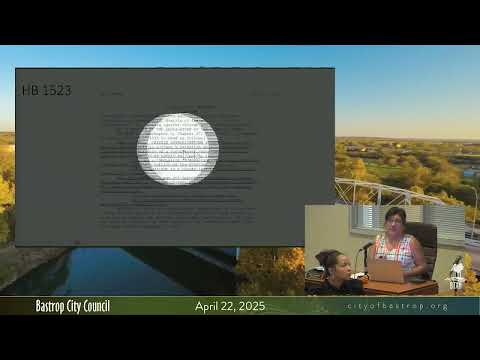
Acting Mayor Pro Tem John Kirkland and the Bastrop City Council voted unanimously April 22 to approve Resolution R2025-85, directing the city manager to submit comments in support of House Bill 15 23 and to gather additional information about the City of Austin's proposed aquifer storage and recovery project.
Acting Mayor Pro Tem John Kirkland and the Bastrop City Council voted unanimously April 22 to approve Resolution R2025-85, directing the city manager to submit comments in support of House Bill 15 23 and to gather additional information about the City of Austin's proposed aquifer storage and recovery project.
The resolution follows a public briefing from City Manager Sylvia Wynn, who told the council she had only recently learned of the project and that the pace of negotiations had "forced" the matter onto Bastrop. Wynn said testing for underground injection raises unanswered questions and potential risks, including the leaching of metals such as arsenic into the Simsboro and Carrizo-Wilcox aquifers that serve Bastrop.
"This particular topic brings me great pause," City Manager Sylvia Wynn said during her presentation. She said she will testify at a committee hearing in Austin and requested data she said the city has repeatedly sought but not received, including desktop models, test-site locations, injection and withdrawal rates, and full descriptions of treatment methods.
Why it matters: House Bill 15 23, filed by Representative Gertes, would prevent the injection-based phase of aquifer storage and recovery in Bastrop County. Wynn and several council members said the city lacks sufficient information about test sites and monitoring, and that the project could put private wells and the municipal Simsboro supply at risk if tests fail or if groundwater chemistry is altered.
Council discussion and public comments emphasized local control and transparency. Councilperson Meyer said the project "shouldn't be talked about in the back room" and expressed support for the resolution. Council members Lee, Plunkett and Fossil likewise voiced concern about lack of data and possible impacts to farmers' wells.
During public comment George Ferrell asked about who benefits from the project. Carol Spencer, who described living through a well contamination incident in New Jersey, urged the council to be cautious and told residents how to submit comments to the House natural resources committee. Heather Green asked how citizens could support the council's efforts; Wynn and Spencer pointed the public to the committee's online comment portal.
Discussion vs. decision: Council approved a formal resolution supporting HB 15 23 and authorized the city manager to collect additional information, work with the city attorney on state comments, and submit those comments to the House Committee on Natural Resources. Wynn said if Austin can later provide robust, public data the city could support reconsidering the issue in a future session.
Action taken: A motion to approve Resolution R2025-85 was made by Councilperson Meyer, seconded by Councilperson Plunkett, and carried unanimously.
What remains open: Wynn said the city still does not have the desktop models, test-site maps, or treatment-monitoring plans she has requested; the council asked the manager to continue pursuing that information and to keep the public informed.