Get Full Government Meeting Transcripts, Videos, & Alerts Forever!
Get email alerts on the Utilities topic
No spam. Unsubscribe anytime.
Smithville reviews two decades of water and sewer work, impact fees and capacity limits as major projects loom
Summary
City staff reviewed historical projects and rate changes, described a shift from reactive repairs to proactive replacement programs, and warned of near-term capacity limits on the North force main. Staff flagged large upcoming projects and a planned debt issuance step.
City of Smithville staff reviewed about 20 years of water and wastewater projects, rate changes and development impact-fee revenue during a work session, and outlined capacity constraints and large capital projects that will drive near‑term borrowing.
Cynthia, a city staff member, opened the session saying the presentation would “examine the history of our projects and rates” to set the stage for future planning. Rick, a city staff member who presented historical and financial data, and Jack, a city staff member who addressed development and capacity, led the discussion.
City staff told the council the city has shifted in recent years from a largely reactive maintenance approach to a proactive replacement and rehabilitation program. Rick said the city began tracking major projects and borrowing more actively after long periods (roughly 2004–2016) with limited capital work. He identified three recent project “bumps”: the south interceptor (sewer) in 2017–2018, a raw‑water pump project in 2020–2021, and a concentrated push on projects tied to the 2018 Water Master Plan and the 2021 Wastewater Master Plan beginning in 2023–2024.
The presentation broke out water and wastewater rates and showed a structural change implemented in February 2014: a fixed monthly charge plus a usage rate per 1,000 gallons. Rick said the fixed portion supports operations while the usage portion is “pegged for capital projects.” Water impact fees were increased to $3,100 in 2020, while wastewater impact fees have remained at $2,800 since 2004, staff said.
Staff described operational results from recent programs: a slip‑lining program begun around 2020 has greatly reduced monthly sewer line maintenance. Dave, sewer department staff, said the city used to run up to about 20 lines monthly for maintenance; today staff reported only one line that requires regular monthly attention and only a handful of emergency call‑ins in the last year. Rick estimated that at the current budgeting level — roughly $150,000 per year — the city can slip‑line about 4,400 linear feet annually, a cost that works out to roughly $34 per linear foot in the examples presented.
On the water side, staff showed a long decline in main breaks after replacing cast‑iron mains with PVC; there was a spike to 49 breaks in 2020 tied to an extended cold spell and higher household usage during the pandemic.
Jack outlined how recent and proposed development affects capacity and impact‑fee revenue. Staff listed ongoing and approved developments including Clay Creek Meadows (about 216 dwelling units), Greyhawk (phases 5–10, roughly 165 units), and Landmark Farms (about 287 units, paused for two years). Staff said the city collected about $128,100 in impact fees last year from 92 single‑family permits. They warned that multifamily projects generate less impact‑fee revenue per dwelling because fees are charged per connection (meter) rather than per unit.
On system capacity, staff said the North force main — the line serving much single‑family development on the north side of town — has only about 11 dwelling‑unit equivalents of capacity remaining under the assumptions in the 2021 wastewater master plan. Jack said restoring meaningful north‑side capacity will require one or both of: replacing and rehabilitating the Wildflower pump station (staff said that replacement would add capacity equivalent to several hundred lots, but the presenter noted a math error on an earlier slide) and constructing the Owens Branch interceptor and gravity line phases, the first segment of which staff expects to install next year. Owens Branch would shift flow off force mains to gravity and reduce electricity use at pump stations.
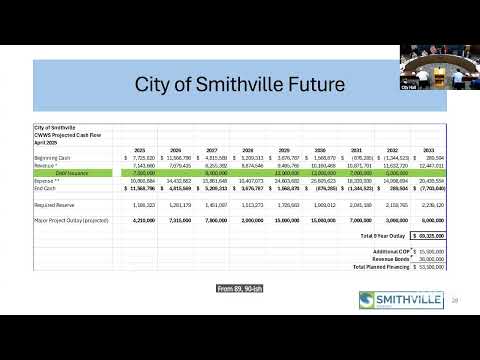
Staff listed several large projects planned or underway that will affect cash flow: the West Bypass, the 140th Street lift station/interceptor (listed in the presentation as “Hundred And 40 Fourth Street”), Owens Branch gravity line, water‑treatment plant improvements and expansions, and wastewater plant expansion. City staff said the estimated cost for the 140th Street project has increased from $7.0 million to $7.5 million. Rick described a prior discussion in February with bond counsel and financial advisers and said the city plans to issue certificates of participation (COPs) later this year to help fund the 140th Street interceptor and related projects. The work session included notice that a reimbursement resolution acknowledging the city’s intent to issue debt was on the week’s agenda; staff said that is an early administrative step and that multiple approvals and steps remain before sale of any COPs.
Staff also noted that federal funding secured with assistance from Representative Graves has delayed the immediate need for debt on some pieces of the project, but the city still expects to use debt to cover large upcoming capital needs.
Alderman Hartman and others in the session emphasized that the expense projections include capital costs and debt service; staff clarified operating revenues are projected to outpace operating expenses but overall cash‑flow lines will show deficits in years with large capital outlays because the models include those projects. Rick told the council that, historically, Smithville did not invest heavily in capital in the early 2010s, which combined with rising construction and energy costs has increased the current financing burden.
No formal votes on project authorizations were taken at the work session. The meeting adjourned after a routine motion to adjourn was approved.
Ending: Staff said the reimbursement resolution and further COP planning will return to the council with financial‑adviser recommendations; staff also flagged that final timing and terms for any debt issuance will depend on subsequent steps, available grants, and market conditions.