Get Full Government Meeting Transcripts, Videos, & Alerts Forever!
Get email alerts on the Large Annex Zoning topic
No spam. Unsubscribe anytime.
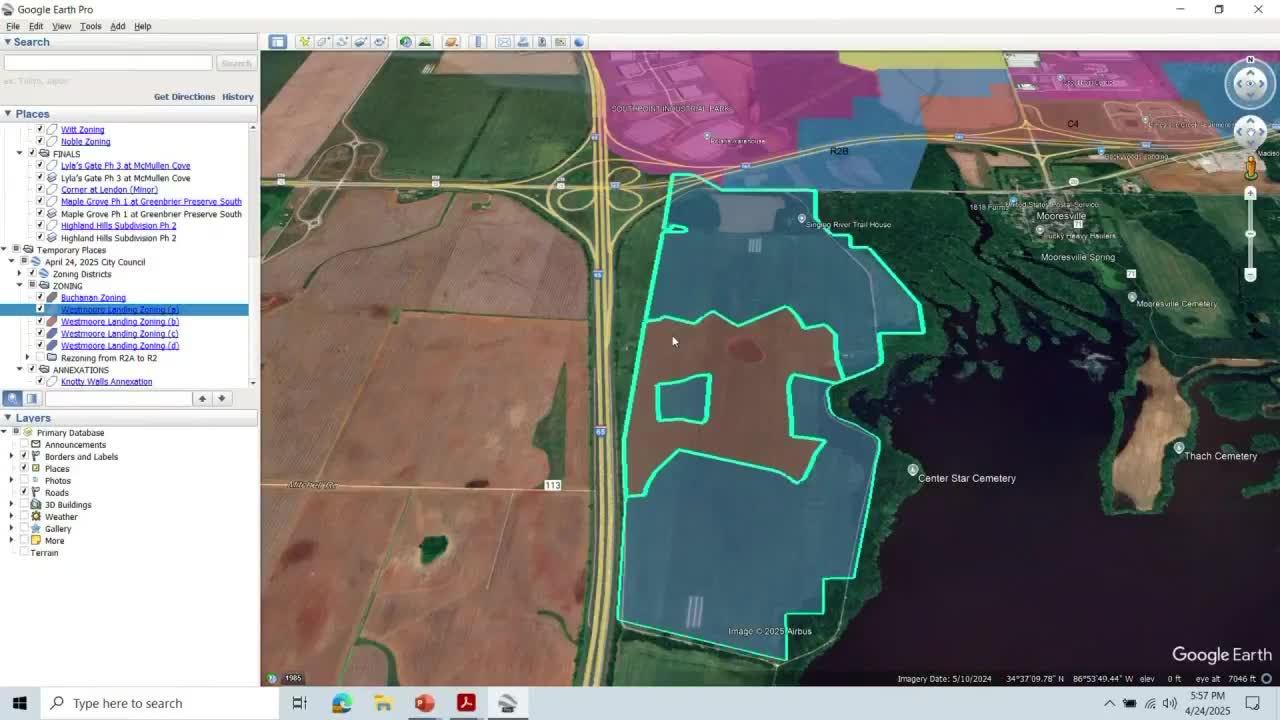
Council approves initial zoning for 395-acre annex; developers may later request planned development
Summary
The City Council approved initial zoning for 395.38 acres annexed into Huntsville, assigning portions to Residence 2B and Highway Business C-4; city staff said future site assessments and stormwater plans will guide protections for native vegetation and a nearby wildlife refuge.
The Huntsville City Council on April 24 assigned initial zoning to 395.38 acres recently annexed into city limits, designating parts of the tract as Residence 2B and parts as Highway Business C-4 to accommodate a future planned development.
Why it matters: The site is large and will likely host both residential neighborhoods and a denser commercial core; council members and nearby residents raised questions about impacts to native vegetation and stormwater flow into a nearby wildlife refuge.
Thomas Nunez, manager of planning and zoning services, described the item as an "initial zoning for an establishment of a future plan development" and said the property will have to meet stormwater requirements as projects come forward. In response to public questions, Nunez said the city has not yet reviewed a site assessment, so staff "are unsure of any native American artifacts and or vegetative species that are prevalent on this property. When we go through the site assessment through the development phases, we will be able to assess that and address that through the planning commission."
A member of the public asked whether the city had efforts planned "to preserve the native Chickasaw plum" and to protect runoff into a nearby refuge; planning staff said that stormwater improvements required during development must retain current water levels and hold runoff on-site, and that the wildlife refuge is protected and will remain in its natural state.
Council discussion emphasized that the zoning is a first step and that detailed development plans and engineering reviews will follow. Council member Dr. Robinson said she was "very glad to see here is that there is no direct access off of 65," noting that limited access from the interstate could shape the mix of uses.
The motion to approve the ordinance was made by Doctor Robinson and seconded by Mr. Little; the council voted to adopt the zoning. Planning staff said future reviews will evaluate stormwater, environmental surveys, and potential archaeological assessments as part of the plan-development process.
Ending: The rezoning clears the way for the petitioner to develop a mixed residential and commercial plan, but detailed environmental and infrastructure reviews are still required before final site approvals.