Get Full Government Meeting Transcripts, Videos, & Alerts Forever!
Get email alerts on the Zoning Neighborhood Protection topic
No spam. Unsubscribe anytime.
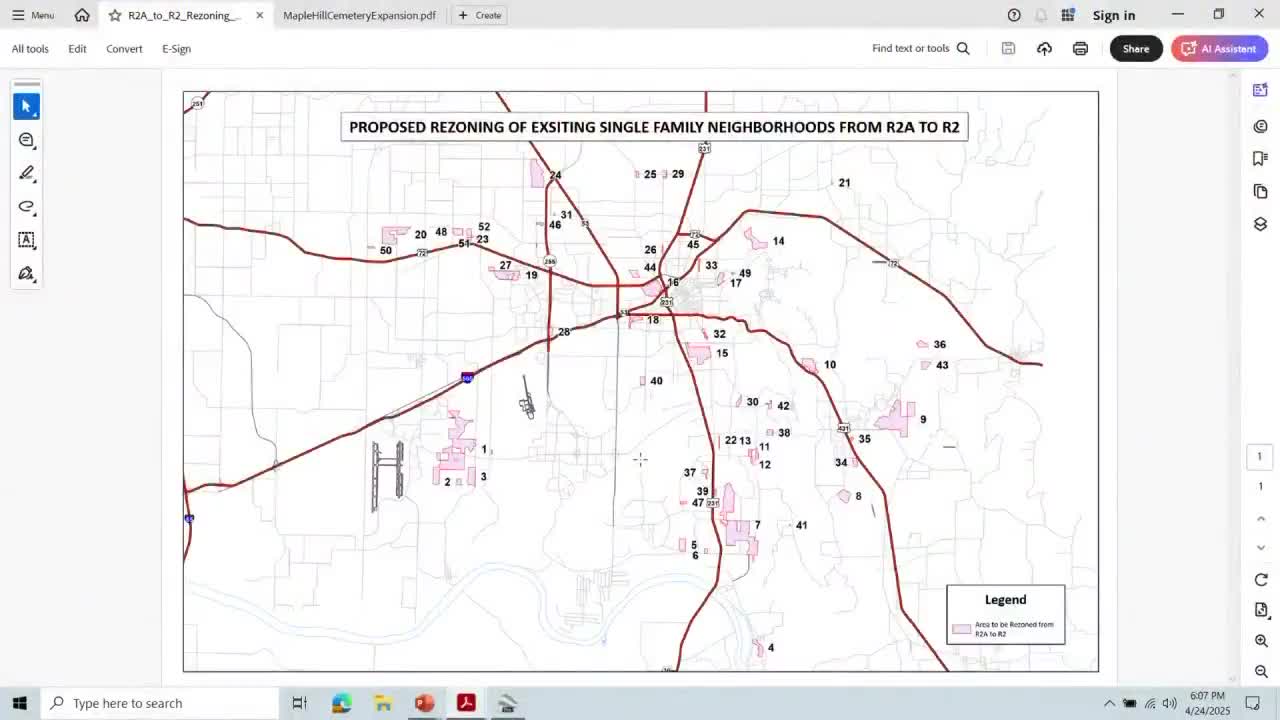
Huntsville council adopts ordinance to limit multifamily conversion in about 52 neighborhoods
Summary
The Huntsville City Council voted to reclassify multiple parcels from Residence 2A to Residence 2 to prevent by-right conversion of established single-family lots into multifamily developments; the move drew sharp public debate about housing supply and neighborhood protection.
The Huntsville City Council on April 24 approved an ordinance that rezones roughly 52 established single-family neighborhoods from Residence 2A to Residence 2, a change city planners said will remove multifamily uses as a by-right option in those areas.
Why it matters: City officials and neighborhood advocates said the action is meant to protect aging single-family areas from being purchased and redeveloped as dense multifamily projects, while opponents argued the measure restricts housing supply as Huntsville grows.
Planning staff said the rezoning blocks a specific pathway that allows developers to buy multiple adjoining lots and replace them with multi-unit buildings. Thomas Nunez, manager of planning and zoning services, told the council the change "helps to retain single family neighborhoods" and that the rezoning "protects neighborhoods from multifamily developments coming into the established neighborhood."
Public speakers were sharply divided. Nicholas Freevold, a West Lawn resident, asked the council to reject or modify the plan, saying the change "would go against the character of this neighborhood by restricting what can be built" and arguing "the amount and type of housing built in neighborhoods should be decided by the free market and not the government." Levi Montgomery, who said he lives on Slaughter Road, described the proposal as "about exclusion" and warned it would "create artificial scarcity to inflate property values."
Council members debated both property-rights implications and neighborhood preservation. Councilman Kling and others supported the measure as a way to protect established community character; Dr. Robinson said the ordinance protects "aging neighborhoods" where residents often include nurses and teachers and where reinvestment can be disrupted by wholesale conversion.
The motion to approve was made by Doctor Robinson and seconded by Mr. Little. Council President recorded the vote as passing with four votes in favor and one abstention; the transcript records Councilwoman Michelle Watkins as abstaining. The ordinance as adopted removes multifamily uses that were permitted by right under Residence 2A but does not eliminate other forms of redevelopment (for example, duplexes and attached single-family are still possible in some zones). City staff told the council that parcels zoned Residence 2 elsewhere in the city remain available for higher-density development.
What comes next: Planning staff said this action preserves the existing single-family lot patterns but that future requests for rezoning or planned-development deviations would still be considered on their own merits. The council and staff said they will continue examining neighborhoods citywide for additional targeted measures.
Ending: The City Council approved the ordinance after extended debate and public comment; supporters cast it as protection for aging neighborhoods, while critics urged the council to consider housing supply and regional growth in future reviews.