Get Full Government Meeting Transcripts, Videos, & Alerts Forever!
Get email alerts on the Public Safety Enforcement topic
No spam. Unsubscribe anytime.
Committee advances RV parking limit, expands nuisance fund for enforcement costs
Summary
The Community Safety and Justice Committee voted to move two ordinances to the full council setting a public hearing on April 2. One would limit recreational vehicle parking on county roads to 72 hours; the other would allow existing nuisance-fund money to cover enforcement costs tied to that rule.
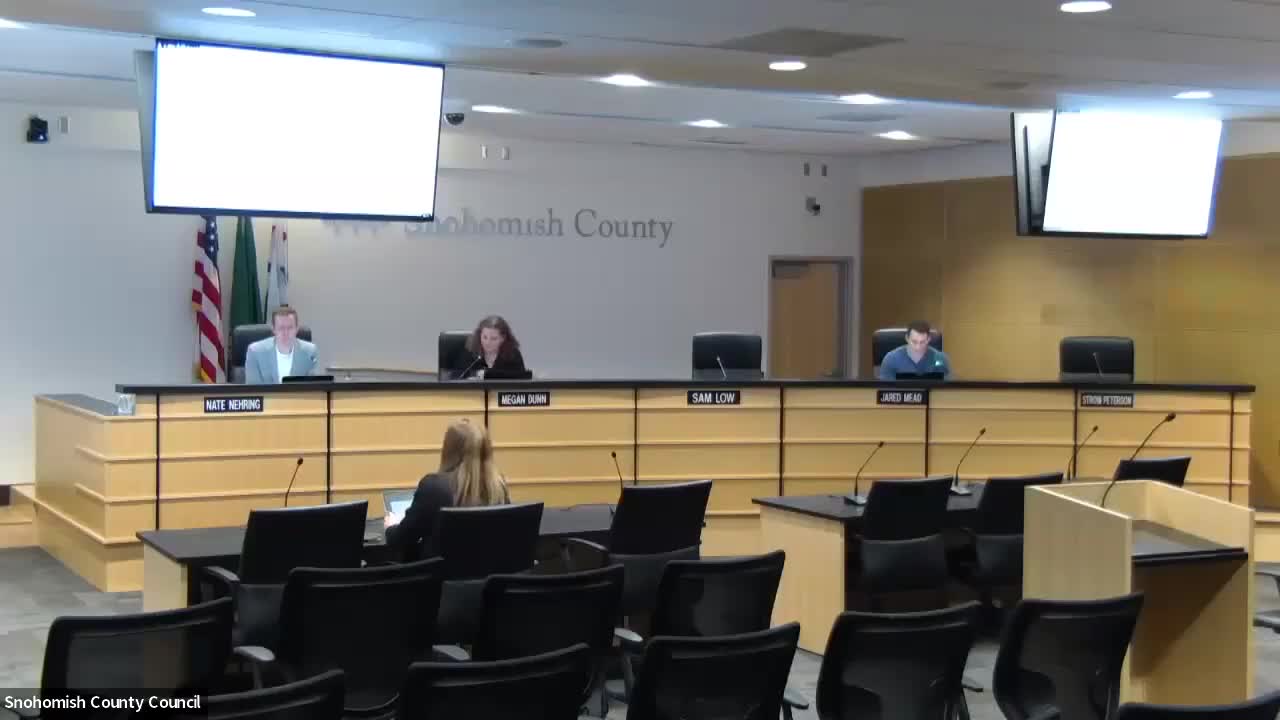
The Snohomish County Council Community Safety and Justice Committee on March 25 voted to move two ordinances to the full council to set a public hearing April 2 that would: (1) prohibit recreational vehicles from parking on county roads for more than 72 hours without moving and (2) allow the county's nuisance property fund to pay certain enforcement costs if the sheriff's office impounds vehicles.
Nicole Gourley, council staff, told the committee that Ordinance 25-021 would add “chapter 11.06 to the Snohomish County Code” and “prohibit the RVs from parking on county roads for more than 72 hours without moving.” She said a law-enforcement officer could place a notice on a vehicle; the notice would give the vehicle owner 72 hours from the time it is posted to move, and if the vehicle fails to move the officer “may have the vehicle impounded at their discretion.”
The companion measure, Ordinance 25-022, would amend the county's nuisance property abatement fund (SCC 4.121) by changing its name to the nuisance property fund and making costs incurred enforcing SCC 11.06 an eligible expense.
Councilmember Nehring, the ordinances' sponsor, said the effort grew from complaints about “derelict RVs” in unincorporated areas and denser parts of the county and that several cities have similar rules. Nehring described the package as an attempt to provide a uniform tool “so that you have some teeth to be able to move these when needed.”
Committee members and staff clarified funding and enforcement details. Gourley said the change would not create a new revenue source; the county would not collect citation revenue from the notice itself. “They're not getting a citation. The tag that is placed on the vehicle is just their notice that they need to move,” Gourley said, and any fees residents pay would generally be towing and impound fees set through court proceedings.
Bureau Chief Martin of the Snohomish County Sheriff’s Office said the Office of Neighborhoods would be the unit that builds cases and deploys the tool rather than giving every deputy new discretion. Martin warned that court judgments can impose unexpected costs: “Last year, we had actually hit twice for a lawful impound in a total more than $25,000,” he said, and added that access to the nuisance fund — which staff said is small today — would help cover costs that are not budgeted.
Committee Chair Mead and other members also discussed legal limits tied to people who use vehicles as dwellings. Committee Chair Peterson noted state and case-law constraints and asked staff to follow up. Gourley and members referenced Seattle v. Long and the Homestead Act’s protections to explain that while certain protections can limit the county’s ability to sell impounded vehicles, they do not by themselves prevent impoundment.
Without objection, the committee directed staff to move both ordinances to the General Legislative Session on April 2 to set the time and date for a public hearing.
The ordinances remain proposals; no new enforcement program or revenue stream was adopted at the committee meeting. Further details about how often the Office of Neighborhoods would use the tool, how costs would be tracked, and the potential budgetary impact will be developed as the ordinances move through the council process.