Get Full Government Meeting Transcripts, Videos, & Alerts Forever!
Get email alerts on the Budget Contingency topic
No spam. Unsubscribe anytime.
Finance director outlines plan to push proportionate COLA contingency to departments amid revenue uncertainty
Summary
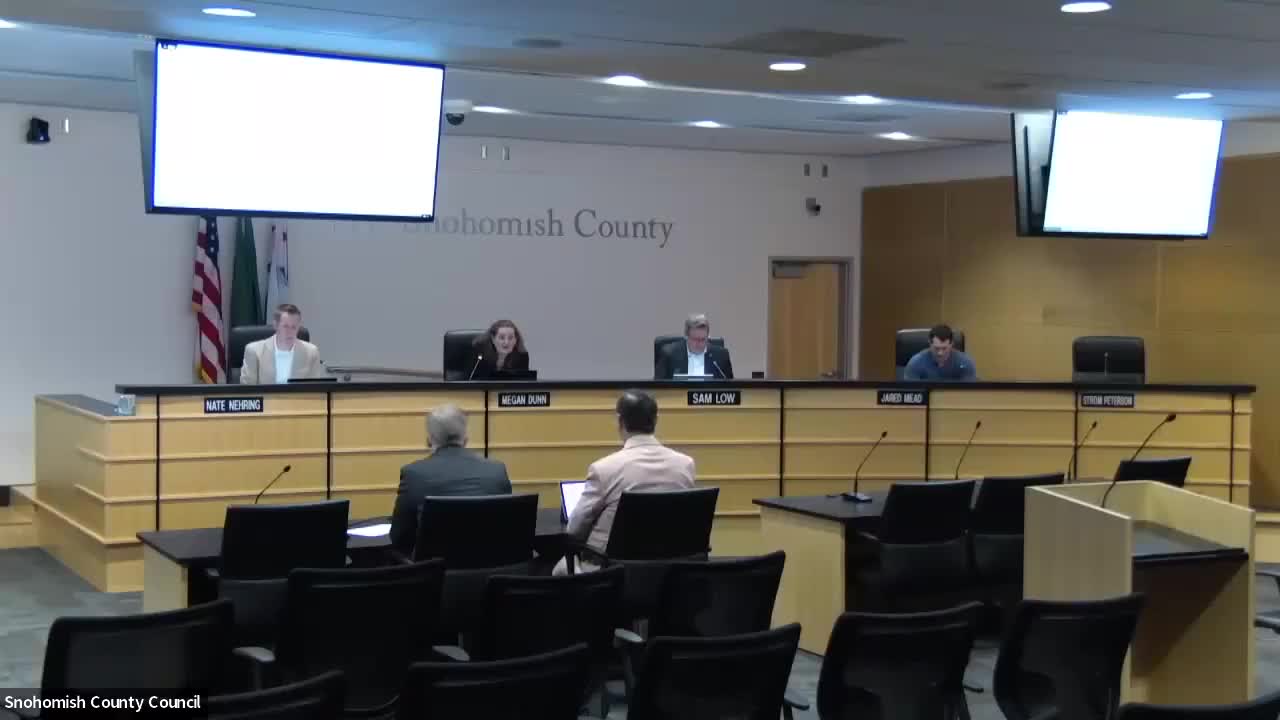
The Snohomish County Finance, Budget and Administration Committee spent its April 8 meeting hearing from finance staff about moving a proportional share of the county’s cost-of-living (COLA) contingency into departmental budgets to reflect settled contracts and give departments better visibility amid revenue uncertainty.
The Snohomish County Finance, Budget and Administration Committee spent the bulk of its April 8 meeting discussing the county’s non-departmental cost-of-living adjustment (COLA) contingency and budget risk for the current biennium.
Nathan, Snohomish County’s director of finance, told the committee the COLA amount placed in non-departmental was an estimate developed in March–May of the prior year and noted: “It is an estimate. It's not what we are required to pay because that comes later once the collective bargaining agreements are settled and Council adopts a budget.” He said the county typically pushes COLA appropriations out to departments during the annual cycle, but because the county operates on a biennium budget staff is recommending the executive push a proportional share of the COLA contingency out earlier to help departments manage 2025 costs tied to recently settled labor contracts.
Nathan described the approach: staff will calculate settled bargaining-unit salary amounts (including nonrepresented staff) and push appropriations sufficient to cover the COLA percentages already settled — for example, the 4.51% for 2024 and 3.63% for 2025 — into departmental budgets so departments can better see where they stand in the biennium. He said the county also has contingency funds that reflect staff estimates for 2026 but cautioned that projecting farther into the biennium carries more risk.
Committee members pressed for more frequent updates on revenue and contingency status. Council member Lehi asked whether federal uncertainty was a key driver; Nathan and other staff replied that the risk mix included broader market uncertainty, sales-tax volatility and federal or state funding changes. A council member noted an unanticipated federal reduction — a roughly $3.5 million cut to the health district — as an example of funding the county had not expected and urged caution in promising funds that might later be lost.
Committee members asked staff to provide transparent tables that show the delta between the contingency assumptions used when the biennium was built (based on 2023 data) and the actual settled contract costs so the council can see how much of any shortfall is driven by salary and benefit changes versus other spending. Nathan said finance already monitors those deltas and will present them as contracts are finalized.
Staff also told the committee that recent health-benefit rate increases have been higher than budgeted in some plans — “up to a 30% increase in some of the health care plans,” as discussed in committee — and that January sales-tax receipts were the only complete recent data point available to assess revenue near-term. Committee members requested that the revenue forecasting work group continue regular meetings and that council receive more frequent briefings or written updates than the standard quarterly budget notes if needed.
Nathan said the executive will recommend the proportional transfer to the council once staff completes the calculations and that the recommendation will be time-sensitive because of ongoing contract settlements and evolving revenue forecasts. He emphasized that pushing appropriations now would give departments visibility while preserving policy levers for 2026 if revenues deteriorate.
The committee did not take formal action at the April 8 meeting; members directed staff to return with detailed tables, regular revenue updates and explicit figures showing what remains in the non-departmental contingency and fund balance as transfers are made.