Get Full Government Meeting Transcripts, Videos, & Alerts Forever!
Get email alerts on the Solid Waste Rates topic
No spam. Unsubscribe anytime.
Snohomish County panel hears plan to raise tipping fees, add 3% annual inflator to shore up solid-waste system
Summary
Snohomish County Public Works on Tuesday urged the County Council’s Public Infrastructure and Conservation Committee to adopt a new waste export fee schedule that would raise tipping fees and add a 3% annual escalator, with staff saying the changes are needed to preserve service levels and complete deferred capital work.
Snohomish County Public Works on Tuesday urged the County Council’s Public Infrastructure and Conservation Committee to adopt a new waste export service fee schedule that would raise tipping fees and include a 3% annual inflator beginning Jan. 1, 2027, with the new fee schedule proposed to start Jan. 1, 2026 after review by the Utilities and Transportation Commission (UTC).
The change, presented by Kelly Snyder, Snohomish County public works director, and Dave Schoenhardt, solid waste director, is intended to bring the solid waste enterprise fund to full cost recovery, restore delayed capital projects and maintain service levels that county staff said are at risk without additional revenue.
County staff say the increase matters because equipment and construction costs have jumped, labor costs have risen year-over-year and the county must replace key infrastructure such as tip floors and vehicle scales. Without the proposed adjustments, staff warned, Snohomish County could be forced to reduce service hours or close drop-box sites and may again need staff reductions similar to layoffs experienced in 2016.
Kelly Snyder, public works director at Snohomish County, told the committee the system has gone 16 years without a rate adjustment and that staff have exhausted temporary measures used to keep services running. "The cliff is coming and we're concerned that we are running out of options," Snyder said.
Snohomish County staff described several factors that drove the proposal: a 30% rise in construction and equipment costs in recent years, annual labor increases, disruptions to waste export routes and contracts, and increased regulatory compliance including new treatment requirements for liquids (PFOS-related concerns) that will raise operating costs. The county expects to have about $30 million in its solid-waste fund by year-end but noted a required reserve of $25 million; staff said roughly $5 million of available funds are needed to preserve two immediate capital priorities, described in the presentation as tip floors and scales.
Dave Schoenhardt, Solid Waste director, said the Solid Waste Advisory Committee (SWAC) — which includes municipal and private-hauler representatives — generally supported a single, larger adjustment followed by smaller annual inflators rather than repeated incremental hikes. "Let's do it in one bite if we can," Schoenhardt said, summarizing SWAC's preference.
Staff gave examples of how the proposal would affect users: a self-haul truckload that now pays $20 at a transfer station would instead pay about $30 under the proposed schedule; curbside customers would see an estimated $3–$4 monthly increase depending on hauler and negotiated city rates. Snyder and Schoenhardt told the committee the proposed increase also builds a cushion to prepare for a renegotiated export contract expected within three years, which staff said may be substantially more expensive.
County staff explained the procedural timeline to the committee. If the council adopts the proposed ordinance and motion, the changes would be filed with the UTC for a roughly 75–90 day review; staff said the practical effective date for customer charges would be Jan. 1, 2026, after cities and haulers complete their fall rate-setting and budget processes. Staff said they would conduct signage, social-media and press outreach during the UTC review period to alert station users and curbside customers.
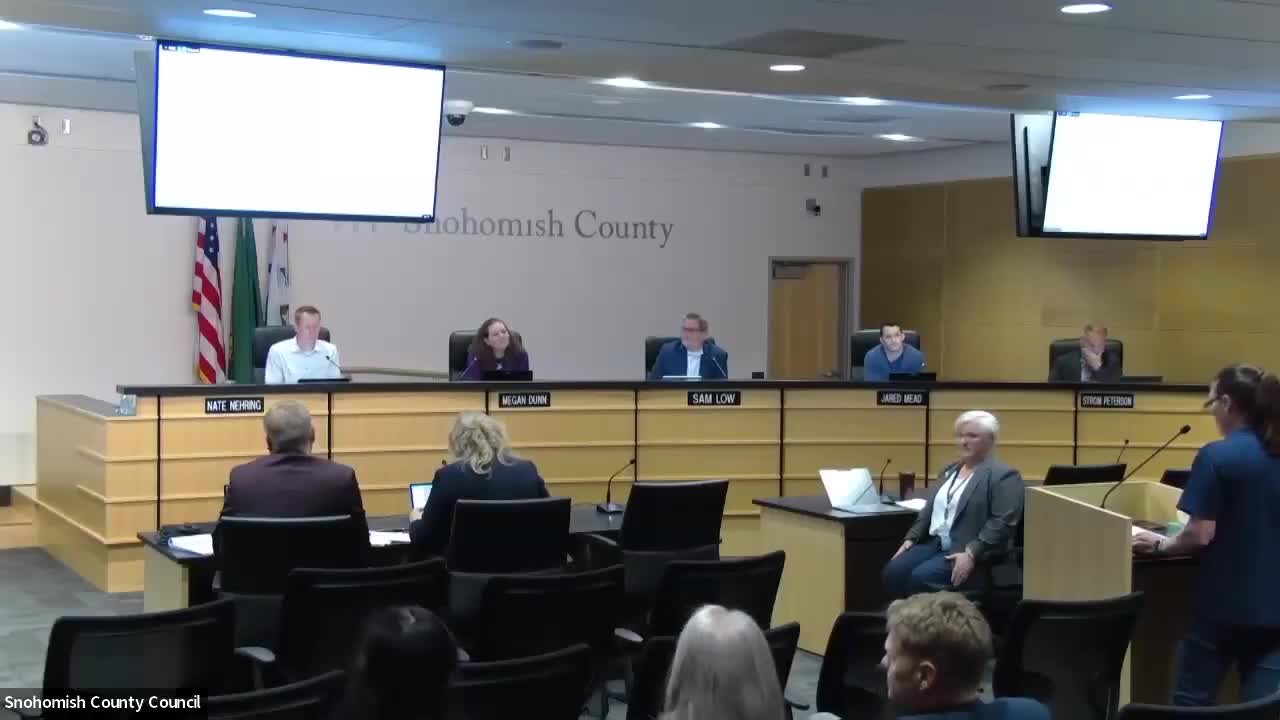
A member of the public who identified themselves as a sanitation worker urged the committee to approve the increases, saying higher fees are an investment in maintaining reliable service and preventing staff shortages. "Approving this fee increase is an investment to maintaining reliable services, preventing staff shortages, and ensuring our waste system continues to serve all the residents effectively and responsibly," the speaker said.
Council members asked about comparisons with neighboring counties, the history of Snohomish County’s rate changes, and the mechanics of the rate model. Councilmember Mead said she supported an automatic inflator to avoid future large, single increases and expressed concern about the perception of a large “catch up” increase after many years without adjustments. Staff said part of the proposal moves solid-waste elements into ordinance language (rather than motion) so an annual inflator would be automatic and avoid long gaps between adjustments.
Deb Evison Bell, council staff, summarized the legislative vehicles: proposed ordinance 25-027 would create the separate waste-export service fee schedule effective Jan. 1, 2026 and proposed motion 25-207 would adopt related fee updates; the motion also would hold the illegal-dumping fee at $50 per ton rather than increasing it to $52 as previously authorized. Evison Bell told the committee the ordinance and motion were scheduled to be moved to Governmental Linear Schedule (GLS) and set for public hearing on May 28, with the staff recommendation that council consider both items at that hearing.
Next steps: staff will return with the ordinance and motion for the council’s consideration, file the adopted schedule with the UTC for review, and conduct outreach to customers and municipalities during the UTC approval period. The committee moved the ordinance and the motion forward for further action and public hearing.