Get Full Government Meeting Transcripts, Videos, & Alerts Forever!
Get email alerts on the State Legislation topic
No spam. Unsubscribe anytime.
Snohomish County lobbying team briefs council on 2025 state bills, budget pressures
Summary
County lobbying staff updated the Snohomish County Council on priority bills and budget risks for behavioral health, transportation, public safety and several county-favored projects; lawmakers’ work is focused on the budget with roughly 60 days left in the session, staff said.
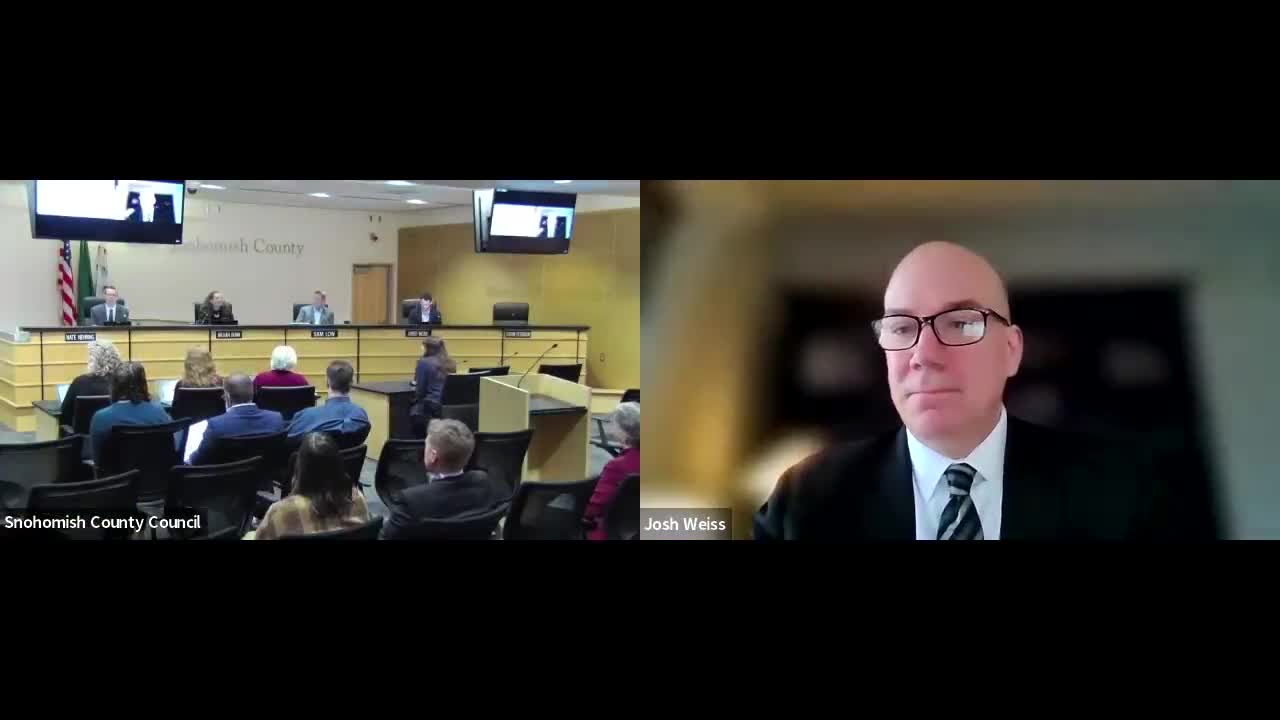
Snohomish County lobbying staff gave the County Council a detailed briefing Feb. 26 on state-level legislation and the budget outlook for 2025, emphasizing behavioral health funding and several bills the county is tracking.
Erin Jajic, one of the county’s behavioral health lobbyists, told the council that “this year in the behavioral health space, it's gonna be about the budget in the end,” and that the county is urging legislators to avoid reductions to behavioral health programs because the local system is already “struggling and strapped.” Jajic said the county welcomed the relatively small reductions in a governor-released budget book but is monitoring forthcoming proposals from Gov. Jay Inslee and Gov. Jay Inslee's successor discussions; she also described local work to secure crisis funding for facilities that cannot open due to staffing and provider shortages, citing the Lynnwood facility as an example.
Josh Wiese, part of the county’s state lobbying team, told council members the Legislature has about 60 days left in the session and described several bills and budget items Snohomish County is tracking, including:
- “18 13,” a bill the county supports that would route more crisis funding directly to communities through behavioral health administrative service organizations (BHSOs), work the county is coordinating on with North Sound BHSO; - “12 18,” legislation tied to a state settlement about competency restoration and involuntary treatment that contemplates new diversion programs and county penalties, which the county said it has concerns about because of contemplated fines for counties; - House Bill 12 61 (open space legislation), which had moved out of finance committee and, per county staff, looked likely to advance; - House Bill 15 92 (indigent defense vehicle) and other large fiscal items the lobbyists said were still contingent on the overall state revenue picture; and - transportation funding discussions, including briefings on the transportation budget and debate about possible road usage charges.
Wiese also described county priorities and budget asks that were submitted for inclusion in state budget requests, noting projects such as the Snohomish River Trail and other transportation items. He flagged a suite of bills that raised concerns for counties—examples he cited included bills that would shift local developmental disability funding to the state and a proposed requirement affecting fire districts—and identified several proposals the county supports, including REIT harmonization (house bill 17 91) and a bill to provide veteran service officer funding capacity (house bill 11 02).
Why it matters: Council members and county staff said the legislative and budget choices this session could affect funding for local behavioral health services, crisis facilities, transportation projects and county revenue options. Lobbyists repeated that many outcomes will turn on the state’s revenue package and the March 18 revenue forecast.
Council members asked questions and flagged additional bills to monitor, including house bill 19 46 (which one council member said would add tribal membership to county boards of health). The lobbying team told council members it will continue meetings in Olympia next week and work on policy and budget issues raised during the briefing.