Get Full Government Meeting Transcripts, Videos, & Alerts Forever!
Get email alerts on the Education Finance topic
No spam. Unsubscribe anytime.
Orange County Public Schools board adopts amended FY25-26 budget to raise pay, reassign staff and add classroom space
Summary
The Orange County Public Schools Board approved amendments to its FY25-26 budget that increase employee pay, reassign a first-grade teacher to Locust Grove Primary, fund classroom reconfiguration there, and incorporate a one-year security officer grant; the board approved the changes by voice vote.
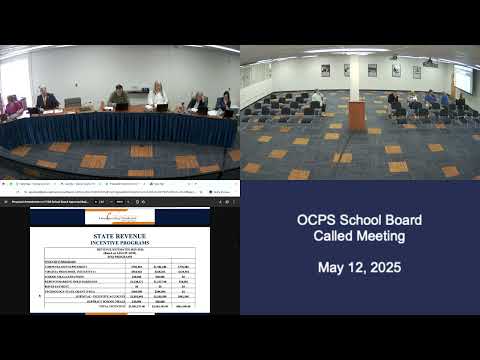
The Orange County Public Schools Board approved amended fiscal year 2025–26 operating and ancillary budgets after a presentation and discussion of staffing, pay scales and capital reconfiguration needs. The board adopted the amendment by voice vote at the meeting; the motion passed.
The amendments, presented by Doctor Hornick (presenter), include a proposed change to the teacher pay scale intended to reduce the district’s gap to the market median, a 3% across‑the‑board pay increase for most employees, hourly raises for custodial and building‑secretary starting pay, reassigning an existing first‑grade teacher slot from Orange Elementary School to Locust Grove Primary School, an additional $350,000 for reconfiguring classroom space at Locust Grove, and the incorporation of a grant‑funded school security officer (SSO) into staffing plans.
Why it matters: Personnel make up most of the district’s budget, and the board said the package prioritizes improving teacher and support‑staff pay while keeping the budget balanced. Doctor Hornick told the board the adjustments are intended to “chip away” at the district’s teacher pay gap and that the amendments reflect a smaller revenue award than the division initially sought.
Key details
Doctor Hornick said the district will move an existing first‑grade teacher position from Orange Elementary School to Locust Grove Primary School and described that relocation as necessary: “we do absolutely have to have this position,” he said, adding that the primary school also needs a counselor, special educators and an English‑learner instructor. He said the transfer is not an additional net position in the budget, but is “in addition to the staffing the primary school is absolutely essential.”
On pay and benefits, the district included a 3% raise for the majority of employees and absorbed an anticipated 15% increase in health insurance (and a 5% dental increase) in the amended operating budget. The presentation raised custodial starting pay to $15.00 per hour and moved building‑secretary starting pay to $15.25 per hour; the presenter said those changes average about a 4% raise for custodial staff and about a 3.87% increase across the building‑secretary scale. The district will also move most registrars to 12‑month contracts, except the high‑school registrar who already has one.
The board reviewed a revised teacher pay scale that the presenter said narrows the division’s gap to the median pay in neighboring divisions: the presenter said the new scale delivers larger percentage increases at higher steps (reaching the “high fives touching 6%” at some steps) and, if neighboring divisions award straight 3% increases, would get all steps within about $1,800 of the market median compared with current steps that exceed the median by $3,000–$4,000 in some cases.
Positions added and cut
The presenter listed positions omitted from the revised budget to make the numbers work: three proposed high‑school positions (a reading specialist, a TV/media broadcasting teacher and a criminal‑justice teacher), two English‑learner positions (the division originally hoped for four and is funding three), one additional bus driver (originally four, reduced to three), and certain other proposed roles. The district also reintroduced a school security officer position at the high school and staffing at both middle schools after learning a grant application had been approved; the presenter said the grant will cover salary and benefits for one of the two middle‑school SSO positions.
Capital and other funds
The board approved adding $350,000 in one‑time funds, above the district’s historically annual contribution of $778,666, to begin reconfiguring classroom space at Locust Grove Elementary and Locust Grove Primary. The presenter described that work as interior reconfiguration—removing old lab fixtures, relocating prep rooms and moving interior walls to convert two existing rooms into three classrooms—and said the project likely will cost at least $100,000; the presenter said the project specialist was seeking contractor quotes and the board would see a formal request for approval once quotes are in hand.
The amended budget also accounts for state revenue changes (an SOQ increase Doctor Hornick identified as about $1.3 million), federal revenue changes (a stated increase of $13,105), local transfers (including the county transfer and bus lease proceeds), textbook and technology fund transfers, and categorical and lottery‑funded programs. Food‑service staff were included in the 3% raise and the food‑service budget was presented as balanced.
Board questions and next steps
Board member Miss Harrington asked whether positions originally proposed but not included in the amended budget could be restored in future years; Doctor Hornick replied that mandatory staffing such as special education positions remain and that the district is prioritizing positions it “cannot live without.” Harrington also asked the presenter to clarify why the adopted salary schedule was modified; Doctor Hornick said the original funding request was reduced, so the district had to find personnel savings, and described the change as a phased approach to narrowing the pay gap over multiple years.
Board member Jack Birkett praised the staff and moved to adopt the amended budget. “We’re not done. We are gonna keep continue to chip away to get to the median of the market,” Birkett said before moving adoption. The board approved the amendment by voice vote; the chair stated “Motion passes.” Doctor Hornick asked the board to approve the amendment at the meeting so staff could begin issuing contracts the next day or by the following Wednesday.
Discussion versus action
Discussion: The meeting included deliberation about which positions to fund, the trade‑offs between one‑time purchases and recurring salary increases, and uncertainty about final health‑insurance increases and future grant renewals.
Direction/assignment: The board approved bringing the amended budget forward and the presenter said staff would prepare contracts for issuance within days.
Formal action: The board adopted the FY25‑26 amended budget by voice vote.
What remains uncertain
Health‑insurance rates remain a variable: the presenter said final rates likely would be known within one to two months and that any difference between assumed and actual insurance costs would remain available to the district and could be applied to one‑time purchases or future salary decisions (subject to the board’s decisions). The SSO grant was described as renewable by application but not guaranteed; the presenter said if the grant does not recur the district would need to add the position’s salary and benefits into the operating budget.
—End—