Get Full Government Meeting Transcripts, Videos, & Alerts Forever!
Get email alerts on the School Meals topic
No spam. Unsubscribe anytime.
Board hears warning that free-meal program may be unsustainable without new funding
Summary
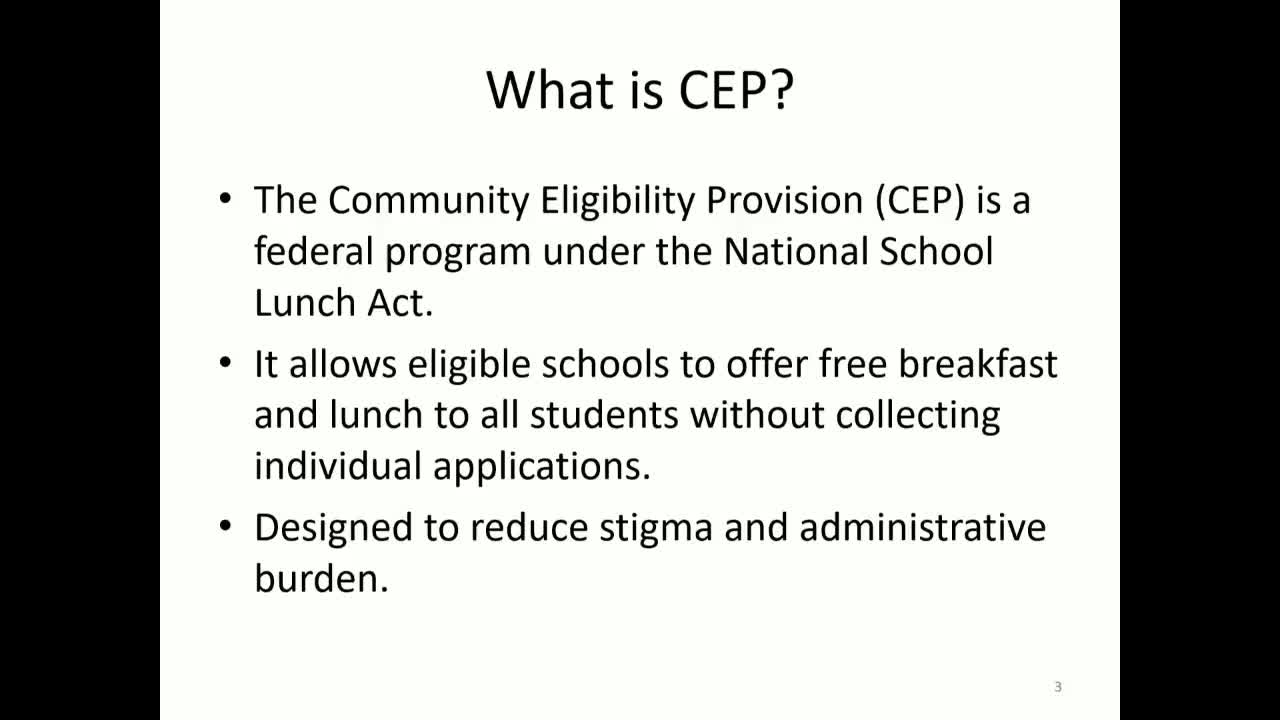
School nutrition staff told the Gloucester County School Board that participating in the Community Eligibility Provision (CEP) covers many students but leaves a structural funding gap: federal reimbursements do not match actual meal costs, and the district may exhaust its food service fund balance without new revenues or changes to the program.
School nutrition and finance staff told the Gloucester County School Board on May 13 that the district’s participation in the federal Community Eligibility Provision (CEP) is increasing meal access but creating a structural shortfall that could exhaust school‑food reserves.
Nutrition directors said Gloucester’s identified student percentage (ISP) is 40.7%, which the district multiplies by 1.6 under federal rules to calculate meal reimbursement tiers. That math, officials said, yields about 65.12% of meals reimbursed at the federal free rate ($4.43) and the remainder reimbursed at 42¢, producing a blended federal reimbursement of about $2.97 per meal. Finance and food‑service staff told the board that the district currently spends roughly $4.41 per meal, creating a funding gap that has been covered in recent years by a food‑service fund balance that grew during COVID‑era full reimbursement.
“Free is not free,” R. Hartley, who presented nutrition data, told the board, summarizing the shortfall and warning that continued CEP participation at current ISP levels requires local subsidy. Hartley and colleagues estimated the division needs on the order of $600,000 a year to continue CEP at recent participation levels without changes.
Board members pressed staff on options: returning to a paid model with applications for free and reduced-price meals, tightening costs and pursuing operational efficiencies. Staff said moving off CEP would require a public outreach effort to collect applications and that unpaid meal charges would likely reappear if a paid model returned. Officials also said some federal and state grants that previously aided food service were uncertain in the next budget cycle.
The board did not take a final vote on CEP participation on May 13. Members asked staff to provide an updated, month‑end fund balance projection and to model the financial impact of returning to a paid system ahead of the next budget cycle.
Why it matters: CEP improves access and eliminates unpaid‑meal balances, but at Gloucester’s ISP and current meal costs staff said CEP produces a structural deficit that must be covered with local funds or program changes.
What to watch: Staff will deliver updated fund‑balance projections and options — including a phased return to paid meals, operational efficiencies, or requests to county supervisors for supplemental funding — at upcoming meetings.