Get Full Government Meeting Transcripts, Videos, & Alerts Forever!
Get email alerts on the Education Workforce topic
No spam. Unsubscribe anytime.
Dubuque students present City Life work-based learning to council; program leaders flag funding shifts and capacity
Summary
Students in the Iowa Jobs for America's Graduates (IJAG) City Life program described hands-on visits to city departments and urged expanded internships; IJAG staff told the City Council the program is growing but faces changing funding mixes and classroom-capacity limits.
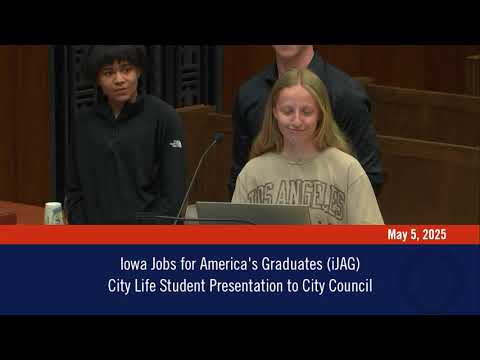
DUBUQUE, Iowa — Students in the Iowa Jobs for America’s Graduates (IJAG) City Life program presented their work-based learning experiences to the Dubuque City Council at a special session on May 5, 2025, describing visits to city departments and suggesting more sustained internship and recreation opportunities for youth.
City staff and IJAG leaders told the council the City Life program gives high school and middle school students exposure to municipal careers and employers, provides follow-up support after graduation, and runs twice a year in Dubuque schools. Tom Oparia, community engagement coordinator with the Office of Shared Prosperity and Neighborhood Support, told the council City Life lets students “get exposure to the various careers that are offered out there” within city departments and to learn what to look for when seeking employment.
The presentation combined short video highlights and student remarks. Students described tours and hands-on demonstrations in the fire, police, public works, parks and recreation, transit and leisure services departments; several students said the visits changed or clarified their career interests. Shayla, a Hempstead High School senior, said the visits deepened her appreciation for local police work and noted changes in technology and training she had not known about. Tanner Mueller, a Hempstead junior, said his group discussed a desire for a city recreation center and more youth-focused mindful-hike programming to support mental health. Jay Bermudez, a junior, described interview skills training and said students want longer internships and resume-building opportunities.
Why it matters: IJAG links classroom learning to employers and community resources at a time when Iowa schools are moving to expand work-based learning requirements. Casey Smith, IJAG program manager, told the council the statewide framework the program supports is rolling into fuller effect next school year, and IJAG is aligning its employer partnerships and student activities to meet that expectation.
Program size and structure: IJAG staff said local capacity is classroom-driven. At the high school level, IJAG can enroll about 60 students in grades 11–12 and 60 students in grades 9–10 at each high school; middle schools serve roughly 45–60 students each; the Alta Vista campus serves about 35 students. Smith said the program also provides post‑graduation support for roughly a year after students finish their senior year, with monthly check-ins to assist with career placement or community resources.
Funding and risks: Council members asked about funding. Smith said IJAG is affiliated with a national organization but the program’s operating dollars in Iowa are provided at the state level with additional support from employer partners and participating school districts. She said the local funding mix has shifted over time: “Years ago we were about 75% government money and 25% (other); now it’s about fifty‑fifty,” and that program leaders are working to diversify long‑term partners to reduce year‑to‑year funding risk. No specific future federal or state grant awards were cited at the meeting.
Competitions and student outcomes: IJAG staff described competitive learning opportunities. Staff said students from the Alta Vista campus won a state-level project-based learning competition and traveled to Indianapolis for a national leadership conference; staff noted some students had never flown before that trip. The program will bring about 15 students to Des Moines for upcoming state competitions.
Council response and next steps: Mayor Cavanaugh and council members thanked students and staff and said they had taken notes on ideas raised, including requests for internships and a recreation center. The council did not take any formal action or vote during the session; public comment was not accepted for the special meeting. Council members encouraged students to continue bringing ideas to city staff and to use the city website to contact councilmembers.
Discussion versus decision: The session was a presentation and discussion meant to inform council members and staff; there were no motions, votes or formal policy changes recorded. Council direction was informal: praise for the program, requests to consider student suggestions, and notation of possible follow-up by staff.
Meeting context: The council described City Life as an established partnership between the City of Dubuque and IJAG serving multiple schools in the district. Presenters and students emphasized hands-on exposure, state-aligned work-based learning goals, and a desire for longer internships and employer connections.