Get Full Government Meeting Transcripts, Videos, & Alerts Forever!
Get email alerts on the Community Impact topic
No spam. Unsubscribe anytime.
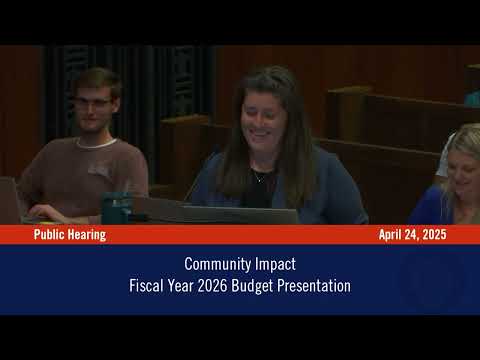
Dubuque council hears details of new Office of Community Impact, including AmeriCorps, volunteer and fine-and-fee pilot programs
Summary
City staff described the Office of Community Impact’s first-year work and budget request for FY 2026, highlighting an AmeriCorps program, a volunteer-matching platform and a pilot Community Impact Service Program that lets residents perform service hours to reduce city utility fines and fees.
DUBUQUE, Iowa — City staff described the Office of Community Impact’s FY 2026 budget and first-year results Thursday, telling the Dubuque City Council the new department has launched an AmeriCorps program, a volunteer-matching platform and a pilot program that helps residents reduce city utility fines and fees through approved service.
The presentation outlined three main program areas: AmeriCorps members who deliver social-emotional programming and other youth supports; Volunteer DBQ, a city–United Way platform to match volunteers with nonprofits; and the Community Impact Service Program, a pilot that converts unpaid municipal fines and utility fees into verified service hours.
Why it matters: Council members emphasized that the programs address basic needs, boost volunteer capacity for nonprofits and reduce financial instability that can lead to larger problems. Staff said the pilot program and volunteer investments are meant to be preventive and to expand the city’s capacity to serve residents who face short-term financial crises.
Antonio, who introduced the department and its mission, framed the work as “data driven, outcome focused” and said the department is built on a collective-impact model that ties AmeriCorps, community volunteering and diversion services together. Sarah Burna, who presented AmeriCorps performance data, said, “AmeriCorps members serve boots on the ground every day,” and pointed to pre/post assessments showing improvements on several social-emotional competencies after AmeriCorps interventions.
Staff displayed financial and program metrics for the AmeriCorps program: local partner investment reported at $177,000 last program year leveraged federal resources and produced an estimated community impact valued at roughly $679,000 when hours and professional development are included. Program-year-to-date local investment was $81,000 with roughly $200,000 of leveraged hours and services reported so far; staff said the numbers will rise as the summer portion of the program begins.
On volunteer management, Britney (Bridal/“Britney”) Hayes, community service and outreach coordinator, highlighted Volunteer DBQ’s growth: more than 5,500 registered users and 175 organizations on the platform, with 8,098 total community service hours submitted across several coordinated events last year. Hayes said the site also helped organizers record a spike in submitted hours when a local tax-assistance program reported volunteer time.
The Community Impact Service Program — described by Miranda Nolfre, community diversion prevention coordinator — is a pilot focused on City of Dubuque utility-billing accounts. Miranda said the program launched in January and, as of April, had received 50 applications, approved 35 households for participation, had 17 active households and 10 program completions. The city converts a household’s outstanding balance into service-hours using a standard hourly valuation ($28.88 per service hour), requires participants to perform a minimum of two service hours per week while enrolled, and connects residents to wraparound services such as financial coaching, discount utility billing and other city programs.
A resident who used the pilot, Kainde Tariq, told the council he had been connected to grief counseling and other supports while enrolled after a family tragedy led to missed bills: “They introduced me to so many different opportunities and, like, grief counseling and mental health counseling,” Tariq said during public comment.
Council members praised the department’s approach. Councilmember Rochelle called volunteering “an investment in your community and in yourself,” and Councilmember Farber said the “ripple effect” of stabilizing one household can have broad benefits for employment, childcare and neighborhood safety. Several members asked about scaling the pilot and whether similar programs exist elsewhere; Miranda said the team researched other communities and believes Dubuque’s proactive service-for-fines model is uncommon.
What’s next: Staff asked the council to consider modest FY 2026 funding for program expansion and administrative support — items that program leads said would help increase reach, support AmeriCorps member retention and add an administrative assistant to manage intake and operations. Miranda and program staff said they plan to scale outreach into Census Tract 5 and other areas with high delinquencies and to continue evaluating the pilot’s outcomes, including referrals to the discount utility billing program.
The council opened a public hearing on the Office of Community Impact budget during the same meeting; the city did not make a formal funding decision at the session, and no votes on the budget were recorded in the transcript. Council members asked staff to return with follow-up information on metrics and expansion plans.
Evidence of presentation and public comment for this topic appears in the meeting transcript beginning with the Office of Community Impact handoff to staff and ending after the public hearing and council discussion of the Office’s budget.