Get Full Government Meeting Transcripts, Videos, & Alerts Forever!
Get email alerts on the Information Technology topic
No spam. Unsubscribe anytime.
Dubuque council hears IT budget with $1.8M data center move and Copilot pilot
Summary
City IT leaders outlined a fiscal 2026 budget request and described a new Tier‑3-ish data center, broadband partnerships and a Microsoft Copilot pilot. Net property tax support for IT is roughly $2.0 million; the department is also seeking recurring funding for 100 Copilot licenses.
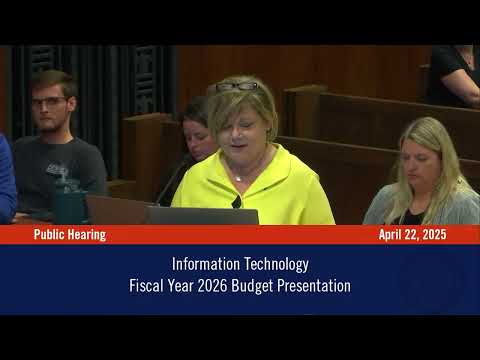
Chris Coleman, special projects manager in the Dubuque information technology department, told the City Council on April 22 that the department plans to move operations into a new Chavenau data center and is requesting continued property tax support as part of its fiscal‑year 2026 request.
Coleman and Joe Pragler, interim chief information officer and chief security officer, described the data center as a roughly 1,000‑square‑foot, Tier‑3‑class installation built with redundancy for cooling, power and monitoring; the IT team reported the combined cost for the data center build and office redesign at about $1.8 million. Coleman said the project was paid for with a combination of CIP savings, available ARPA funds and other department savings. The department’s FY26 net property tax support request is “slightly over $2,000,000,” and IT’s share of the average homeowner property‑tax cost was given as about $32.14.
The presentation emphasized ongoing broadband partnerships and cybersecurity work. Coleman said the city used ARPA funds for fiber extensions and has master services agreements with multiple Internet providers; he noted iMon’s recent fiber investment in the city (described by staff as about $35.1 million) and said that partnership helped close gaps in city coverage. Pragler described cybersecurity measures including weekly vulnerability scans provided through Department of Homeland Security resources, monthly phishing tests, staff training, and FirstNet deployment for public‑safety devices.
Pragler also outlined software and operations priorities for FY26: continued rollout of the Central Square public safety replacement, increased use of Laserfiche forms, asset tagging and software audits to find license savings, and the planned Copilot implementation. The department’s FY26 request includes funding to support up to 100 Microsoft Copilot licenses (staff noted about $36,000 in recurring cost) and other items such as a compact rapid deployable (CRD) FirstNet cellular/Internet system with recurring and non‑recurring costs noted during the presentation. Coleman described the new data center as a “quantum leap” from the previous basement facility and said the city expects to be able to offer colocation capacity to other public sector partners.
Council members asked about Copilot reliability, security and training; Pragler described a pilot with about 15 users underway, said the city will limit Copilot’s access to external sources for local deployments, and noted training partnerships (GetControl and Microsoft resources) to help staff use the tools. Council members also asked whether the 100 licenses would be phased in; Pragler said the “up to 100” budget request reflects a phased rollout driven by ready users, with administrative assistants and other frontline staff expected to be early adopters.
Coleman and Pragler responded to questions about the data center’s redundancy, describing an initial 16‑rack deployment, planned capacity of 100 kilowatts expandable to 175 kilowatts, an on‑site generator, CO2 fire suppression and multiple fiber feeds. The presenters said phase‑2 funding would add further generator and alternate electrical feeds.
The city held a public hearing on the IT budget; no public commenters spoke on this item during the session.
No formal council vote or ordinance was recorded on the IT presentation during the special session; the meeting item was a public hearing and budget presentation.