Get Full Government Meeting Transcripts, Videos, & Alerts Forever!
Get email alerts on the Community Survey topic
No spam. Unsubscribe anytime.
City of Clayton consultant presents 2025 citizen survey; finds high overall satisfaction, flags streets and sidewalks as top priorities
Summary
City of Clayton officials heard a presentation of the 2025 citizen survey on May 13 from Ryan of ETC Institute, who said the firm completed 403 surveys and found Clayton’s residents report high overall satisfaction but identified maintenance of streets, sidewalks and perceived value for taxes as the primary improvement opportunities.
City of Clayton officials heard a presentation of the 2025 citizen survey on May 13 from Ryan of ETC Institute, who said the firm completed 403 surveys and found Clayton’s residents report high overall satisfaction but identified maintenance of streets, sidewalks and perceived value for taxes as the primary improvement opportunities. "We conducted and completed 403 surveys to give us a margin of error just below 5% at about 4.7% at the 95% level of confidence," Ryan told the board.
The survey matters because it is used by city staff and elected officials to prioritize capital projects and communications. Ryan said Clayton’s results remain “extremely positive” compared with regional and national databases, but that recent national trends showing declines in perceived value for taxes and some development-related satisfaction also appear in Clayton. He told the board that, despite the declines, Clayton still rates above Plains-region and U.S. averages on most perception measures.
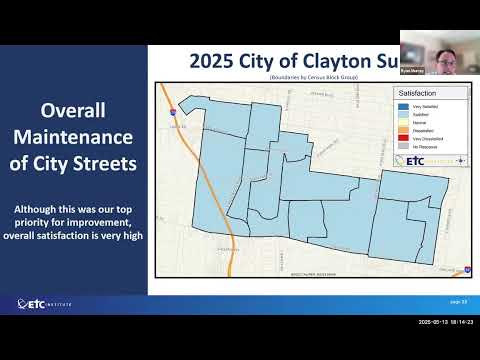
Most important findings and context: Ryan said the random-sample survey was mailed to households and supplemented by email, text and social media follow-ups, and that the results are intended to be statistically valid for decision-making. He highlighted that respondents rated the city highly on overall quality of life and parks maintenance (with maintenance of city parks rated satisfied or very satisfied by 94% of respondents) but identified street repair services and condition of sidewalks as the areas with the highest dissatisfaction and importance ratings. He recommended focusing improvement efforts on items that are both below-average in satisfaction and above-average in importance.
On communications, Ryan said respondents reported that direct mail (the mailed Clayton guide), the city newsletter and the parks and recreation guide are the most-used and most-effective communication channels. He noted that many residents do not subscribe to digital channels and suggested continued use of mailed materials alongside online platforms. "Direct mail from the city of Clayton" was singled out in the presentation as an effective channel.
Board members framed the survey results against ongoing plans and projects. Alderman Fader and others asked how city staff will convert the survey findings into actions; Ryan said staff could use the maps and cross-tabulations to target specific census block groups. City staff and several aldermen noted the city already has capital projects and bond-funded work planned to address some lighting and sidewalk concerns, and staff said spot repairs are handled as needed while larger citywide upgrades are part of a long-term capital program.
Questions about specific items included the apparent 9% drop in perceived effectiveness of fire prevention and safety programs. Ryan and Clayton officials noted much of that drop reflected “don’t know” or neutral responses and that the underlying sentiment toward the fire department remains positive; the fire chief later explained that some community outreach activities (for example, car-seat installations) had been discontinued for operational reasons and that heavier emergency call volumes limit opportunities for some mitigation training.
Ryan offered follow-up analysis on request: cross-tabulations by age and household type, and comparisons with benchmark communities selected by population and median household income. The consultant said he would provide staff those cross-tabs and alternative benchmark sets for review.
The board did not take formal action on the presentation itself; aldermen directed staff to review the survey cross-tabs and consider where to apply the findings in capital and communications planning.
Looking ahead, Ryan recommended the city consider shortening the mailed survey or running a shorter periodic pulse survey to gather targeted information without diluting the random-sample benchmarking that makes the current survey comparable year to year.
The survey presentation and the board’s questions underscore that Clayton retains high resident satisfaction overall but faces recurring maintenance and communications challenges that the city’s capital program and targeted messaging are expected to address.