Get Full Government Meeting Transcripts, Videos, & Alerts Forever!
Get email alerts on the Opioid Settlement Allocation topic
No spam. Unsubscribe anytime.
Sheriff’s office urges including law‑enforcement response in Clallam County opioid‑settlement planning
Summary
Clallam County law‑enforcement representatives asked the Behavioral Health Advisory Board to include a field‑response/law‑enforcement component in the county’s inventory of opioid‑settlement allowable uses, and county staff asked stakeholders to add service listings and gaps to a live document ahead of a June 17 Department of Health meeting.
Law‑enforcement and county public‑health partners debated how Clallam County should inventory services and identify gaps for proposed uses of opioid‑settlement funds during a Behavioral Health Advisory Board joint discussion on May 13.
Why it matters: The county is compiling a list of existing programs and gaps to guide recommendations about how to spend opioid‑settlement dollars; law‑enforcement speakers argued that state guidance allows uses addressing criminal‑justice‑involved people and local first‑responder wellness and that those uses should be included in local planning.
Amy (introduced during the meeting as the commander of a regional narcotics enforcement team) told the board her unit lost dedicated state provisional funding that had covered a records specialist and related task‑force functions, and she urged the advisory board to include a law‑enforcement field‑response component in the county’s planning for opioid‑settlement funds. “If you don't think that our cops and first responders are affected by going to Narcan overdoses and overdose reversals and deaths, then that's wild,” Amy said, arguing for funding to support a dedicated behavioral‑health response deputy who could work alongside co‑response teams and help sustain drug court and mental‑health court operations.
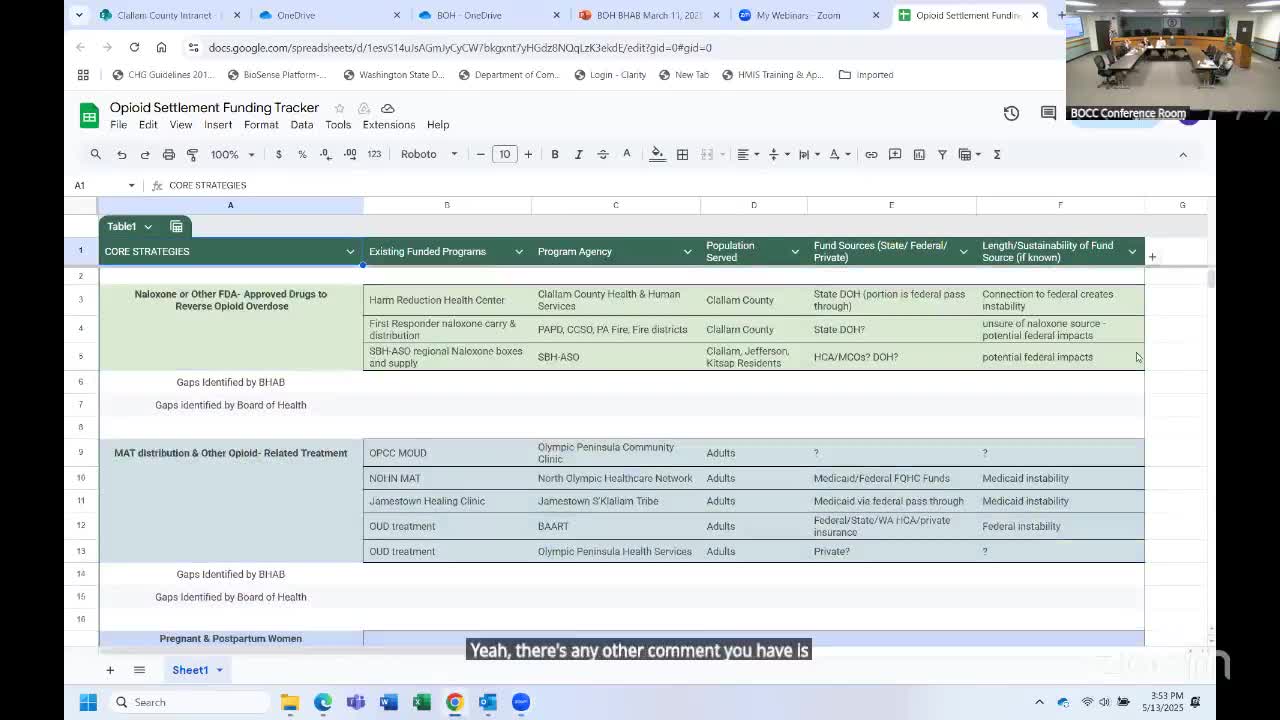
County staff described a draft “core strategies” document intended as a starting point to catalog existing services and identify holes; staff asked advisory‑board members to add programs and note where funding is unstable or gaps remain. Board staff set a near‑term deadline: county staff and Board of Health members will review related materials and convene with the Washington State Department of Health on June 17 to combine findings and identify priority gaps.
Jenny, a county staff member participating remotely, pointed the group to the state document for allowable uses and noted that Section D includes services for criminal‑justice‑involved persons; she urged the board to consult that guidance when classifying possible uses. Several board members and county colleagues cautioned that compiling an exhaustive inventory of all existing programs would be time‑consuming and may duplicate resources already held by partner organizations; Olympic Community of Health staff suggested using OCH’s resource directory as a starting point.
The board agreed on process directions rather than a formal funding decision: staff will circulate a shared document (Google Doc) where providers and board members can add existing programs, funding sources and identified gaps; contributors were asked to mark items they see as gaps. County staff will collect inputs and present consolidated findings at the June 17 meeting with the Department of Health; no formal vote to allocate opioid‑settlement funds occurred at the May 13 meeting.
Board members emphasized several recurring local gaps raised during the discussion, including limited inpatient medical detox capacity, limited specialized services for pregnant and postpartum people with substance‑use disorders, and the impending loss of task‑force funding that had supported narcotics enforcement records work. Several participants said outpatient SUD providers and existing warm‑handoff/recovery services remain essential and should be considered when prioritizing future funding.
Next steps: county staff will share the collaborative document and accept program listings and gap notes from board members and providers ahead of the June 17 Department of Health meeting; the Board of Health and Behavioral Health Advisory Board plan to combine their inventories and present joint recommendations later in June. No motions or votes were taken.