Get Full Government Meeting Transcripts, Videos, & Alerts Forever!
Get email alerts on the Wilburton Vision topic
No spam. Unsubscribe anytime.
Planning Commission holds public hearing on Wilburton Vision land‑use code changes; debate centers on affordable‑housing rules and access corridors
Summary
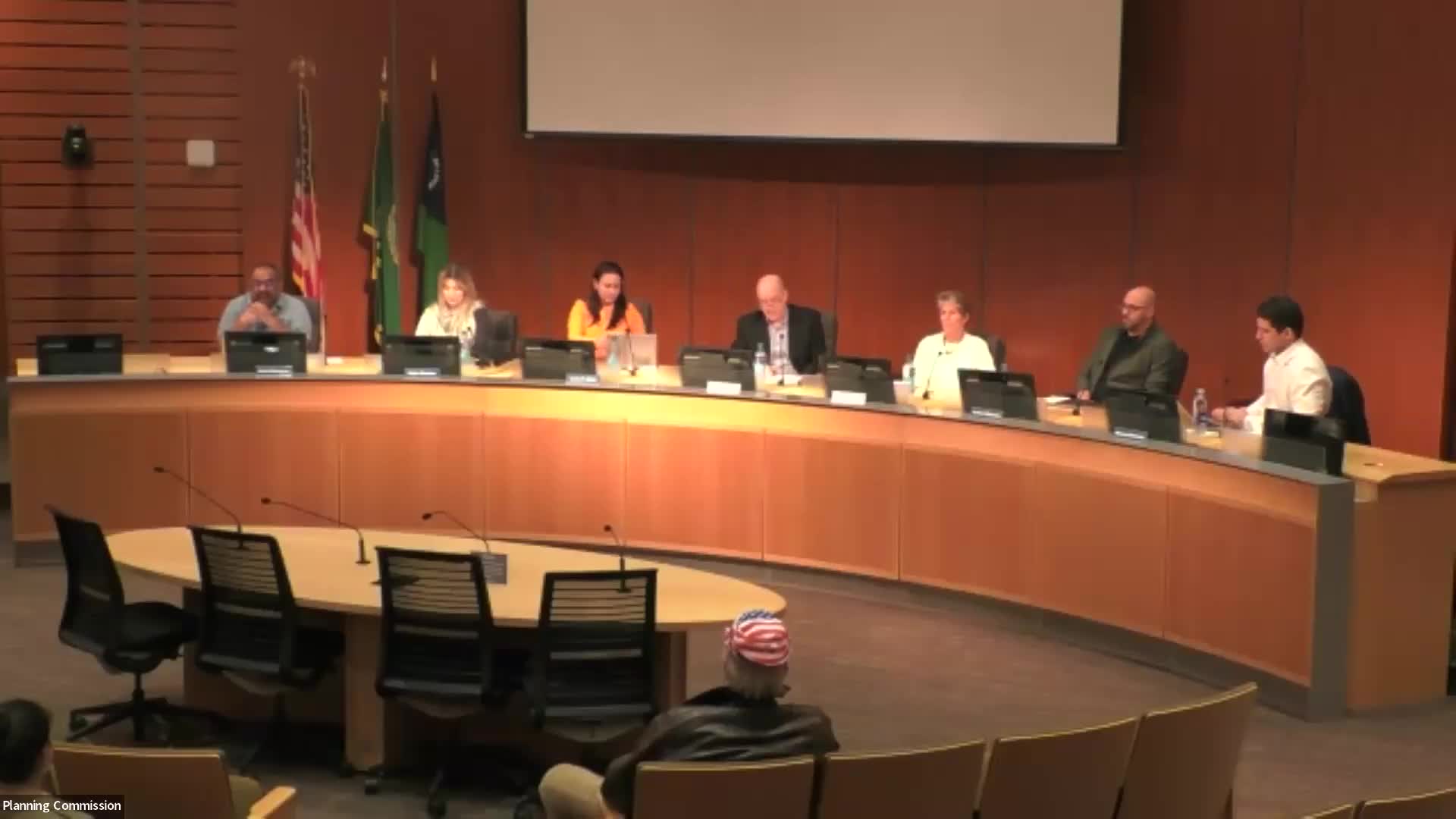
The Bellevue Planning Commission opened a public hearing on Feb. 26 on a land‑use code amendment intended to implement the Wilburton Vision, with staff asking commissioners either to make a recommendation or to schedule a follow‑up meeting for final action.
The Bellevue Planning Commission opened a public hearing on Feb. 26 on a land‑use code amendment intended to implement the Wilburton Vision, with staff asking commissioners either to make a recommendation or to schedule a follow‑up meeting for final action.
The amendment, staff said, would create new land‑use districts aligned with the Wilburton Comprehensive Plan amendment and establish base and maximum height and floor‑area‑ratio (FAR) rules, an amenity incentive system and options for affordable housing. “The direction we are seeking tonight is to have the commission hold the public hearing on the proposed LUCA,” Development Services Assistant Director Nick Whipple told commissioners.
Why it matters: Wilburton is a planned transit‑oriented neighborhood; the LUCA would reshape allowable density, height and public‑realm requirements on roughly 300 acres and is intended to enable housing, jobs and public‑space objectives adopted in the July 2024 comprehensive plan amendment. Public testimony and stakeholder letters focused on whether the code’s affordability approach, parking and the proposed network of “access corridors” will make new development feasible while preserving neighborhood and business needs.
Staff presentation and options Staff said the draft establishes four mixed‑use districts ranging from mid‑rise to high‑rise, tighter block‑size rules to support walkability, a 10% open‑space baseline with options for podium and rooftop plazas, and an amenity incentive system that would be required to exceed base FAR. Two implementation options were presented.
- Option A (staff recommendation): a mandatory affordable‑housing requirement — a 10% set‑aside at 80% area median income (AMI) with lower set‑aside levels for deeper affordability tiers, plus a fee‑in‑lieu option; a higher base FAR under the mandatory approach.
- Option B (alternative): a voluntary, tiered incentive program that lets developers exceed the base FAR in exchange for on‑site public benefits including affordable housing, with a lower base FAR and fee‑in‑lieu/on‑site performance options.
Josh Steiner, senior planner, summarized the staff recommendation: “This is the staff recommendation tonight. This approach supports affordable housing goals by integrating housing and job growth with inclusivity.”
Public testimony: competing priorities More than a dozen speakers addressed the commission during the hearing. Written submissions summarized at the meeting included a multi‑stakeholder letter from the Eastside Housing Roundtable and responses from business and property‑owner groups.
Representatives of the Eastside Housing Roundtable, the Housing Development Consortium and several affordable‑housing developers urged a mandatory requirement calibrated to produce significant on‑site affordable units and said the group had negotiated a compromise string of changes. Patience Malaba, CEO of the Housing Development Consortium and co‑chair of the roundtable, said the group “support[s] the affordability requirement, 10 set aside for the 80% AMI” and urged commissioners to adopt the calibrated option.
Housing providers and nonprofits (for example, Joe Fain of the Bellevue Chamber and housing coalition members, and Sarah Dickmeyer of Plymouth Housing) argued that a mandatory program, combined with a measured fee, would produce both units and revenue to support deeper affordability.
Developers, property owners and the Wilburton Property Owners Group urged caution on mandatory set‑asides and asked for fee levels and other standards that preserve feasibility. Jody Alberts, representing local business stakeholders, told commissioners that replacing dwelling‑units‑per‑acre metrics with FAR is “a very smart step” and urged a pro‑forma study before locking in affordability mandates. Bill Finkbeiner, speaking for the Wilburton Property Owners Group, said the draft still contains requirements that could add cost and slow redevelopment.
Several property‑owners and neighborhood speakers pressed staff and commissioners to reduce or clarify the proposed access‑corridor widths and the open‑space and sidewalk requirements because those dimensions can reduce developable area and increase costs. Opponents also said the amenity/incentive point system needs more options to be feasible for a wider range of sites. Briarwood Center owners asked the commission to re‑examine a proposed local access street requirement that they said could be imposed before a specific project exists.
A few residents urged greater outreach in centers that do not have active neighborhood associations and said some neighborhoods have not been made aware of proposal specifics.
Process, schedule and next steps Staff noted that five draft versions of the Wilburton LUCA were released during engagement and that the latest draft was published Feb. 6. Whipple said staff will return with edits if the commission directs further study; a placeholder was noted for March 26 for a potential recommendation to council.
Formal actions recorded during the meeting - Motion to approve the Feb. 26 agenda: moved (not identified in the public transcript); the motion passed by voice vote. - Motion to open the Wilburton LUCA public hearing: moved (not identified); the commission voted aye and opened the hearing. - Motion to close the public hearing: moved (not identified); motion carried by voice vote. - Motions to extend the meeting (various timing amendments): moved and approved by voice vote. - Motion to adjourn: moved and approved.
What commissioners signaled Commissioners asked staff for more detailed feasibility analysis on fees, clearer comparisons of mandatory versus voluntary approaches, and additional data on how access‑corridor widths, sidewalk dimensions and required on‑site amenities would affect project economics — particularly for small sites and parcels likely to be developed in the near term. Several commissioners said they were sympathetic to the Roundtable’s negotiated language and asked staff to return with cost‑and‑yield comparisons to inform any final recommendation.
Ending The commission recessed the hearing and indicated it will either make a recommendation on the LUCA at a subsequent meeting or carry additional study items forward; staff said it would work with the commission on a schedule for follow‑up. The matter will proceed to the City Council after the commission recommendation.
Speakers quoted in this article are listed in the article’s speaker section and quotations are taken verbatim from the meeting transcript.