Get Full Government Meeting Transcripts, Videos, & Alerts Forever!
Get email alerts on the Middle Housing Luca topic
No spam. Unsubscribe anytime.
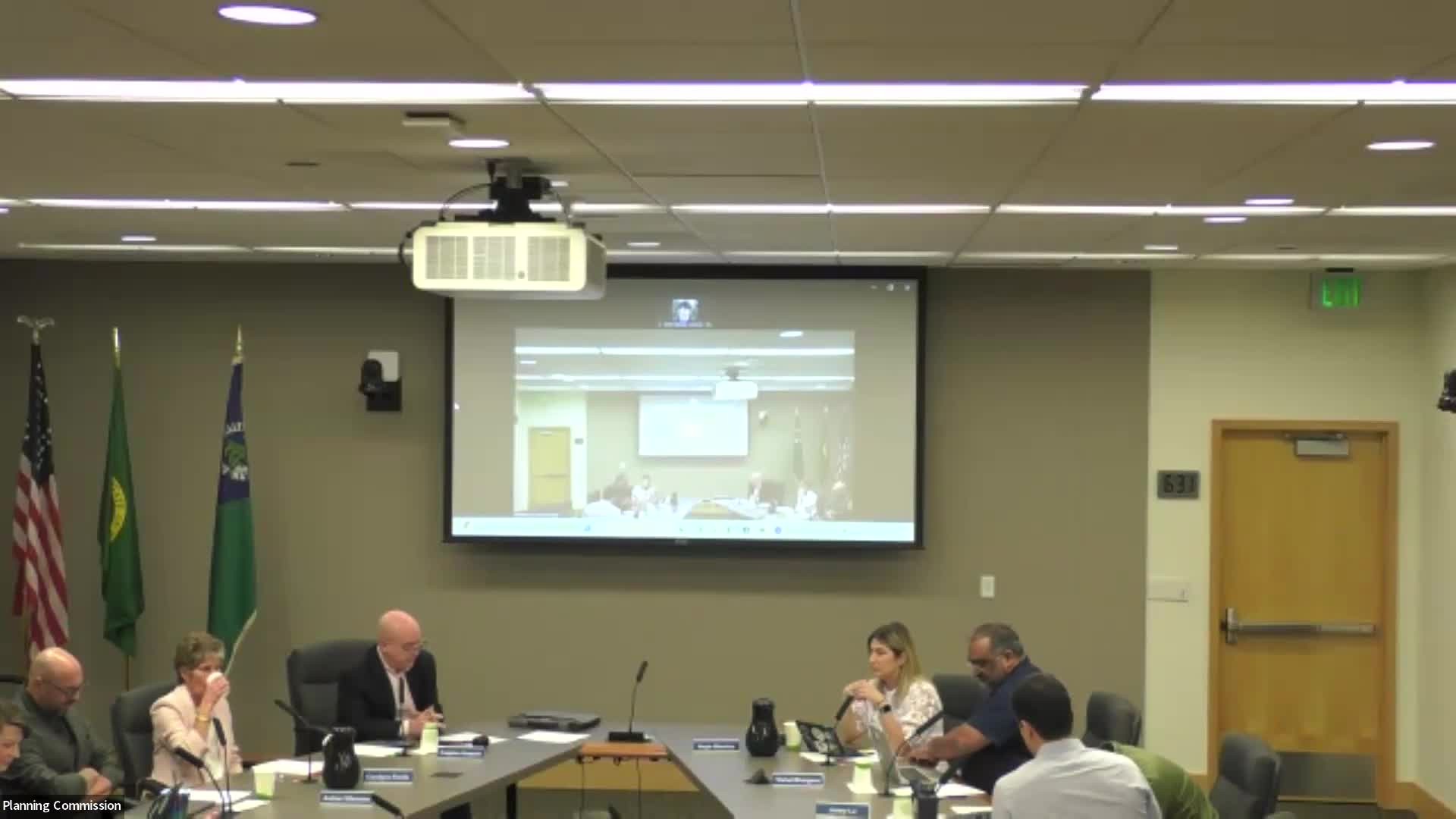
Planning Commission studies middle‑housing code changes as public speakers urge broader options near transit
Summary
The Bellevue Planning Commission held a study session April 23 on proposed middle‑housing land‑use code amendments to implement House Bills 1110 and 1337, heard more than a dozen public speakers urging denser “middle housing” near transit and neighborhood centers, and directed staff to refine code language and maps before sending a recommendation to the City Council.
The Bellevue Planning Commission spent its April 23 meeting on a study session to consider a middle‑housing land‑use code amendment intended to implement Washington state House Bill 1110 and House Bill 1337, with staff outlining options for unit density, parking, floor‑area ratios, accessory dwelling units and a fee‑in‑lieu to support affordable housing.
The LUCA under review would require cities to allow at least four dwelling units per lot and offers paths to allow six units per lot under specified conditions. Nick Whipple, Code and Policy Assistant Director, told the commission staff sought feedback on a package that generally matches the state baseline but proposes several local choices, including allowing six units within a half‑mile walk of major transit stops, additional locations near frequent bus service and neighborhood centers, and options for how accessory dwelling units (ADUs) count toward unit yield.
Why it matters: Commissioners and staff said Bellevue must add housing capacity to keep pace with long‑term growth targets and to support schools, the workforce and neighborhood vitality. Speakers at the meeting — many of them Bellevue residents — urged the commission to exceed the state minimums so more families and workers can live near jobs and transit.
Public comment: The commission allotted 45 minutes for oral communications and heard from more than a dozen speakers. Liz Boggs, a Bellevue resident, said, “Bellevue's growth needs to be managed in a way that fosters a diverse community and allows for those who work here to live here long term, and going beyond the state minimum for middle housing is an important piece in achieving that.” Ariel Davis, also a resident, told commissioners the city should “allow more housing, especially near transit,” and said denser housing near transit will reduce vehicle miles traveled.
Other commenters described personal housing barriers. Ben Mickle, a downtown Bellevue resident, asked the commission to adopt staff recommendations that allow “6 units per lot within a quarter mile of bus stops and within a half mile of major transit stops.” Ed Wang, who said he has lived in Bellevue more than 10 years, warned that declining school enrollment is tied to a lack of housing for families and argued that middle housing could reverse that trend.
Staff presentation and options: Senior Planner Kirsten Mant and Mr. Whipple reviewed elements of the staff proposal and a menu of options for commissioners to consider. Key elements presented included: - A baseline of 4 dwelling units per lot citywide, with 6 units allowed where two units are permanently affordable or if a fee‑in‑lieu is paid; - A staff recommendation to treat ADUs so that detached ADUs would count toward the lot’s unit yield while attached ADUs would not (this was later amended by the commission; see Actions); - A half‑mile walk‑shed around major transit stops (light rail stations and bus rapid transit/rapid ride) for the proposed six‑unit allowance, and separate consideration of a quarter‑mile walk‑shed around frequent bus service; - Floor area ratio (FAR) proposals tailored to typical Bellevue lot sizes, with a 250‑square‑foot garage/store exemption from FAR (the commission later amended that exemption; see Actions); - Cottage and courtyard standards driven by FAR and site design rather than a strict unit count; and - A fee‑in‑lieu option (staff presented $150,000, $100,000 and $75,000 per bonus unit as alternatives) so developers could pay into the city housing trust fund instead of delivering on‑site affordable units.
Commission discussion and staff clarifications: Commissioners pressed staff on implementation risks and constraints, including utility and sewer capacity in some neighborhoods (staff referenced a prior example where sewer extension estimates reached millions of dollars for private extensions), the uncertain effect of restrictive covenants on some parcels, and how walk‑shed calculations and transit service frequency could change over time. Kate Ness, staff liaison, explained the application process would require an applicant to show feasible walking connections, not just a straight‑line distance.
Amendments and interim votes: The commission opened a motion to recommend the LUCA to the City Council and then considered a series of amendments. During the discussion the commission took several formal actions (listed below) to clarify the draft and adjust staff recommendations; some amendments passed, others failed or were tabled. Notable actions recorded in the meeting record included: - An amendment to count detached ADUs toward the lot’s allowed unit yield while treating attached ADUs as not counted (amendment passed); - An amendment to raise the per‑unit garage/store exemption from 250 square feet to 300 square feet for FAR calculations (amendment passed); - Debate and a subsequent motion to limit the six‑unit by‑right allowance for additional density to parcels near the city’s regional and countywide growth centers rather than to all neighborhood centers or all areas served by frequent bus lines (motion carried); - Consideration of fee‑in‑lieu levels ($75,000, $100,000, $150,000 per bonus unit); commissioners debated tradeoffs between maximizing market‑rate production and securing funds for off‑site affordable housing. A motion to set a $75,000 per‑unit fee failed; the transcript does not record a final fee figure adopted by the commission at this meeting.
What was not decided: The full recommendation motion was opened and multiple amendments were adopted or tabled, but the transcript ends during further deliberations (discussion of height and other details) and does not record a final, signed recommendation to City Council. Staff said the intent remains to bring a recommendation to council in May to meet the state deadline for code changes.
Votes at a glance (formal votes recorded in the meeting): - Approve agenda: motion carried, in favor (unanimous) (mover not specified in the transcript). - Election of vice chair: Commissioner Conlu elected vice chair (unanimous). - Motion to extend oral public comment to 45 minutes (3 minutes per speaker): carried. - Motion to extend the meeting to 10:28 p.m.: carried. - Amendment to count detached ADUs toward lot unit yield (attached ADUs not counted): amendment adopted. - Amendment increasing FAR exemption for garage/storage from 250 to 300 sq ft: amendment adopted. - Motion to limit six‑unit by‑right expansion to parcels within regional/countywide growth centers (rather than broad neighborhood center coverage): motion adopted with several commissioners opposed. - Motion to set fee in lieu at $75,000 per bonus unit: failed. (Transcript does not record a final fee amount adopted.)
Commissioners and staff emphasized there will be additional steps before any final council action: staff will refine code language, include more mapping and feasibility checks (for covenants and walkable access), and present a finalized recommendation to the City Council in coming weeks. Nick Whipple and Kirsten Mant said the state deadline of June 30 requires timely action and that the commission’s feedback would be folded into a council package.
Meeting atmosphere and decorum: Public comment was strongly in favor of going beyond the state minimum in many cases. There was one instance of a disruptive speaker (identified in the record as Alex Zimmerman) whose remarks were outside the scope of the commission’s jurisdiction and were cut off; staff noted the conduct violated Ordinance 67‑52 on public comment rules.
Next steps: Staff said they will return a revised LUCA to the Planning Commission and then to City Council, incorporating the commission’s amendments and any additional direction. Commissioners asked staff to include clearer maps of where restrictive covenants may limit redevelopment, to coordinate with utility planning on likely infrastructure needs and costs, and to clarify how walk‑sheds and transit frequency will be verified at the time of application.
Ending note: The commission held a broader pre‑meeting recognition for Commissioner Bhargava (appointed recently to the City Council); the commission and Deputy Mayor Malakouti thanked him for five years of service on the Planning Commission.