Get Full Government Meeting Transcripts, Videos, & Alerts Forever!
Get email alerts on the Middle Housing topic
No spam. Unsubscribe anytime.
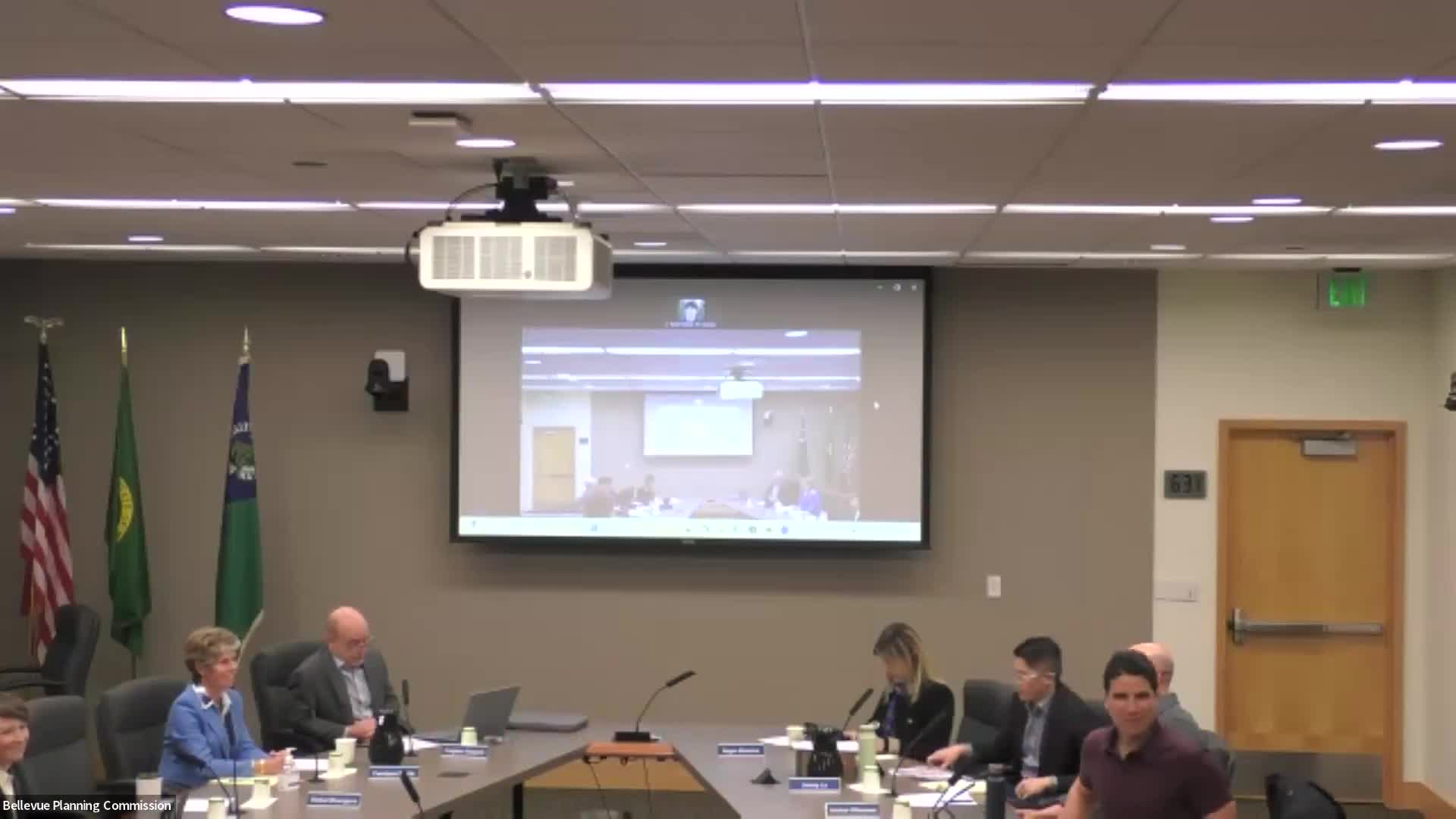
Bellevue Planning Commission holds public hearing on middle-housing LUCA after hours of testimony
Summary
The Planning Commission opened and closed a public hearing April 9 on a proposed land‑use code amendment to implement Washington state House Bills 11‑10 and 13‑37. Staff outlined draft density, parking, FAR and tree‑code changes; more than 30 people testified with mixed views. The commission deferred formal deliberation to a later meeting.
The Bellevue Planning Commission opened a public hearing April 9 on a proposed middle‑housing land‑use code amendment (LUCA) intended to implement Washington state House Bill 11‑10 and House Bill 13‑37 and then closed the hearing after hearing from more than 30 speakers.
The proposal presented by city staff would allow a baseline of four units per lot citywide, increase to six units per lot in specified areas (for example near frequent transit and neighborhood centers), exempt accessory dwelling units from the count required by HB 11‑10, and retain a parking minimum of one space per unit outside major transit stop exemptions. Staff presented a range of voluntary fee‑in‑lieu options for required affordable units (proposed examples: $75,000, $100,000, or $150,000 per unit). "It's great to be here this evening to talk about middle housing and accessory dwelling units," Development Services Assistant Director Nick Whipple told the commission during the presentation.
The commission heard a broad mix of views during the public comment period. Supporters told the commission the city should go “above and beyond” the state baseline to produce more housing and choice. Karen Cass, a Bellevue resident, said the city should "promote a diversity of housing options" and urged allowing six or more units by right near neighborhood centers and frequent transit. Several younger residents and housing advocates argued higher densities near transit are needed to keep working families in the city.
Opponents urged the commission not to exceed the statutory minimums and raised concerns about neighborhood character, parking, infrastructure capacity and tree canopy loss. Heidi Dean, speaking from Newport, said staff should "stick to what those bills require and don't take it further," and said infrastructure such as sidewalks and water mains in some neighborhoods would not support added density. Multiple residents from Newport Hills, Somerset and other neighborhoods described narrow streets, limited sidewalks and existing on‑street parking pressures; they warned that reducing parking minimums would worsen safety and congestion.
Other frequent themes: developers and builder representatives asked for higher FAR or other changes to increase feasibility of projects (the Master Builders Association asked, for example, that denser options extend to a half‑mile around light rail), while some commenters urged stricter protections for view neighborhoods, HOA/CC&Rs and for tree retention. Several speakers urged clearer rules to ensure fee‑in‑lieu money actually produces affordable units and requested that any fee be indexed to construction cost inflation.
Staff summarized technical components of the draft LUCA: a 0.5 FAR baseline with adjustments for lot size and a proposed 38‑foot building height limit for most middle‑housing types; a quarter‑mile or half‑mile buffer approach for transit and neighborhood centers; a 250‑square‑foot garage exemption in FAR calculations; and limited tree‑code adjustments to clarify thresholds and credits. Staff also explained the new state requirement to allow coliving in locations where six units are allowed by right — coliving units count as 0.25 of a dwelling and have specific parking and unit counting rules under state law.
The Planning Commission did not deliberate on or recommend changes to the draft at the meeting. Chair Creighton Gopal (identified in the meeting) said the commission would "digest all of the excellent feedback" and return the item for further discussion at a future meeting.
Votes at a glance - Motion to open the public hearing on the middle‑housing LUCA: moved and approved by voice vote. - Motion to close the public hearing: moved and approved by voice vote. - Motion to extend the meeting time to 10:25 p.m.: moved and approved by voice vote. - Motion to approve the April 9 agenda: moved and approved by voice vote.
Why it matters: House Bills 11‑10 and 13‑37 change how cities must allow certain middle‑housing types and ADUs; Bellevue's final code decisions will affect where higher‑density housing may be built, the scale of new development, and whether the city concentrates growth near transit and centers or applies a broader, citywide approach. The commission's recommendation to City Council — together with Council action and final code language — will determine whether Bellevue adopts the staff proposal as written, modifies the buffers and density rules, adjusts fee‑in‑lieu amounts, or adopts other changes.
Next steps: Staff told the commission the LUCA could be returned for further planning commission review at the April 23 meeting with additional study sessions and eventual City Council consideration ahead of the state deadline. The commission did not take final action April 9 and will deliberate at a future meeting.
(Quotes used above were taken verbatim from the transcript of the April 9, 2025 Planning Commission meeting.)