Get Full Government Meeting Transcripts, Videos, & Alerts Forever!
Get email alerts on the Homa Luca topic
No spam. Unsubscribe anytime.
Planning Commission previews HOMA code changes, debates mandatory set‑aside vs. incentives; asks staff for more analysis and schedules public hearing in fall
Summary
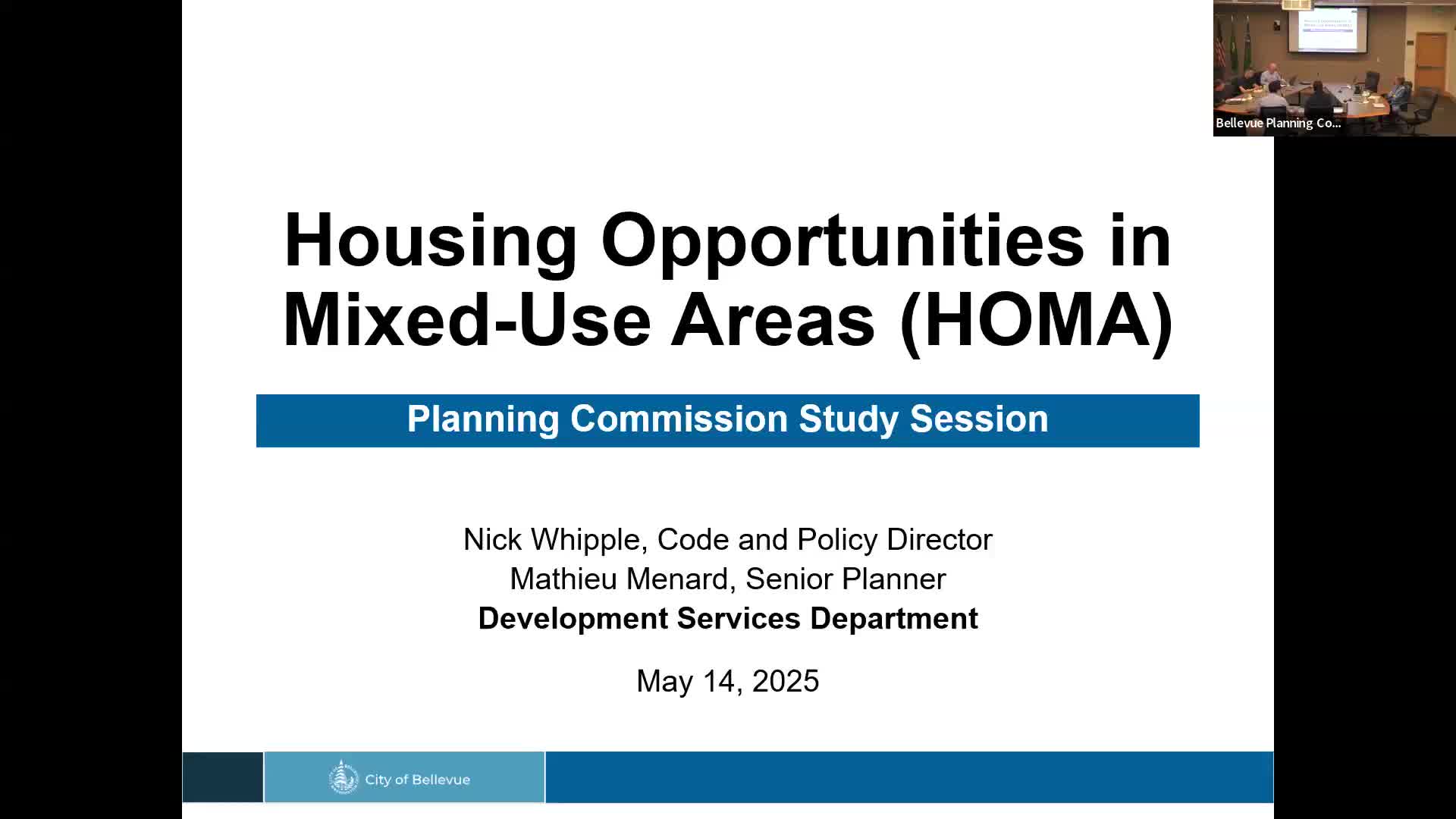
City planners presented a draft of the Housing Opportunities in Mixed‑Use Areas land‑use code amendment (HOMA, also called Houma) and the Planning Commission debated mandatory 10% affordable set‑aside versus incentives; the commission directed staff to return with more analysis and to schedule a public hearing in the fall.
City planners presented a draft of the Housing Opportunities in Mixed‑Use Areas land‑use code amendment (HOMA, also referred to as Houma) to the Bellevue Planning Commission on May 14, and commissioners debated whether to pursue a mandatory affordable‑housing set‑aside or an incentives‑based approach.
Nick Whipple, code and policy assistant director, and Matthew Menard, senior planner, told the commission HOMA would apply to most of Bellevue’s mixed‑use areas (excluding Wilburton, Bel‑Red and recently updated East Main). Staff said the amendment aims to remove zoning impediments to housing, align standards with the adopted comprehensive plan, and create an affordable‑housing program modeled on recent LUCA work.
The staff presentation outlined two options: Option A (mandatory) would require a 10% affordable set‑aside at 80% of area median income (AMI), with FAR and height incentives and a fee‑in‑lieu option; Option B (voluntary) would provide an incentive pathway that increases height and FAR in exchange for affordable housing but sets lower base maximums. Menard explained that the mandatory program uses an FAR exemption approach — “for every square foot of affordable housing you provide, you are exempting four square feet of market rate housing,” — and that staff intend to add affordable housing into downtown’s existing amenity incentive system while preserving perceived downtown “wedding‑cake” setbacks.
Public commenters and developers offered sharply different views. Brady Nordstrom of the Housing Development Consortium and the Eastside Affordable Housing Coalition said Houma "represents the realization of the Bellevue comp plan vision" and urged support for Option A, calling a 10% set‑aside at 80% AMI “well calibrated.”
By contrast, Jesse Clausen urged the commission to favor the incentive approach (Option B). He warned that a flat 10% requirement may violate rough‑proportionality legal tests and argued the mandatory approach could reduce residual land values and delay projects; he urged reliance on the city’s Multifamily Tax Exemption (MFTE) and incentive pathways instead.
Developers raised implementation concerns. Alan Cantlin of Trammell Crow Company said proposed HOMA language would alter existing IOC (incentive) provisions and asked that projects already using IOC be vested under the current code. Shuqi Chu described a downtown project that, under the proposed update, could gain additional affordable units only if reasonable flexibility were granted for height or floor‑plate limits.
Staff addressed fee questions and gave examples to explain how downtown amenity fees are calculated: Menard said a downtown amenity buy‑out was proposed at $52 per square foot for the amenity bonus and presented worked examples showing substantially smaller dollar totals than some public commenters had claimed. He also said the city is working with the city attorney and developers to allow projects previously approved under IOC provisions to vest under the code they used when they invested.
After questions and debate, the commission voted to ask staff to return with additional information and to schedule a public hearing in the fall; the motion carried with recorded opposition from at least two commissioners. Commissioners asked staff to provide additional analyses before a hearing, including: a clearer explanation of how the mandatory and incentive options compare in real‑world pro formas; the effect on in‑flight/downtown projects and vesting; parking and traffic impacts; the nexus/proportionality basis for proposed fees; and targeted outreach to neighborhood groups and affordable‑housing developers.
Ending note: staff will return with refined materials and quantitative examples for another study session before a public hearing later in 2025. No final code changes were adopted at the meeting.