Get Full Government Meeting Transcripts, Videos, & Alerts Forever!
Get email alerts on the Telecommunications topic
No spam. Unsubscribe anytime.
DeWitt planning board opens public hearing on proposed 120-foot Verizon monopole near Jamesville‑DeWitt school
Summary
The DeWitt Planning Board opened a public hearing May 8 on a proposal from Verizon Wireless to build a 120‑foot monopole at 6045 Edinger Drive behind the Jamesville‑DeWitt bus garage to address reported service gaps.
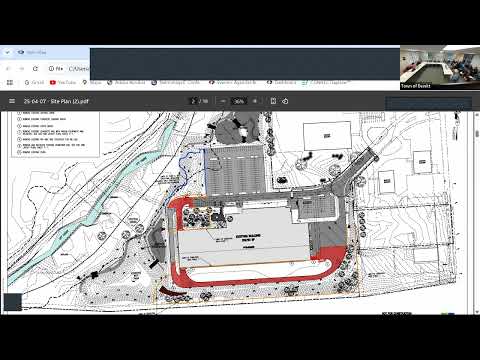
The DeWitt Planning Board opened a public hearing May 8 on a proposal from Verizon Wireless to build a 120‑foot monopole at 6045 Edinger Drive, on town‑owned land behind the Jamesville‑DeWitt School bus garage and adjacent to a water tank.
Verizon attorney Robert Bergdorf said the company’s radio‑frequency engineers have identified a coverage deficiency in the Edinger cell that, in Verizon’s analysis, can only be remedied by a tower inside the study area. “The only way to remedy the service deficiencies are to get a wireless facility in an appropriate spot,” Bergdorf said. He described the company’s propagation study and before‑and‑after maps submitted as Exhibit G.
The company proposes a fenced equipment compound and a 120‑foot monopole with room for at least one future colocating carrier. David Wiseman of Pascach Engineering, who presented a view‑shed analysis for Verizon, said the visible footprint of the pole would be limited and “pretty much a quarter‑mile” or smaller in most directions, with the largest view shed oriented toward the school.
Why it matters: Verizon said the tower would fill persistent dead zones around Woodstock Hill Road and parts of the neighborhood and the school campus. Several residents and school staff said mobile service outages have tangible consequences — from dropped calls to missed information — and urged the board to weigh coverage benefits against neighborhood impacts.
Public comment was strongly mixed. Jamesville‑DeWitt School District representative Peter Smith and several school staff supported the project as a way to reduce dead spots on campus; resident Jim DiStefano said, “We need something up in that area.” Other neighbors submitted a petition with roughly 25 signatures opposing a tower adjacent to residences and the school and pressed Verizon to consider alternate, more screened placements within the search area.
Technical and procedural details discussed during the hearing: - Proposed height: 120 feet; Verizon performed balloon simulations with a 140‑foot marker to show visibility during review. The 120‑foot height requires a 20‑foot variance from the town’s standard 100‑foot limit and therefore the project will be considered by the Zoning Board of Appeals for the height variance/special permit, per the applicant. - RF study: Verizon said its propagation tool accounts for topography, trees and buildings and is typically “90–95%” accurate. Its exhibits show before/after coverage improvement for multiple frequency bands. - Colocation: the compound layout includes space for at least one future carrier; Verizon representatives said carriers commonly add equipment later but may only increase height by up to 20 feet without additional approvals in some federal interpretations. - Referral and review: Bergdorf asked the town to submit the project to county planning for a 239‑m style review; the application record indicates that a county referral has been sent. The board also acknowledged it has retained an independent RF consultant to review Verizon’s materials. - Lease terms (as stated by Verizon at the hearing): initial rent to the school district reported as $2,250 per month, plus a one‑time $4,000 startup payment; the company described the standard lease term as five years with multiple renewal options (applicant said renewals could extend total occupancy for decades under common market terms). - Construction: Verizon representatives estimated that, once permitted and scheduled, tower erection would take a day or two and site work minimal—construction typically less than 30 days—though they said mobilization timing depends on schedules and permits.
Board directions and outstanding items: the board opened the public hearing and voted to waive formal reading of the notice. Members asked Verizon to provide additional materials before the next step to the Zoning Board of Appeals and to the town’s RF consultant: (1) clearer documentation of alternatives within the search area, with justification why some parcels were excluded (including conservation/forever‑wild parcels); (2) higher‑resolution photo simulations (balloon sims) from key vantage points, particularly Old Quarry Road and nearby yards; (3) suggested screening and architectural treatment for the equipment compound (board members emphasized higher standards than a basic chain‑link fence given the school context); and (4) demonstration of noise and generator plans and an explicit colocation plan showing proposed antenna heights for future carriers. The board also discussed a short extension of the 30‑day review window so the town’s consultant can complete its technical review.
No final substantive decision on siting or height was made at the planning board meeting; next formal steps are the town consultant’s report, the planning board’s response to that report, and then an anticipated Zoning Board of Appeals public hearing on the requested height variance/special permit.