Get Full Government Meeting Transcripts, Videos, & Alerts Forever!
Get email alerts on the Infrastructure topic
No spam. Unsubscribe anytime.
Council adopts 2024 annual level-of-service report; members debate next steps for stormwater, roads
Summary
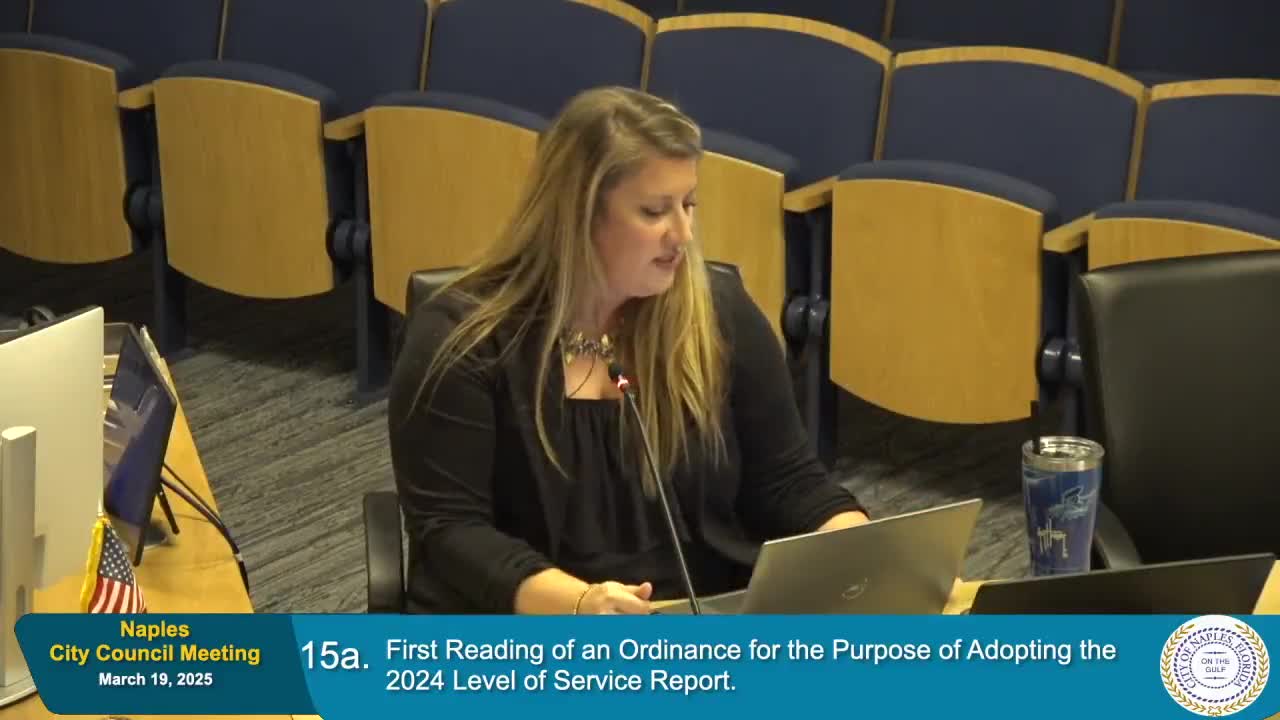
After extended discussion and two dissenting votes, City Council adopted the city’s 2024 annual level-of-service report, prompting council requests for follow-up actions and for staff and consultants to develop mitigation options and code updates ahead of a May follow-up reading.
City Council voted 5–2 to adopt the 2024 Annual Level-of-Service (LOS) report, the code-required inventory that compares current public infrastructure capacity against the city's adopted LOS standards. The meeting included an extended presentation from multiple city departments and a lengthy council debate over stormwater, roadway capacity and how to proceed when neighborhoods fail to meet adopted standards.
What the report does: Staff presented LOS findings for potable water, wastewater, solid waste, stormwater/drainage, traffic and parks/recreation. Readings showed the city meets potable water and wastewater standards based on current usage and treatment capacities; solid-waste per-capita measures are within the adopted standard; parks inventories meet the comp-plan metrics being used. Stormwater modeling and multi-basin assessments identified areas with shortfalls—most notably Basin 4 (Aqualane Shores area) where projected improvements exceed a half-billion dollars. Traffic counts showed most city collectors operating within the city's adopted level-of-service C; county and state arterials use county/state standards and are measured differently.
Council debate and next steps: Councilmembers and staff disagreed over timing, tools and remedies. Several members stressed the report is a factual inventory required by city code and urged that it be approved so staff can develop mitigation measures. Others warned against using the LOS exercise as a vehicle to reduce adopted standards or to unintentionally restrict property transactions or redevelopment. City Attorney Matthew McConnell and staff advised that the code offers three broad responses if adopted standards are not met: fund improvements within a transition window, adopt a lower standard consistent with current performance, or cease issuing development orders that would further degrade service. Council directed staff and the city’s comprehensive-plan consultant to return with a menu of mitigation options, basin prioritization and draft code amendments; staff proposed a follow-up reading in May to present concrete options.
Why it matters: The LOS discussion intersects with flood resiliency plans, multi-basin stormwater modeling, and the city’s ongoing comprehensive-plan update. Several council members said they want to align LOS standards with longer-term resiliency planning and capital-investment prioritization rather than adopt blanket changes on short notice.
What staff will do: Departments will continue multi-basin modeling and prepare an implementation matrix of improvement priorities and funding options; staff said they would bring proposed code updates and mitigation alternatives to council in May for a second reading and policy direction. The council vote to adopt the inventory allows staff to move forward on scheduling and deeper analysis, staff said.