
Sunny Isles Beach commissioners direct administrative updates to East Side development 'bonus' program
Get AI-powered insights, summaries, and transcripts
Subscribe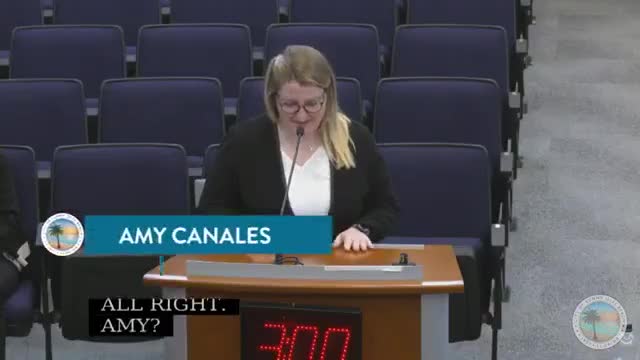
Summary
At a commission workshop, staff and planning consultants outlined options to revise the city's development "bonus" program for the East Side, and commissioners gave direction to pursue four administrative steps including an economic study of participation-unit fees, budget reformatting, and code and comprehensive-plan text amendments.
At a workshop, the City of Sunny Isles Beach commission directed staff to pursue four administrative steps to update the city's development bonus program that governs density and floor-area-ratio (FAR) increases for East Side parcels.
The direction follows a presentation by planning consultants Caitlin Forbes and Jeff Cadems of Complete Cities Planning Group, who reviewed how the city's participation-unit system has been used to buy FAR and described inconsistencies between the city's land development code and its comprehensive plan. "This work is not optional. The city currently has a zoning in progress that cannot be lifted until the bonus program is addressed. And we cannot do so without direction from this body," said Amy (staff member), introducing the topic.
Why it matters: The commission heard that the city's bonus framework lets developers buy increments of FAR (participation units) and that those fees were last formally updated in 2018. Consultants and staff told commissioners that the comp plan and the code are not consistent on maximum intensities and densities; that participation-unit fees have historically risen (from about $72,000 pre-2015 to $100,000 in 2015 and $200,000 in 2018); and that those fees are paid at master-permit time, which results in lags between permits and fund receipts. Caitlin Forbes said the consultants' goal is "to ensure a legally defensible bonus program and to ensure that consistency is included between the comp plan and the code as it relates to maximum intensity and density."
Key direction and next steps: Commissioners generally agreed on four administrative actions staff will pursue and return with details: (1) retain or hire an economic consultant to review participation-unit pricing and the underlying methodology, (2) revise the city's budget presentation to keep bonus/trust-fund receipts and expenditures clearly separated and tied to code-identified projects, (3) prepare land development-code text amendments to clarify how bonus funds and physical-improvement options must be used and maintained, and (4) prepare East Side comprehensive-plan text amendments that explicitly state the intended maximum densities and FAR to be consistent with recent practice. Staff and the consultants said changes for the West Side (Town Center North) will be handled in a separate, later process.
Commissioners raised concerns and requested more analysis. Vice Mayor Lamo said the visual example of a recently built tower showed how bonuses and TDRs can substantially increase a project's size: "So it is an eye opener. I think when you see the visual of it, and we need to be very careful about how we approach bonuses for the West Side." Commissioner Viscara asked for clearer measures of overdevelopment: "What does it mean to be underdeveloped? What does it mean to be developed? And what does it mean to be overdeveloped? And I've never gotten a straight answer." The city attorney described those determinations as governed by the comprehensive plan and by concurrency rules under state law, noting that some elements are necessarily quantitative (infrastructure capacity) and others are qualitative (vision and policy).
Program details discussed: Consultants summarized the Mixed Use Resort (MUR) district (East Side) bonus system: base allowances and multiple bonus buckets (trust fund payments, required physical improvements, locational bonuses such as waterfront) that together raise allowable FAR and unit counts; participation units are sold in increments (example: 0.05 FAR increments), and the Beach Access Trust Fund units have been priced at $200,000 per unit since 2018. The consultants showed the Turnberry Ocean Club (approved 2014) as an example of how buy-right area, bonus FAR and transfer-of-development-rights (TDRs) combined to reach the built FAR.
Operational issues identified: consultants and staff cited four challenges: fees are outdated and last adjusted in 2018; the city budget does not always track bonus funds separately for the code-identified trust funds; land-development language about eligible uses of funds is vague; and inconsistencies exist between the comprehensive plan and the code on maximum intensity and density. Consultants recommended an economic analysis to test fee methodology, clearer budget accounting, code text amendments to define allowable uses and maintenance responsibilities, and comp-plan amendments aligning stated maximums with how the city has historically allowed development on the East Side.
Options discussed but not currently directed: presenters outlined a menu of possible program changes for later consideration, including revising the beach-access and streetscape bonuses to clarify maintenance responsibilities; replacing or tightening the enclosed-parking and site-assembly bonuses; collapsing similar streetscape funds; adding new bonus categories (Collins Avenue enhanced streetscape, public-safety or micromobility funds, plaza or public-parking improvement bonuses); and a potential option to require public parking spaces within private structures under specific signage, location and revenue-sharing criteria. Commissioners did not adopt any of those optional program changes at the workshop; staff will return with the four administrative items described above.
Public- and infrastructure-related questions: commissioners asked staff to include concurrency and infrastructure capacity analyses with upcoming materials. The consultants said the city's upcoming concurrency ordinance will address levels of service for traffic, water, sewer and parks and that those quantitative measures will be used to assess how much additional development the city can accommodate.
What's next: staff and the consultants will draft and return with: a scope and budget for an economic consultant to study participation-unit pricing and methodology; proposed changes to budget presentation separating bonus funds; draft land-development-code text clarifications for bonus funds and maintenance requirements; and East Side comprehensive-plan text amendments showing the maximum densities and FARs the commission intends to allow. The presenters said Town Center North (West Side) will be addressed in a separate process and vision document.
Ending: Commissioners asked that the workshop presentations be posted on the city website and social media to solicit additional public comment before staff returns with formal amendments. No formal motions or votes were taken during the workshop; the commission's direction was recorded as consensus to proceed with the four administrative steps identified by staff and consultants.