Get Full Government Meeting Transcripts, Videos, & Alerts Forever!
Get email alerts on the Public Health Strategy Communicable Disease topic
No spam. Unsubscribe anytime.
Worcester DPH outlines strategic framework, data dashboards and vaccination outreach as communicable-disease risks rise
Summary
Worcester Department of Public Health presented a five-year strategic framework that emphasizes data dashboards, trusted-messenger vaccine outreach and accreditation work; Dr. Hirsch presented communicable-disease updates including measles, tick- and mosquito-borne illnesses, and bird flu in wildlife.
The Worcester Department of Public Health (DPH) presented a strategic framework that centers data-driven public-health leadership, new data dashboards, accreditation work and community-based vaccination outreach; the Board of Health discussed the plan after a communicable-disease update from Dr. Hirsch.
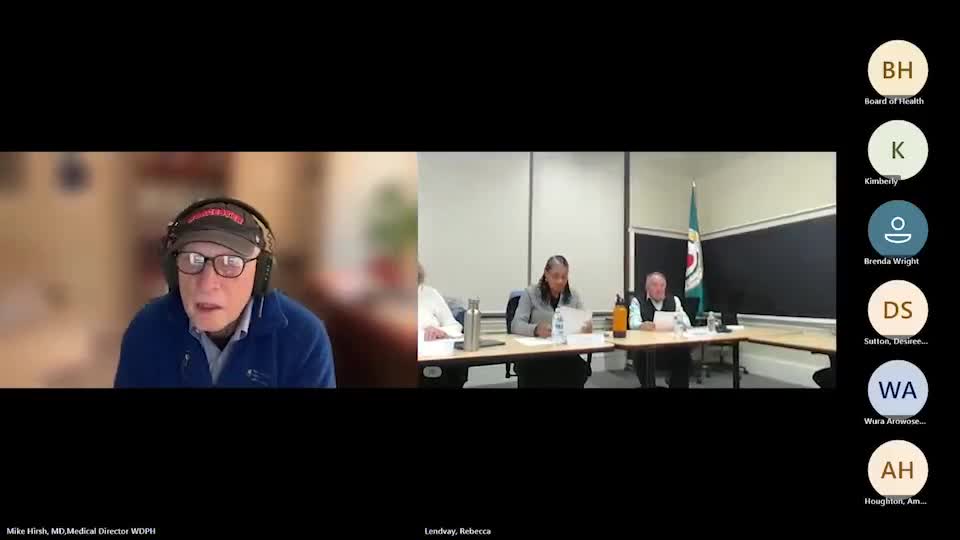
Dr. Hirsch summarized current communicable-disease trends: COVID-19 shows a modest, seasonal uptick associated with gatherings but not the large hospitalizations seen earlier; measles cases are rising nationally (reported in roughly 26 states with nearly 1,000 cases and three deaths in the U.S., per the presentation), and measles post-exposure vaccination can reduce severe disease. He flagged an expected increase in mosquito- and tick-borne illnesses after a wet, warm winter, and noted continuing spread of avian influenza (H5N1) among wild birds and some wild mammals; human cases have been rare and concentrated among agricultural workers in outbreaks noted nationally. Dr. Hirsch advised mask use in high-risk settings and checking measles immunity if exposed or uncertain.
Tamara (DPH lead) and Nikki (DPH deputy) described a five-year strategic framework aligned with the city's FY25-FY29 priorities and state public-health expectations. Key elements are:
- Data dashboards: DRIVE (Data Research and Innovation Visualization) will centralize measures across the division, allowing near-real-time program monitoring (tobacco use, youth surveys, tobacco use in pregnancy and neighborhood-level maps for targeted interventions). Speakers highlighted a live tobacco dashboard already in use.
- Vaccination outreach: The division will adapt the "trusted messenger" model used during COVID-19 to community-led vaccine education and outreach; the effort aligns with the Massachusetts Department of Public Health priorities and an expected FY26 work plan and grant applications tied to communicable-disease control.
- Accreditation and internal capacity: DPH is pursuing reaccreditation; staff noted completion of numerous required measures improves workforce development and program quality. The division stressed internal staff development and cross-division collaboration.
- Environmental health and inspection alignment: DPH will concentrate environmental-health resources in Worcester when the regional alliance transitions (noted as occurring June 30), keeping almost all inspectors in place to emphasize local outreach and prevention rather than only punitive enforcement.
Board members asked about booster guidance and vaccine timing; staff said Mass DPH has not recommended boosters now and the CDC has been quiet on updated booster guidance; any fall combined flu/COVID booster remains uncertain. Board members recommended involving board members in working groups and suggested DPH review budget needs with the city manager ahead of the council budget review.
Ending: DPH said it will finalize FY26 workplans, submit required accreditation materials by June 1, and continue developing dashboards and trusted-messenger vaccination campaigns; the board offered support and volunteered to engage in working groups where feasible.