Get Full Government Meeting Transcripts, Videos, & Alerts Forever!
Get email alerts on the Nonconforming Use Special Permit topic
No spam. Unsubscribe anytime.
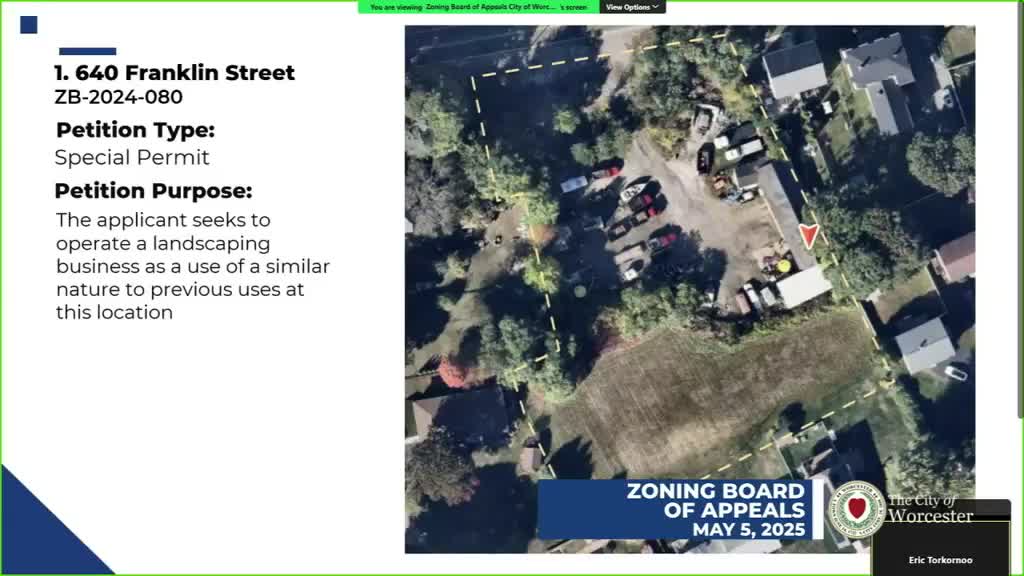
Worcester zoning board denies special permit to landscaping business at 640 Franklin St.
Summary
The Worcester Zoning Board of Appeals denied a request by a landscaping business to retroactively authorize operations at 640 Franklin Street after staff and neighbors said the site lacks evidence of a continuous privileged preexisting nonconforming use and that the landscaping activities are not of a similar nature to prior uses.
The Worcester Zoning Board of Appeals denied a request by a landscaping business to retroactively authorize operations at 640 Franklin Street, voting down a special permit after staff and neighbors said the use is more intensive than historic, privileged uses and may have been abandoned.
The board’s decision follows a staff memo from the city’s Division of Planning and Regulatory Services and a pair of inspectional-services letters that concluded there is insufficient evidence of a continuous privileged preexisting nonconforming use at the site and that the applicant’s outdoor storage and open-lot activities are not a “use of a similar nature” to the historic manufacturing/storage uses cited by the applicant.
Board members debated whether the property retained a legal privilege dating to prior uses, whether those uses were continuous or abandoned, and whether the current landscaping operation is materially different in intensity because much of it occurs outdoors rather than inside a building.
Clay Williams, attorney for the applicant, described the parcel as about an acre and a half with a 3-bay garage and multiple small businesses operating there over many decades. He said Joe Haddad of Haddad Enterprises LLC operates landscaping and storage on the site and that other tenants include Jack and Sons Fence Company and A & A Antiques. Williams noted a long history of commercial and industrial activity at the address and said the applicant began the landscaping business at the location in 2021 and seeks to cure zoning noncompliance.
Victor Panak, planner with the Division of Planning and Regulatory Services, told the board the applicant applied for relief under Article 16, Section 4(c) of the city zoning ordinance — the supplemental rules for extension, alteration or change of a preexisting nonconforming use — and that staff believes two key prerequisites should be determined by the city’s zoning enforcement/inspectional services: (1) whether a privileged preexisting nonconforming use exists; and (2) whether the proposed landscaping use is of similar nature to the existing nonconforming use. Panak summarized inspectional-services findings that the site’s history and demolition of a building in 2017 suggest abandonment and that the applicant’s open-lot storage and salvage-type activities are prohibited in the lower-intensity districts the inspectional services identified as the zoning districts of “least intensity” for earlier uses.
Neighbors testified they have repeatedly filed complaints to inspectional services about trash, uncovered dumpsters, odors and overnight vehicle activity. Leonard Shifredo, chair of the Brown Skin Neighborhood Association, said residents ask the board to deny the permit, arguing “the applicant has shown total disregard and disrespect for both the property and the neighborhood.” Abutter Heather Morello told the board she has lived on Plantation Street 36 years and described odors she called “manure,” junk and frequent late-night vehicle noises. Nancy Leary said the property is “terrible” and that accumulated debris has led to rodents and coyotes. William Palmer called the site “a mess, literally.”
Board members repeatedly said they were reluctant to penalize a small business but that the record does not show continuity of a privileged nonconforming use or that the proposed landscaping/storage activity is a use of similar nature under the ordinance. One member summarized that businesses inside buildings differ materially from outdoor storage and salvage operations and that the applicant had not carried the burden of proof to show the historic privilege remained.
After discussion the board voted on a motion to approve the special permit; the vote was unanimous against approval and the petition failed.
The board advised the applicant that options include withdrawing the petition, seeking continuance to provide additional documentation, or pursuing other administrative relief. The meeting record notes inspectional-services letters dated Feb. 7, 2025 and April 28, 2025 were part of staff materials and that the demolition of a garage building in 2017 figured into staff’s abandonment analysis.
The denial ends the board’s consideration of the special-permit request; separate enforcement action and litigation involving the property were referenced by speakers but are outside the board’s decision.