Get Full Government Meeting Transcripts, Videos, & Alerts Forever!
Get email alerts on the Enforcement Compliance topic
No spam. Unsubscribe anytime.
ABCC stresses ID checks, compliance stings, over‑service risks and ban on hemp‑THC drinks
Summary
ABCC general counsel and investigators told Worcester licensees about newly added acceptable IDs, compliance checks for brick‑and‑mortar and delivery, over‑service enforcement using '24J' reports, and that hemp‑derived CBD/THC beverages remain illegal in Massachusetts licensed premises.
ABCC general counsel Kyle Gill and investigators told Worcester licensees that updated identification guidance, active compliance checks and enforcement tools are central to preventing violations for sales to minors, delivery compliance and over‑service.
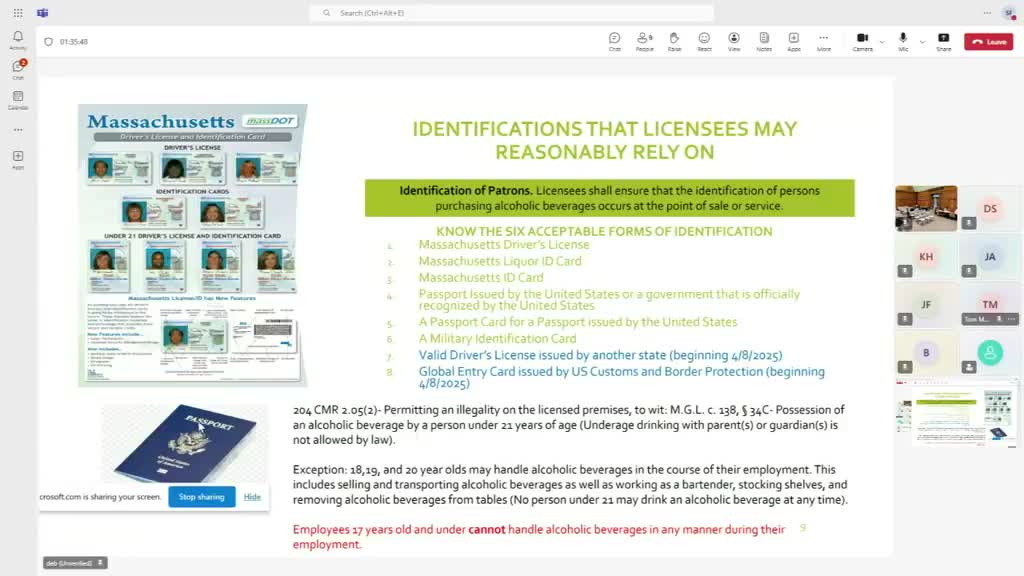
Gill reviewed a recent change to the statute that expanded the types of identifications a licensee can "reasonably rely on" when accepting ID. The list now includes a valid driver's license from another state and a Global Entry card, in addition to Massachusetts driver's licenses, state liquor ID cards, passports and military IDs. "They have to be valid," Gill said, adding that reasonable reliance does not protect sales based on fake IDs or when the buyer clearly does not resemble the presented ID.
Gill and Sacramone described ABCC compliance checks that include both brick‑and‑mortar sting operations and delivery tests. Gill said ABCC investigators are testing delivery drivers and expect carriers and licensees to maintain permits and be able to produce them during inspections.
On public‑safety enforcement, ABCC staff described how "24J" reports — court records naming establishments where a recently convicted OUI offender had their last drink — are used to prioritize enforcement visits. Kyle Gill said repeated 24J entries can prompt undercover observations and potential violations for serving obviously intoxicated patrons.
ABCC general counsel also warned licensees that obstructing or delaying investigators can result in criminal charges; investigators may seek evidence such as surveillance footage, and deleting or withholding footage can be treated as an obstruction.
Gill advised that alcoholic beverages containing hemp-derived CBD or THC are not permitted on licensed premises under current Massachusetts Department of Public Health and Department of Agricultural Resources guidance. "These products should not be on a licensed premises," he said.
Ending: ABCC staff urged licensees to use ID‑checking guides, scanners and staff training; to preserve surveillance and cooperate with investigators; and to remove hemp‑derived CBD/THC drinks from premises until and unless the law changes.