Get Full Government Meeting Transcripts, Videos, & Alerts Forever!
Get email alerts on the Building Emissions topic
No spam. Unsubscribe anytime.
Committee discusses building-emissions benchmarking and examples from Boston and other cities
Summary
Green Worcester members reviewed building emissions benchmarking approaches, including Boston’s building emissions reduction and disclosure ordinance (BERDO), and discussed whether a Worcester-specific program or use of rental-registry inspections could support local decarbonization goals.
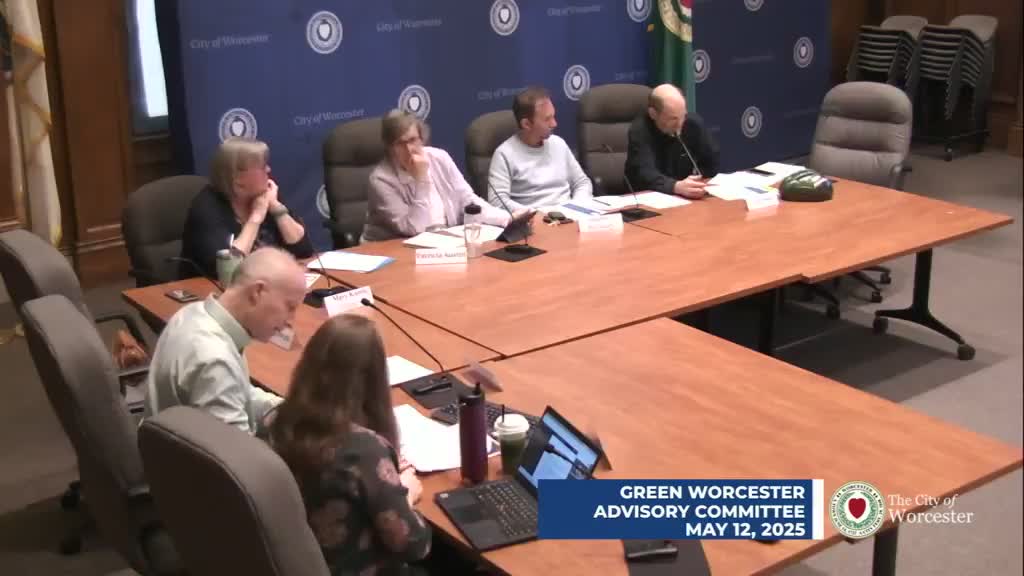
Ted Connor, a committee member, presented research May 12 on building-level emissions benchmarking and city ordinances that require reporting and eventual emissions limits.
Connor described Boston’s Building Emissions Reduction and Disclosure Ordinance (BERDO) and similar programs and said those ordinances apply first to the largest buildings and then ramp to broader coverage with scheduled emissions reductions through 2050. “Those 5,600 buildings represent 40% of Boston's greenhouse gas emissions,” he said, summarizing the staff information he gathered.
Committee members discussed how benchmarking at the building level differs from citywide greenhouse gas inventories and whether Worcester could adapt parts of other cities’ programs to local needs. Connor emphasized three credibility measures he found in the literature: an existing downward emissions trend, legally binding targets, and a detailed implementation plan. He noted, “what’s legally binding now applies pretty much just to new construction,” and suggested a locally tailored approach would be necessary.
Members also discussed synergy with the city’s rental property registry. Ted and others noted the registry’s planned inspections could be an opportunity to gather useful data for decarbonization work, though members raised concerns about imposing burdens on small owner-occupant landlords. “We have to look at that and see how valuable it is,” a committee member said, highlighting possible unintended consequences for small homeowners.
The committee asked staff to seek available data on the specialized stretch code’s efficacy (a code adopted for new construction) and to follow up with state or regional contacts. No ordinance, change to policy, or binding target was adopted at the meeting; the discussion produced a recommendation to continue research and consider whether benchmarking or building-level requirements are appropriate for Worcester.