Get Full Government Meeting Transcripts, Videos, & Alerts Forever!
Get email alerts on the Underground Parking Charter Height topic
No spam. Unsubscribe anytime.
Council debates underground parking, Charter Height limits; staff asked to draft criteria
Summary
Council members debated whether underground parking garages should be permitted and, if so, how they interact with the Charter Height Amendment limiting commercial districts to three stories and 42 feet measured from the First Floor FEMA elevation.
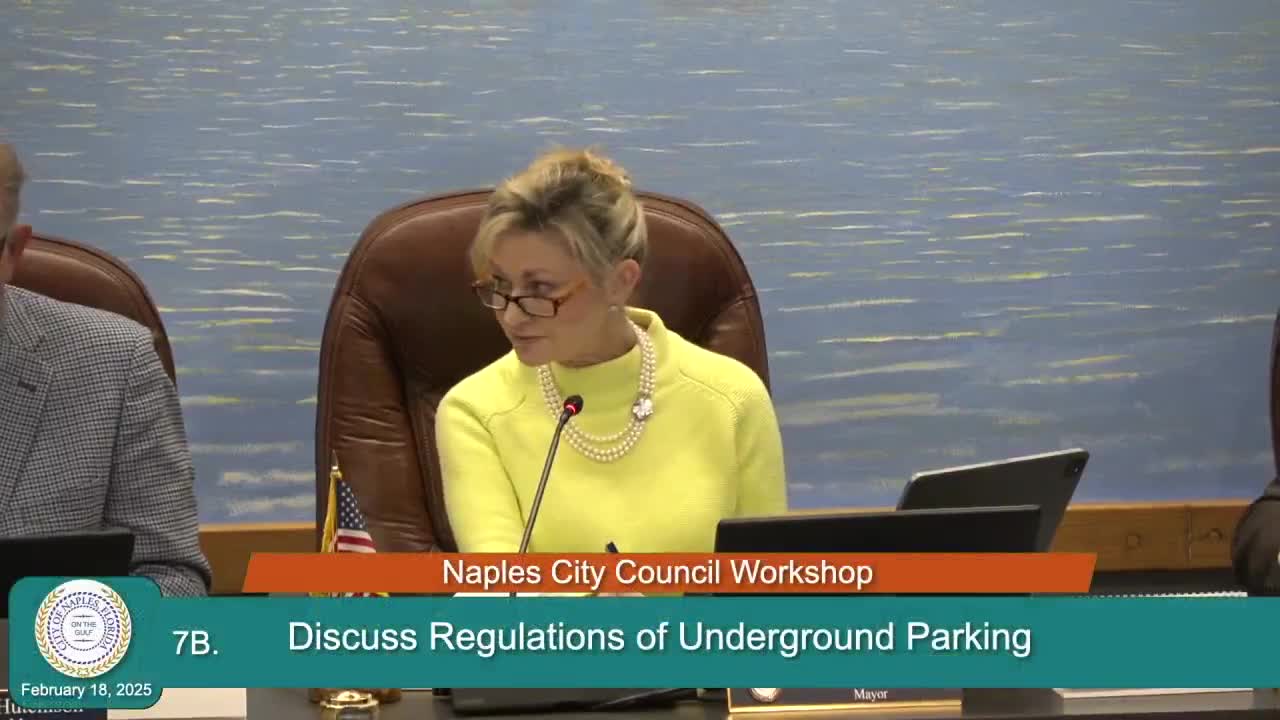
City Council members spent the latter half of the Feb. 18 workshop debating whether underground parking structures should be allowed in Naples and, if so, under what conditions. The discussion crossed legal, planning and resilience topics: how below‑grade floors are counted under the Charter Height Amendment, the risk of dewatering and contaminated discharge, life‑safety and access for fire responders, and potential effects on the city’s flood insurance status.
Council Member Petronoff urged that the Charter Height Amendment must be respected and argued that below‑grade parking should be counted as a story. “To me there’s no doubt that the Charter Height Amendment stipulates the structures must comply with 2 rules, 1 that is measured and 1 that is counted,” she said, and recommended staff craft language to treat underground levels as counted floors unless the council decides otherwise.
Other council members urged a more flexible approach. Council Member Christman said underground parking can reduce visual surface parking and recommended evaluating proposals case‑by‑case as a conditional use with high standards that preserve egress and protect the public. Council Member Kramer suggested allowing underground parking only when it yields significant public benefits—particularly permanent green space—so the tradeoff is visible and enforceable.
Legal and technical issues surfaced repeatedly. City Attorney Matthew McConnell and Building Director Steve Beckman advised caution: a change in interpretation could create nonconforming buildings or legal challenges because earlier council decisions and past approvals used different readings of the charter. Staff also noted recent examples where underground garages experienced flooding or problematic dewatering during construction; council members asked staff to study the Third Street and Fifth Avenue garages as case studies.
Resilience and operations: council members and staff raised operational questions that would need answers before any ordinance allowing underground parking could be adopted: how to handle dewatering discharge (permits and testing), where contaminated stormwater would be pumped, requirements and cadence for post‑flood inspections, how to manage lithium‑ion electric vehicle (EV) fire risk in enclosed below‑grade spaces, whether valet and revenue‑parking operations would be allowed, and whether a conditional‑use revocation process is sufficient for long‑term enforcement.
Outcome: the council did not vote. Multiple members asked staff and the city attorney to research options and return with a workshop. Council requested a focused staff report to include legal analysis of how the charter's height and story language would apply to below‑grade parking; technical standards for dewatering and contaminated discharge; building‑code and fire‑code considerations (mechanical ventilation, sump systems, EV charging/fire suppression); and policy options (prohibit, allow as conditional use, or allow with defined tradeoffs such as guaranteed public green space). Several members asked that staff also provide sample language from other jurisdictions.
Ending: Council members signalled the issue will require follow‑up workshops. Staff said it will collect technical and legal materials and suggested an initial staff report and a formal workshop to narrow code language options before any ordinance drafting.