Get Full Government Meeting Transcripts, Videos, & Alerts Forever!
Get email alerts on the Stem Education topic
No spam. Unsubscribe anytime.
Elementary teams describe rapid‑relay VEX robotics run that qualified them for world competition; fundraising covered travel
Summary
Students from two elementary schools demonstrated a VEX rapid‑relay robotics game and described qualifying for states and worlds. Presenters explained game rules, team strategy and fundraising that helped cover travel to the world competition.
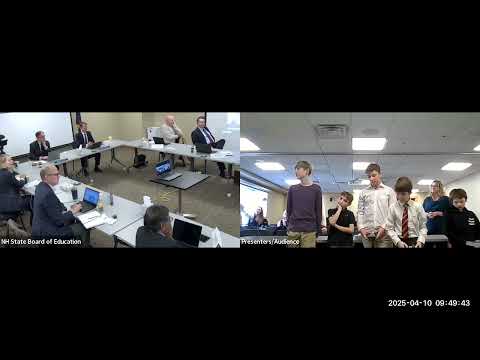
A group of elementary and middle school students presented a demonstration of the year’s VEX robotics challenge — the ‘‘rapid relay’’ teamwork game — to the State Board. Students described a field with four goal posts, scoring that varies by goal height, teamwork requirements that pair teams in alliance play, and three competitive tracks (teamwork, driver‑controlled and autonomous coding).
The students recounted advancing through regional tournaments to states and a final match that scored 43 points and ultimately qualified them for world competition in Dallas. They described practical constraints — team sizes, permissible robot dimensions and the need to reconfigure robots each season — and noted that travel costs were substantial but defrayed in part using unspent local robotics funds. One presenter said the trip cost roughly the equivalent of $1,314,000 in meeting remarks, and staff later clarified that figure was stated during oral remarks at the meeting; the school described tapping available robotics funds to help cover team travel costs.
Nut graf: Student presenters emphasized that the competition stresses engineering, coding and teamwork, and that even small or club‑based teams that meet less frequently can succeed by focusing on strategy and repeated practice.
Students described the program as entirely student run: coaches do not touch robot construction or coding at competitions; students design, build and program their robots, switch drivers mid‑match, and practice autonomous routines. Presenters also demonstrated handwork and coding tools, noting the underlying platform uses Python under the block‑coding interface. The Board thanked the students for the demonstration and the Department acknowledged the role of local district robotics funds in supporting out‑of‑state travel.
Ending: Board members congratulated the students and noted the state’s interest in supporting robotics pathways as part of broader STEM attainment efforts.