Falmouth committee outlines ‘geo boundaries’ contingency plan for nitrogen reduction, urges public outreach and financing options

Loading...

AI-Generated Content: All content on this page was generated by AI to highlight key points from the meeting. For complete details and context, we recommend watching the full video. so we can fix them.

Summary

Falmouth water-quality advisers on the Water Quality Management Committee presented draft "geo boundaries" that identify parcels the town would require to upgrade onsite wastewater systems as part of a contingency plan to meet state nitrogen-reduction targets.

Falmouth water-quality advisers on the Water Quality Management Committee presented draft "geo boundaries" that identify parcels the town would require to upgrade onsite wastewater systems as part of a contingency plan to meet state nitrogen-reduction targets.

The plan matters because Massachusetts Department of Environmental Protection watershed plans must show how each watershed will meet its total maximum daily load (TMDL) for nitrogen over a 20-year schedule, with five-year checkpoints and contingency measures if targets are missed. Committee members said the geo boundaries are intended to limit required upgrades to the minimum number of homes needed to meet TMDLs if other credits (for example, fertilizer reduction or aquaculture) are not available.

The committee’s presentation described the scope and scale of the proposal and the questions that remain. Amy Lowell, Wastewater Superintendent for the Town of Falmouth, said the town has identified 14 nitrogen-sensitive watersheds that require watershed plans and that a contingency plan must rely on sewers and advanced on-site alternative (IA) systems, not on shellfish, inlet widening or fertilizer bans. "There has to be a description of all planned actions to achieve the necessary nitrogen load reduction. That can include a number of things, not just sewers or IAs. And then there has to be an implementation schedule with activities that have to occur within 5 year increments," Lowell said.

The committee gave parcel and housing counts to show the potential scale. By the numbers presented, the 14 watersheds contain 20,761 parcels; about 13,716 single-family homes are in those watersheds. The contingency geo boundaries as drawn now include roughly 7,258 parcels, of which 5,813 are single-family homes. The committee said the first watershed plans due to DEP will cover Great Pond and Little Pond and must be prepared and submitted by 2027.

Committee members emphasized that the geo boundaries are a planning-level, contingency concept not an immediate mandate. Jonathan Kaufman and others said watershed plans will include other actions (for example inlet widening or aquaculture) that can reduce the number of parcels that would ultimately require IA upgrades. "In theory, [other activities] would reduce the need for as many IA homes," a committee member said during the meeting, noting the contingency maps show a worst-case scenario if other credits are not realized.

Implementation questions dominated discussion: How would geo boundaries be enforced (zoning overlay, Board of Health regulation, town meeting vote), who would pay for installations, and whether parcels planned for future sewering should be excluded from IA requirements. Select board member Doug Brown told the committee he thought homeowners in areas that are planned for future sewering should not be required to install IAs and "those people should get some sort of variance," citing the unfairness of paying twice in a short span.

Committee members debated outreach and public education. The group agreed to expand public-facing maps (ArcGIS) and run informational materials in public spaces; one member recommended poster boards in the library and town hall and a short video loop explaining sewers, IAs and tradeoffs. Several members urged that the town produce rough, back-of-envelope scenarios now (for example, what happens if sewering is increased by 20 percent) so residents and decision-makers have ballpark figures while the consultant-led watershed plans are developed.

Costs and equity were raised repeatedly. A draft committee recommendation to the selectmen urged the town to seek more equitable ways to distribute cost burdens on homeowners who may be required to upgrade septic systems. Committee members asked staff to refine that draft before formally submitting it to the select board. The committee also signaled support for pursuing state-level tax-credit legislation and coordinated outreach to other Cape communities and state legislators to expand eligibility and, potentially, make credits refundable for lower-income homeowners.

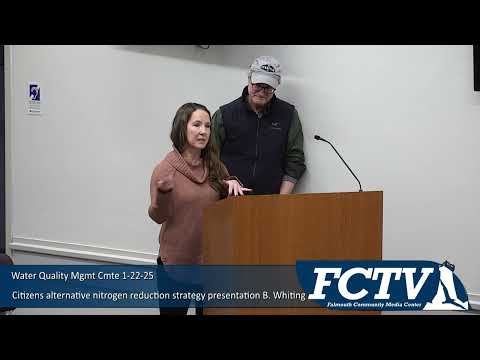
The committee discussed technology choices. The presentation used an accounting assumption that advanced IAs reduce nitrogen to about 10 milligrams per liter; committee members flagged urine-diversion fixtures as a lower-cost alternative for some homeowners but said DEP approval and plumbing-board acceptance are required before such fixtures can be counted toward IA credits. Bob Whiting, a resident of Great Harbors who spoke during a public-comment slot, asked whether more frequent pumping of septic tanks rather than system replacement could reduce nitrogen: "What if we collected that waste and got it out of my septic tank, faster? Like, 4 times a year or even monthly." Committee members and a former Board of Health member responded that conventional septic tanks continuously retain liquid and urine; that approach would require a "tight tank" design and frequent pumping and is restricted by Title 5 and Board of Health variances in many cases.

Next steps and committee directions recorded during the meeting included: retain a consultant to prepare watershed plans (funding article to appear on the April town meeting warrant), refine the draft recommendation on fairness/financing and bring it back for committee vote, create public outreach materials and an ArcGIS map layer, and add a short slide on urine diversion technologies for future presentations. The committee deferred a formal vote on sending its fairness recommendation to the select board until members could refine the language and supporting supplement.

The Water Quality Management Committee stressed that geo boundaries are a planning tool to show the minimum number of parcels that could be required to upgrade in a contingency scenario and that final implementation steps (regulatory mechanism, timing and subsidies) remain to be decided and will be developed during the watershed-plan process.

Ending: The committee encouraged the selectmen and town staff to discuss implementation pathways (town meeting, Board of Health regulation or other mechanism), accelerate public education, and examine financing pathways that might include betterment splits, town-held purchasing for economies of scale, and expanded state tax credits for homeowners.