Get Full Government Meeting Transcripts, Videos, & Alerts Forever!
Falmouth boards weigh townwide rule requiring advanced nitrogen‑reducing septic systems
Summary
Members of the Water Quality Management Committee and the Town of Falmouth Board of Health on Wednesday reviewed draft rules to require advanced nitrogen‑reducing onsite wastewater systems for new construction and substantial renovations and debated whether the regulation should apply only to state‑defined nitrogen sensitive areas or townwide.
Members of the Water Quality Management Committee and the Town of Falmouth Board of Health on Wednesday reviewed draft local regulations that would require advanced nitrogen‑reducing onsite wastewater systems for many new and substantially renovated properties and discussed how that work should coordinate with long‑range watershed permitting and sewer planning.
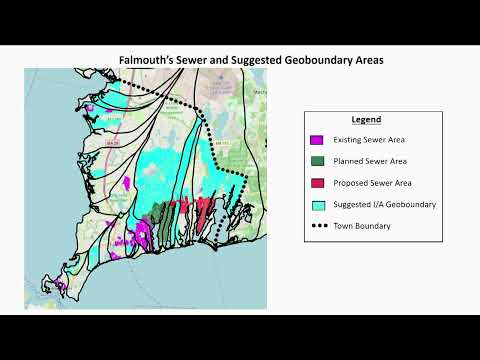
The committees discussed four draft versions of a proposed Board of Health regulation that differ mainly by geographic scope and timing: (1) require systems only in state‑defined nitrogen sensitive areas (NSAs); (2) expand to include watersheds the town considers nitrogen impaired; (3) apply to all of Falmouth but allow delays where a sewer is expected; and (4) a townwide approach that adds a formal credit/delay for properties that install the best available technology and includes a 15‑year window before requiring connection to a sewer. The boards reviewed maps showing watersheds and explained that roughly 67 of the town’s 78 freshwater ponds lie inside areas the speaker identified as nitrogen sensitive.
Why it matters: the town is working on watershed permits under the Massachusetts Department of Environmental Protection (DEP) that the presenters said will be prepared in four groups (applications in 2027–2030) and — once accepted — start reporting clocks that require five‑year progress updates. Committee members warned the watershed permit program is a multi‑decade project with implementation timelines that could extend toward mid‑century, and they framed a local regulation as a near‑term tool to limit additional nitrogen loading while longer‑term sewer solutions are planned and funded.
Key points from the…
Already have an account? Log in
Subscribe to keep reading
Unlock the rest of this article — and every article on Citizen Portal.
- Unlimited articles
- AI-powered breakdowns of topics, speakers, decisions, and budgets
- Instant alerts when your location has a new meeting
- Follow topics and more locations
- 1,000 AI Insights / month, plus AI Chat