Get Full Government Meeting Transcripts, Videos, & Alerts Forever!
Get email alerts on the Advanced Septic Sewage Policy topic
No spam. Unsubscribe anytime.
Falmouth boards weigh townwide rule requiring advanced nitrogen‑reducing septic systems
Summary
Members of the Water Quality Management Committee and the Town of Falmouth Board of Health on Wednesday reviewed draft rules to require advanced nitrogen‑reducing onsite wastewater systems for new construction and substantial renovations and debated whether the regulation should apply only to state‑defined nitrogen sensitive areas or townwide.
Members of the Water Quality Management Committee and the Town of Falmouth Board of Health on Wednesday reviewed draft local regulations that would require advanced nitrogen‑reducing onsite wastewater systems for many new and substantially renovated properties and discussed how that work should coordinate with long‑range watershed permitting and sewer planning.
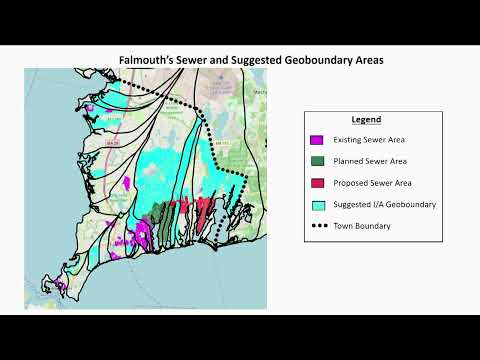
The committees discussed four draft versions of a proposed Board of Health regulation that differ mainly by geographic scope and timing: (1) require systems only in state‑defined nitrogen sensitive areas (NSAs); (2) expand to include watersheds the town considers nitrogen impaired; (3) apply to all of Falmouth but allow delays where a sewer is expected; and (4) a townwide approach that adds a formal credit/delay for properties that install the best available technology and includes a 15‑year window before requiring connection to a sewer. The boards reviewed maps showing watersheds and explained that roughly 67 of the town’s 78 freshwater ponds lie inside areas the speaker identified as nitrogen sensitive.
Why it matters: the town is working on watershed permits under the Massachusetts Department of Environmental Protection (DEP) that the presenters said will be prepared in four groups (applications in 2027–2030) and — once accepted — start reporting clocks that require five‑year progress updates. Committee members warned the watershed permit program is a multi‑decade project with implementation timelines that could extend toward mid‑century, and they framed a local regulation as a near‑term tool to limit additional nitrogen loading while longer‑term sewer solutions are planned and funded.
Key points from the meeting
- Scope and legal defensibility: Several board members said limiting a requirement to DEP‑designated NSAs is more defensible in court because the state has already defined those boundaries; others argued the town may reasonably adopt a broader, townwide standard to protect freshwater ponds and estuaries that are not yet designated but could become impaired with additional development. As one board member put it, the Board of Health’s mandate is to protect public health and the environment, separate from the state’s mapping work.
- Triggers for requiring an IA system: Draft language under discussion would require an IA for new construction and for ‘‘substantial improvement’’ of buildings. Board members and public commenters recommended clarifying the trigger (several suggested measuring added wastewater flow rather than assessed value) and adding anti‑circumvention language (a multi‑year cumulative threshold so owners cannot split work into smaller permit filings to avoid the trigger). The board discussed using a fixed dollar threshold (for example, a number in the $400,000–$450,000 range was suggested) in lieu of a percentage tied to assessed value so the rule is more equitable across properties.
- Sewer connection delay and performance standard: Draft 4 includes a mechanism to let owners who install an approved IA keep using it rather than immediately connect to a future sewer; a 15‑year delay before mandatory hookup was discussed repeatedly and generally supported as a compromise. Committee members and staff recommended setting an explicit performance requirement for installed systems: the group repeatedly referenced a 10 milligrams per liter (mg/L) total nitrogen target for town modeling and regulation purposes.
- Financing and equity concerns: Multiple speakers cautioned that requiring thousands of property owners to install advanced systems will impose heavy upfront costs on homeowners (several people cited IA module costs in the tens of thousands for the technology alone, and committee discussion noted wide variability in installation costs). The meeting reviewed a state tax‑credit program that several participants said is limited (applies to owner‑occupied principal residences and is constrained by the homeowner’s state tax liability) and discussed pursuing legislative changes or other town financing mechanisms (betterments, targeted subsidies, a Proposition 2½ override or similar) to address equity. No financing plan was adopted.
- Management and maintenance: Speakers noted that individual IAs are effectively small treatment plants that require long‑term operation and oversight. The committee discussed the ‘‘responsible management entity’’ model presented previously (a centralized manager that would audit and oversee systems) but made no final decision on structure or scale.
Public comment and technical input
Representatives of the Buzzards Bay Coalition and the Surfrider Foundation urged the town to move quickly and said sewering is the most effective nitrogen control but that IA requirements for new construction are a necessary immediate step. Amy Long, Falmouth wastewater superintendent, supported a 15‑year delay before mandatory hookup and emphasized that the town needs the regulation in place soon because new construction now increases the total nitrogen load the town must address in its TMDL planning.
Outcome and next steps
The two bodies did not adopt a final regulation at this meeting. The Board of Health indicated it will revise the draft language to reflect the points raised (scope, triggers, a possible fixed dollar threshold, the 15‑year delay and the 10 mg/L performance target), then schedule the required public hearings. Committee members said they expect the Board of Health’s regulatory vote to occur this spring and reiterated that watershed permit preparation and sewer planning remain a longer‑term parallel effort.
Quotes (select)
"Sewering is the most effective and efficient way to deal with nitrogen," said Corin Peterson, Buzzards Bay Coalition. "Given the timeline... the town needs to take action sooner rather than later and specifically with new construction."
"I am in favor of a town wide number 4," said Matthew Hanley, representing the Surfrider Foundation, arguing a townwide rule would avoid creating unequal rules for neighborhoods that later host large developments.
"I worry a little bit that the concern about fairness... would slow this particular regulation," said Amy Long, Falmouth wastewater superintendent, urging action on new construction language while financing work continues.
Ending
Board staff said they will circulate a revised regulation that incorporates the technical and policy clarifications raised at the meeting and will set a date for the Board of Health’s public hearings. The watershed permit schedule presented by staff remains on a multiyear timeline (applications grouped 2027–2030) and will require ongoing coordination between the Water Quality Management Committee, the Board of Health and the select board as funding and implementation plans are developed.