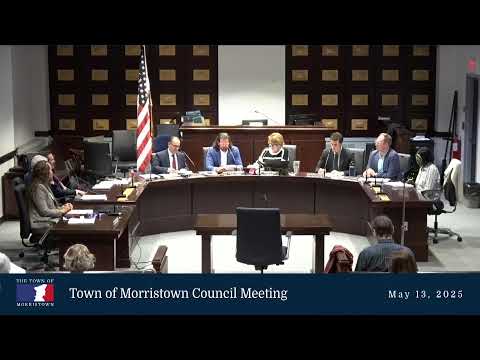
Council introduces M. Lofts Spring Street financial agreement; project includes 150 units, 20% affordable and property gifts
Loading...
Summary
Morristown — The Town Council on May 13 introduced ordinance O-21-2025, authorizing a long‑term tax exemption and financial agreement for the M. Lofts Spring Street redevelopment, a proposed six‑story project with 150 residential units and 20% affordable housing.
Morristown — The Town Council on May 13 introduced ordinance O-21-2025, authorizing a long‑term tax exemption and financial agreement for the M. Lofts Spring Street redevelopment, a proposed six‑story project with 150 residential units, two levels of structured parking and a 20% affordable component.
Daniel Banker of NW Financial Group presented the firm’s review of the developer’s pro forma and told the council the project’s estimated total cost is about $78.36 million. Banker said the firm adjusted some of the developer’s cost assumptions (including land‑value inputs) and concluded the project is unlikely to be financeable under full conventional property taxes. NW recommended a negotiated PILOT to achieve lender‑acceptable underwriting metrics.
Under terms reported to the council, the PILOT would be a 20‑year financial agreement with payments calculated as a percentage of annual gross revenues: roughly 12% for the first five years, 13% for the next five and 15% for the final 10, plus a 2% administrative fee. Banker said the administration’s modeled stabilized year 2 PILOT payment is about $750,000; after statutory distributions the town’s share in that year was estimated at approximately $575,000.
Banker also summarized non‑revenue components the redevelopment agreement would require the developer to deliver: construction of a publicly accessible pocket park on town‑owned land (Block 3504, Lot 1); conveyance of specified lots (Lots 3, 4 and 5 on Block 4901) for public or open‑space use; and transfer of an existing eight‑unit building (12 Spring Street) to Habitat for Humanity for conversion to permanently affordable for‑sale housing.
The adviser said the current taxes on the multiple parcels total roughly $72,000 annually, of which the town’s share is about $26,000. Banker presented a 20‑year projection showing the town would receive approximately $18 million in municipal revenue under the proposed PILOT versus roughly $640,000 if the site remained as‑is at current tax levels (his timeline assumed conventional tax growth). He said the PILOT structure would also help the project meet standard debt‑service coverage ratios required by lenders.
Council members framed the project as both a redevelopment and an affordable‑housing contribution. Council President Umbriac told the council the administration had negotiated additional community benefits and proposed directing recurring support to the Morris Educational Foundation: “We are now going to offer $75,000 per year for 20 years to the MEF,” he said during the discussion, describing the foundation as the nonprofit partner to the public schools. Debbie Santoop, who identified herself as the Morris Educational Foundation chair, told the council such a gift would be “transformational” for programming that serves the district’s 5,200–5,700 students.
Action and next steps: Mayor Tim D. P. Doherty moved to introduce ordinance O-21-2025; the council voted to introduce the ordinance by title. The ordinance was scheduled for a public hearing and final vote on May 27.
Why it matters: The project would replace a stretch of Spring Street described by council members as blighted, add 30 affordable units and provide public open‑space improvements and an affordable for‑sale conversion through Habitat for Humanity; the PILOT is intended to be the financial mechanism that makes the project lenderable.
Caveats: Advisers said the developer’s projected rents are optimistic relative to nearby market availabilities and that actual revenues will determine PILOT payments (because the PILOT is a percentage of AGR). Council members said the town negotiated shorter and more town‑friendly PILOT terms than many long‑term exemptions and emphasized that details of the redevelopment agreement, land conveyances and PILOT credits will be finalized before final adoption.