Get Full Government Meeting Transcripts, Videos, & Alerts Forever!
Get email alerts on the Disaster Response Public Safety topic
No spam. Unsubscribe anytime.
After tornado, Rolla officials defend decision to hold scaled-down parade; volunteers, safety orders follow
Summary
Residents criticized Rolla leaders for allowing a scaled-down parade after an EF‑2 tornado, while officials said keeping a reduced event provided public-safety presence for people already gathering downtown.
Residents who spoke during citizen comment criticized city leaders for allowing a scaled-down St. Patrick’s Day parade to go forward after an EF‑2 tornado struck Rolla on Friday night, damaging homes, businesses and utilities. City officials, police and university representatives said the decision to hold a reduced parade was made jointly for public‑safety reasons and to provide a security presence for people who had already gathered downtown.
In public comment, resident Michael Kaelyn described widespread property damage and said the city prioritized a parade over checking on residents and managing outages. David Shelby and other residents asked who made the decision and why the parade proceeded. Shelby asked, “Who made these decisions and why?”
Mayor (name not specified) said the decision was discussed at a command center Friday evening with then‑Police Chief Fagan, Chief Roberts from the university and himself, and later with the chancellor. He said the group considered cancelling the event but ultimately decided to postpone a final call and reconvene the next morning; by Saturday morning, officials chose to scale the parade down. “We were not gonna stop people from gathering downtown,” the mayor said, adding that much of downtown and the North Side had not been affected by the storm.
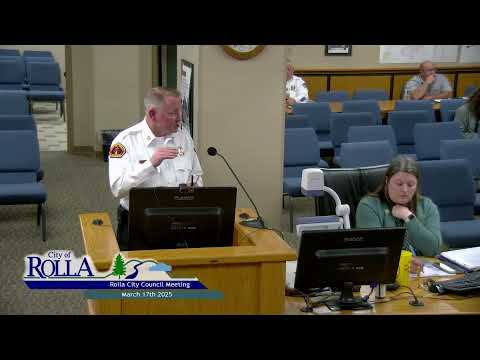
Chief Fagan and other public-safety leaders described how they reallocated personnel, used reserve and volunteer officers and engaged neighboring agencies; Fagan said some officers worked long shifts and that resources had not been taken away from search and rescue and neighborhood checks. Captain Nakanishi reorganized parade assignments to accommodate available personnel. Chief Roberts said canceling a student event would not have prevented people from assembling and that keeping a scaled-down, policed event reduced risks.
Council members and emergency officials described extensive volunteer response and mutual aid. City staff said Rolla Municipal Utilities reported roughly 8,000 of about 9,600 meters without power at the storm’s peak; no deaths were reported to council during public comment, though officials warned about isolated injuries and later a carbon‑monoxide death linked to running a generator indoors. The city established a volunteer command post at Big Lots Park; staff said 350–500 volunteers were assisting daily with yard cleanup and debris management, and the city is issuing vouchers for residents to take debris to the dump for free.
Fire and emergency leadership announced a temporary no‑burn order until further notice and offered safety guidance: run generators outside and at least six feet from combustibles; turn off appliances before power is restored to avoid surge-triggered fires; replace smoke‑detector backup batteries; and do not give personal or banking information to callers claiming to be federal aid officials.
Several residents praised first responders and volunteers. A number of council members thanked the military units, mutual‑aid agencies and community volunteers, noting chainsaw crews and equipment from Fort Leonard Wood and nearby jurisdictions assisted with neighborhood clearing.
Officials asked residents to register with the command center so volunteer work and in‑kind donations can be tracked for reimbursement and coordination; staff said they will present additional information about reimbursement and the financial match for possible state or federal aid at an upcoming workshop.
City leaders said they made a difficult decision under uncertain conditions and that the scaled‑down parade allowed police to focus on safety while avoiding an unplanned congregation downtown. Several residents remained critical of the optics; officials acknowledged the concern but said the choice reflected an operational judgment about resource allocation.