Get Full Government Meeting Transcripts, Videos, & Alerts Forever!
Get email alerts on the Home Occupation Firearms topic
No spam. Unsubscribe anytime.
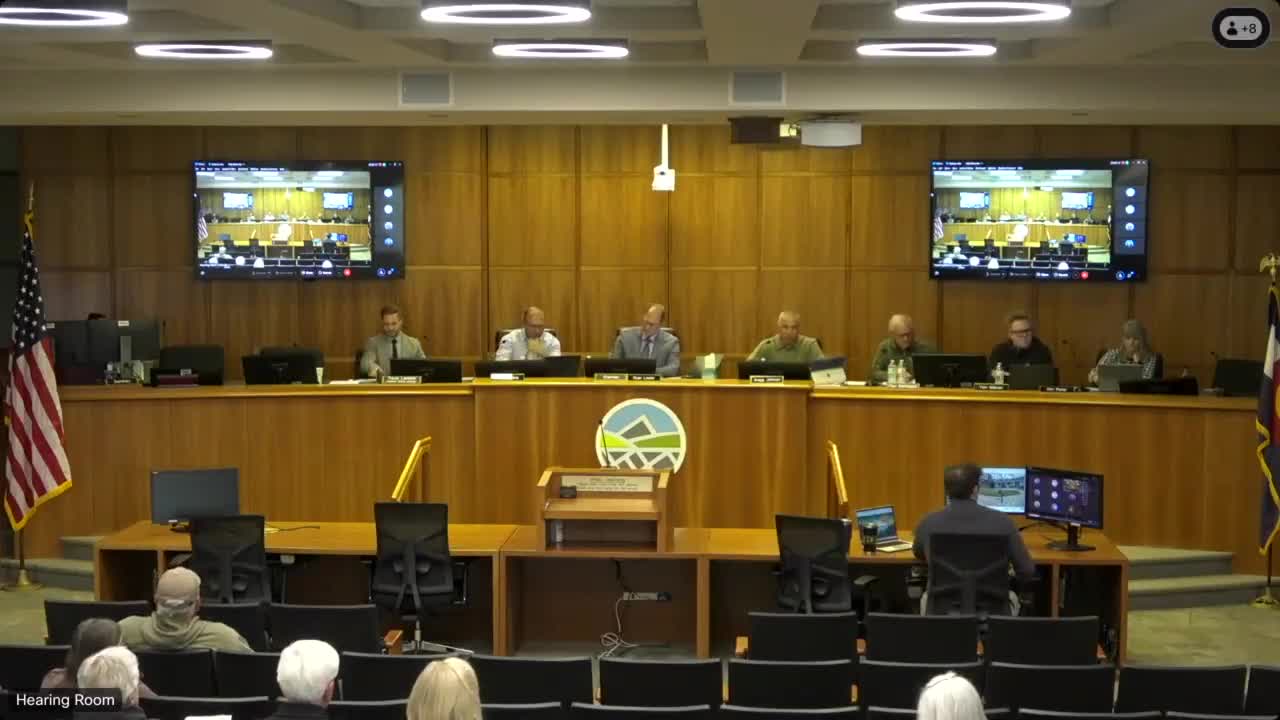
Board continues contested home‑occupation application for firearms sales in Columbine Knolls
Summary
The Board of Adjustment continued a special‑exception request to operate firearms and ammunition sales from a private residence at 6371 West Rowland Avenue to June 18 after extended public testimony raised neighborhood covenant, security and safety concerns and staff and applicant agreed to narrow the proposed on‑site operations.
The Jefferson County Board of Adjustment continued to June 18 a request to allow a home occupation for firearm and ammunition sales at 6371 West Rowland Avenue in the Columbine Knolls neighborhood, after several hours of public comment and board deliberation.
Applicant Camden Zens told the board he seeks a Federal Firearms License to operate a business that would primarily bid on government contracts and arrange deliveries to government agencies. “I am committed to upholding all federal, state, and local laws regarding firearm sales, transfers, and record keeping,” Zens told the board, describing a plan to store any firearms in a locked, fireproof safe inside a locked room under 24‑hour video surveillance.
Thousands of neighborhood‑level public comments and many residents spoke at the hearing. Anita Twisselman, president of the Columbine Knolls Homeowners Association, presented the association’s governing documents and said the HOA’s declaration restricts lots to residential use: “Our covenants apply, and they are enforceable … our Columbine Knowles Homeowners Association covenant c1 states that no lot shall be used except for residential purposes,” she told the board. Twisselman also said the HOA has an ongoing lawsuit related to unpermitted commercial activity on the same property.
Numerous neighbors said they see daily traffic and multiple parked vehicles at the property and asked the board to consider security and the proximity of several schools. Several speakers described being upset by perceived threats or confrontations tied to the existing, unpermitted activity at the address. Some neighbors described lasting emotional impacts from the Columbine school shooting and said allowing firearms commerce nearby would be traumatic for families.
The county planner explained the zoning resolution allows home occupations only if they meet specific criteria and that firearm and ammunition sales are not listed as an excluded use; staff had conditioned any approval on meeting the required miscellaneous permit criteria (for example, limiting increased vehicle traffic to two additional vehicles at a time and following sign rules). Planner Alexander Folkes also noted initial staff recommended approval could be conditioned, but that the board could add conditions or deny the request.
During the hearing Zens agreed to narrow the requested on‑site operations: he asked that the board remove the garage as a designated business space and limit the on‑site business to a locked room in the house; staff indicated that could be made a condition. Zens also said most transactions would be handled online or shipped directly to government agencies, and he estimated any firearms temporarily at the residence would typically number one or two.
After prolonged public testimony, the board voted unanimously to continue the case to a date certain of June 18 to allow the applicant and staff to address the outstanding issues: (1) the presence of another, apparently unpermitted home business at the address (A to Z Elevator Inspections), (2) potential conditions narrowing on‑site storage and eliminating garage use, and (3) any remaining security measures the ATF or local agents might recommend. The continuation requires the applicant to work with planning staff on specific permit and security details; the board asked staff to return the case when those items had been clarified.
The continuation does not prejudge a final decision; the board said it would consider staff’s recommended conditions and any additional conditions the board or public raise at the continued hearing.