Get Full Government Meeting Transcripts, Videos, & Alerts Forever!
Get email alerts on the Public Health topic
No spam. Unsubscribe anytime.
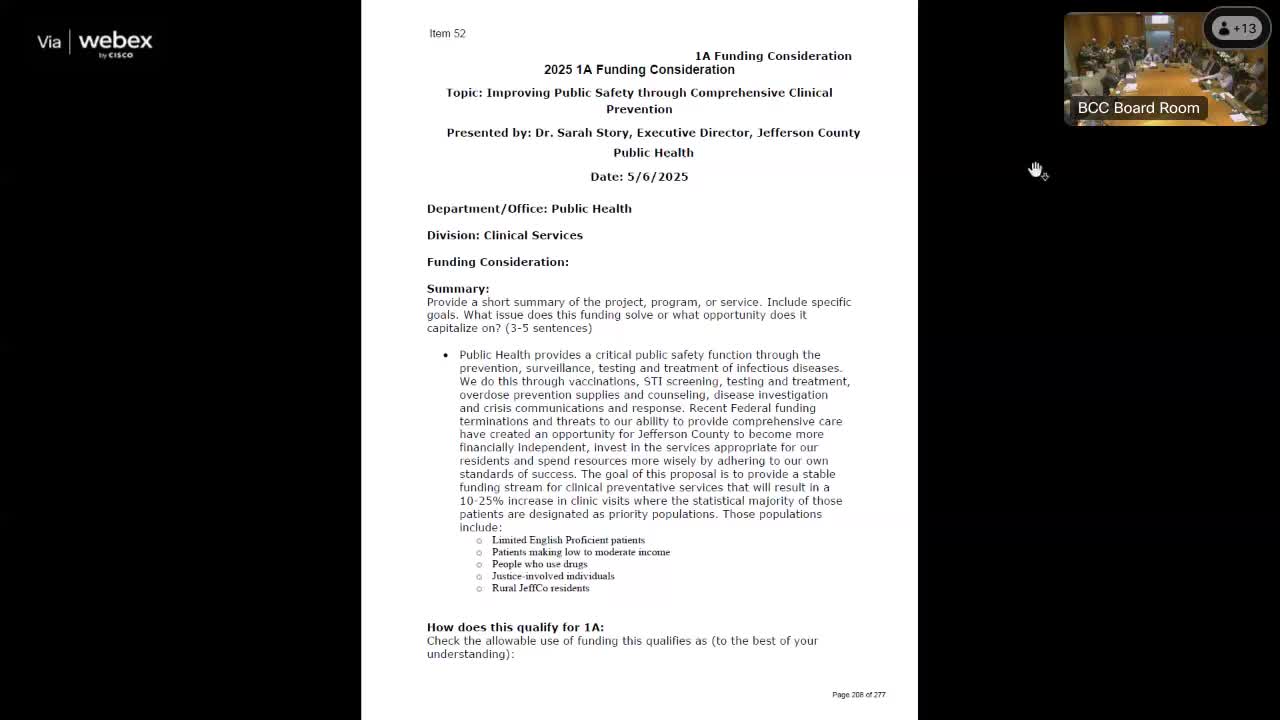
Public Health requests $3 million to backfill federal cuts for vaccines, STI care and overdose prevention
Summary
Jefferson County Public Health asked commissioners to approve about $3 million through 2027 to replace federal funding now restricted or eliminated for vaccines, sexually transmitted infection detection/treatment (including jail services), family planning and expanded naloxone distribution; staff framed the ask as a modest, high‑impact public‑s
Jefferson County Public Health Director Dr. Sarah Storey asked the Board to approve retained revenue funding through 2027 to backfill federal programs that the department said are shrinking or carrying new restrictions.
Storey framed the request as a public‑safety priority and said the proposal is focused on three pillars: vaccines for uninsured or underinsured residents; sexually transmitted infection (STI) testing, treatment and family‑planning services (including jail‑based care); and expanded naloxone distribution and related overdose prevention services. "This request is barely scratching $3,000,000 through 2027," Storey said, asking commissioners to provide a runway of funding stability while the department pursues sustainable revenue.
Examples and rationale: - Vaccines: Public Health said roughly half of the thousands of county vaccine doses administered annually go to patients who would be unable to pay, and recent measles cases nationally have been concentrated among unvaccinated people. The department said continuing free or low‑cost vaccines prevents outbreaks. - STIs and jail health: The department highlighted syphilis increases and said they served about 400 unique patients in the jail last year; staff said expanded testing and treatment in the jail and street‑medicine programs are critical to control transmission. - Overdose prevention: The department reported distributing roughly 4,000 naloxone units last year; about 400 uses were reported and 80 percent of those interventions reversed overdoses, saving lives.
Storey asked commissioners to consider the public health request as a targeted, time‑limited investment to allow staff to stabilize services and pursue alternative grant funding where possible.
Commissioners asked about connections to other regional opioid and harm‑reduction efforts and whether county opioid‑settlement or other local funding sources could be used to complement the request. Storey said public health tried to keep different funding streams coordinated and was seeking a stable bridge while federal trends evolve.
Ending: Staff said they will follow up with more specific program costing, timelines and a priority list for the requested funds.